
The walk-in who bought once and was never contacted again
A jewellery customer who bought once is the most likely person to buy again, and the least likely to be contacted. The retention gap, and what closes it.
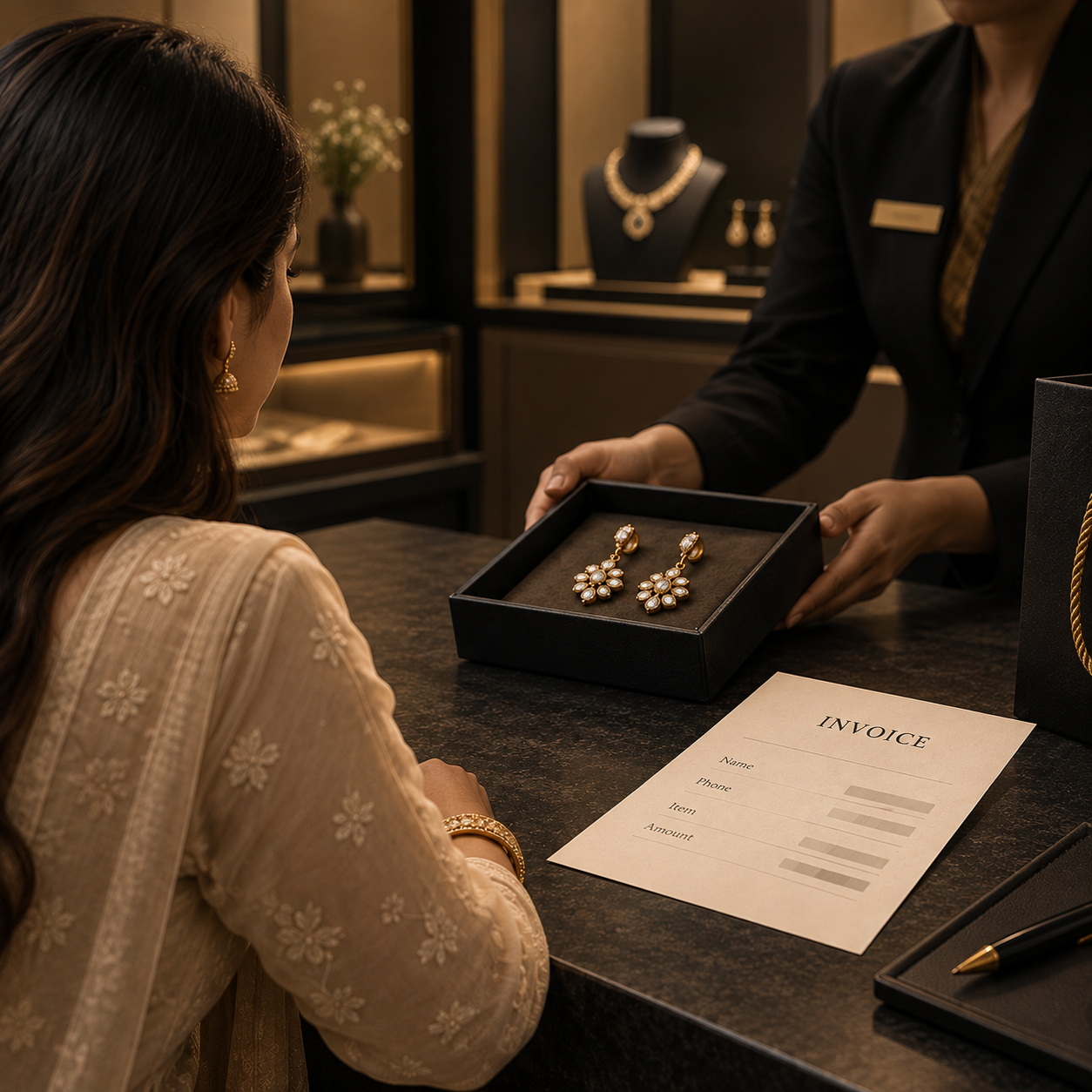
She bought a pair of earrings in the week before Diwali. The invoice has her name, her phone number and what she spent. She has not heard from the business since.
Her daughter's wedding is in fourteen months. She will buy again — a bridal set, several lakhs, the largest purchase of her life — and the showroom she walks into will be whichever one is in her mind that week.
Nothing about that is a marketing problem. The record exists. Nobody reads it.
The Economics Nobody Disputes and Nobody Acts On
Acquiring a new jewellery customer takes effort. A business invests in its showroom, advertising, local visibility, social media, exhibitions, and the reputation it builds over years. Someone sees an advertisement, visits the store, compares designs, discusses pricing, and eventually makes a purchase.
Then the transaction ends, and the relationship often ends with it.
For jewellery retailers, this is an expensive habit. A customer who has already visited the showroom, trusted the salesperson, and completed a purchase has crossed several barriers that a new prospect has not. The business already has a starting point for the next conversation.
Yet many stores spend more time finding new customers than reconnecting with existing ones.
Consider a simple example. A jewellery store serves 1,000 customers in a year. If just 5% of those customers make an additional purchase, that represents 50 repeat transactions. The actual revenue depends on the products purchased, but the opportunity comes from customers the business has already acquired.
This is not a promise that every customer will return. Jewellery purchases are infrequent, budgets change, and customers have plenty of choices. The point is that a store should not leave repeat business entirely to chance.
Customer retention does not replace acquisition. It helps a retailer get more value from the relationships acquisition has already created.
Why Jewellery Retention Is Different From Retail Retention
A grocery store might expect a customer to return several times a month. A jewellery showroom cannot apply the same expectations to its customers.
Jewellery purchases are often tied to significant occasions, personal milestones, savings goals, and family decisions. Someone buying earrings for Diwali might not need another pair next month. But that customer may have an anniversary approaching, a wedding to attend, or a family celebration to prepare for.
The purchase cycle is longer, and the reasons for returning are more specific.
That changes how customer retention should work.
First, follow-up needs to reflect the occasion. A reminder about a wedding anniversary can be relevant. A generic promotional message every few days is unlikely to be.
Second, purchase history matters. A customer who purchased lightweight daily-wear jewellery may have different preferences from someone who bought a diamond ring or a traditional gold necklace. The previous transaction offers useful context for future conversations.
Third, individual attention has commercial value. For a high-value purchase, customers may want to discuss design options, compare making charges, understand exchange policies, or revisit a collection with family members. A salesperson who remembers the customer's previous purchase can make that interaction more useful.
Finally, the relationship needs continuity. A customer may not visit the showroom for a year. That does not necessarily mean the relationship has ended. It means the business needs a sensible way to stay connected until the next relevant occasion.
Jewellery retention is therefore less about contacting customers frequently and more about remembering them at the right time.
The Occasions You Already Know About
A jewellery business does not need to predict every future purchase. Many useful opportunities are already visible in conversations that happen at the counter.
A customer may mention an upcoming wedding. Another may be buying a gift for a spouse. Someone might enrol in a jewellery savings scheme, while another asks about a particular design that is unavailable at the time.
These details can help the store plan a relevant follow-up, provided the customer has agreed to appropriate communications and the information is recorded responsibly.
Common opportunities include:
- Birthdays and anniversaries: Offer a timely greeting or a relevant collection suggestion when appropriate.
- Upcoming weddings: Record a customer's stated wedding date or buying timeline, with their permission, and plan follow-up around it.
- Bridal enquiries: Reconnect with customers who explored bridal sets but have not yet made a decision.
- Savings scheme milestones: Contact participants about maturity dates, redemption procedures, and the next steps under the scheme's terms.
- Product enquiries: Notify customers when a requested design, size, or collection becomes available.
- Festive shopping: Reach out ahead of relevant festive periods based on previous buying preferences, rather than sending the same message to everyone.
The difference between a useful reminder and an intrusive message is context.
A salesperson who remembers that a customer was searching for a bridal necklace has a reason to call when a suitable collection arrives. A store that sends an unrelated discount message simply because a phone number exists does not.
The objective is to turn information already shared with the business into better service, not to collect personal details without a clear purpose.
What the Billing System Already Holds
Most jewellery retailers already have the beginnings of a customer database. Their billing or POS system may record a customer's name, phone number, invoice value, purchase date, product details, store location, and salesperson.
That information can answer important questions:
- Who purchased from this store during the last festive season?
- Which customers purchased bridal jewellery?
- Which customers have not returned for a long time?
- What did a customer enquire about or purchase previously?
- Which salesperson handled the original transaction?
- Which customers have agreed to receive follow-up communications?
The first step is to understand what the existing system records and how reliably that information can be retrieved.
A billing system and a customer relationship management system serve different purposes. Billing records the transaction. A CRM helps the business manage the relationship before and after that transaction.
A jewellery retailer does not necessarily need to replace its billing software to improve retention. It may be able to integrate the existing POS with a CRM so that customer and transaction information can support follow-up activities.
For example, when a customer purchases a pair of earrings, the POS can provide the purchase details to the CRM. The CRM can then make that customer available for an appropriate future campaign or salesperson follow-up, subject to the customer's communication preferences.
The business can also record enquiries, preferred store locations, assigned salespeople, important dates voluntarily shared by customers, and the outcome of each follow-up.
There is an important distinction here: having customer data is not the same as using customer data. A spreadsheet full of phone numbers does not create a retention process unless someone can identify whom to contact, why to contact them, and what happened afterward.
The Follow-Up That Is Welcome and the One That Is Not
Customer retention can quickly become counterproductive when a store confuses repeated messaging with relationship building.
Jewellery is a trust-driven purchase. Customers expect discretion, accurate information, and respectful service. A store that repeatedly sends irrelevant offers risks damaging the very relationship it wants to strengthen.
A better approach begins with relevance and permission.
For example, a customer who has agreed to receive updates might receive a message about a requested design becoming available. Someone approaching a stated wedding date might appreciate an invitation to view a bridal collection. A previous buyer might receive a seasonal greeting accompanied by an optional invitation to visit the showroom.
Each message should have a clear reason for being sent.
A practical starting policy for a jewellery retailer could look like this:
- After a purchase: Send the invoice or service information, along with a brief thank-you where appropriate.
- After a product enquiry: Follow up once within an agreed period if the customer has invited further contact.
- Before a relevant occasion: Send a timely, occasion-specific message if the customer has consented to that type of communication.
- During festive campaigns: Limit messages to a manageable frequency and prioritise relevance over volume.
- After no response: Avoid repeatedly pursuing the customer. Pause outreach and respect any request to stop receiving messages.
These are starting guidelines, not universal frequency rules. The right schedule depends on the customer's preferences, the purpose of the communication, and the store's own response data.
Jewellers should maintain clear records of consent, honour opt-outs, and follow applicable privacy and messaging requirements. Customer information should be accessible only to authorised staff and used for legitimate business purposes.
The question before every follow-up should be simple: Would this message be useful to this customer, or are we sending it only because we can?
Segmentation a Jeweller Can Actually Run
Customer segmentation does not need to begin with complicated analytics. A jewellery retailer can start with a handful of groups that reflect how its sales team already understands the business.
1. Recent customers
These customers have purchased recently. The priority is good post-purchase service, answering questions, and recording preferences that may be useful later.
2. High-value customers
These customers have made substantial purchases or have a history of significant transactions. They may benefit from personalised service, relevant collection previews, or a dedicated relationship manager, depending on their preferences.
High spending alone should not be treated as permission for more frequent marketing.
3. Occasion-driven customers
These customers have shared information about an upcoming wedding, anniversary, birthday, or other buying occasion. Follow-up should be timed around the event and the customer's stated requirements.
4. Enquiries that did not convert
These customers visited the store or enquired about a product but did not purchase. A follow-up can address an unanswered question, offer an alternative design, or let them know when the requested item is available.
5. Lapsed customers
These customers purchased in the past but have not returned within a period that makes sense for the business. The store can review their purchase history and, where appropriate, send a single relevant re-engagement message.
A customer who has not purchased in six months is not automatically inactive. For some jewellery categories, six months is a short interval. The definition of a lapsed customer should reflect the product category, purchase cycle, and the retailer's actual history.
Once these segments are in place, the CRM can help prioritise follow-ups and measure which activities lead to meaningful conversations, showroom visits, and completed purchases.
The purpose is not to put customers into boxes. It is to help staff recognise what each relationship needs next.
Who Owns the Relationship: The Store or the Brand?
In many jewellery showrooms, a salesperson is the person who truly knows the customer.
They remember the customer's preferences, family occasions, previous purchases, and the designs they considered. Over time, the relationship becomes valuable to both the customer and the salesperson.
The difficulty begins when that salesperson leaves.
If customer details, conversation history, and follow-up reminders exist only on a personal phone, the business may lose access to a relationship it helped create. Another salesperson might have to start from scratch, and the customer may not receive the expected service.
This is not an argument against personal relationships. Those relationships are one of the strengths of jewellery retail. It is an argument for giving them a reliable business system.
Customer interactions should be recorded in an authorised CRM, with appropriate access controls and customer consent where required. Important notes, enquiry details, purchase history, and pending follow-ups should remain available to authorised team members when responsibilities change.
The store can then preserve continuity without removing the salesperson's role.
For multi-store jewellery businesses, this becomes even more important. A customer might purchase from one branch, enquire at another, and eventually buy from a third. With the right permissions and system integration, authorised staff can access the relevant history and provide consistent service.
The customer experiences one brand. The internal systems should support that experience.
Making the Second Purchase Someone's Job
A repeat purchase rarely happens simply because a retailer decides that retention matters. Someone has to identify the opportunity, contact the customer appropriately, and follow through.
That responsibility needs an owner.
A practical retention process can begin with five steps.
1. Generate a prioritised list. Each week, the CRM should identify customers due for a relevant follow-up, such as pending bridal enquiries, requested product arrivals, or upcoming occasions.
2. Assign responsibility. Each follow-up should have a named salesperson or team member. Customers should not be left on a shared list that nobody owns.
3. Set a next action. The task should explain why the customer is being contacted and what the next step should be. “Call customer” is less useful than “Follow up on bridal necklace enquiry and confirm whether a showroom appointment is required.”
4. Record the outcome. The salesperson should record whether the customer responded, requested a later contact, booked a visit, made a purchase, or declined further communication.
5. Review the results. Store managers should review completed follow-ups, customer responses, showroom appointments, conversions, and repeat sales.
A simple weekly dashboard might track:
- Customers due for follow-up.
- Follow-ups completed on time.
- Customers reached and responses received.
- Showroom visits generated by follow-up.
- Repeat purchases and their revenue.
- Opt-outs and customer complaints.
Repeat purchase rate should also be measured consistently. For a defined period, divide the number of unique customers who made more than one purchase by the number of unique purchasing customers in that same period, then multiply by 100. The business should document how it treats returns, exchanges, and repeat invoices so comparisons remain meaningful.
A CRM cannot guarantee a second purchase. It can ensure that relevant opportunities are visible, assigned, and measured instead of being forgotten.
That is the operational change that matters.
Frequently Asked Questions
How often should a jewellery store contact past customers?
A jewellery store should contact past customers when there is a relevant reason, such as a requested product becoming available, an upcoming occasion, or a suitable seasonal campaign. There is no single frequency that works for every customer because jewellery purchase cycles vary. Retailers should respect communication preferences, limit repetitive marketing, and stop promotional contact when a customer opts out.
What customer data should a jewellery business be recording at the counter?
A jewellery business should record essential transaction details, including the customer's name and contact information where provided, invoice and purchase history, product details, store, and responsible salesperson. With appropriate consent, it can also record communication preferences, product enquiries, preferred designs, and customer-shared occasion dates. The business should collect only information it needs, protect it with appropriate access controls, and follow applicable privacy requirements.
How do you measure repeat purchase rate in jewellery retail?
Repeat purchase rate can be calculated by dividing the number of unique purchasing customers who made more than one purchase during a defined period by the total number of unique purchasing customers during that period, then multiplying by 100. For example, if 100 out of 800 purchasing customers bought more than once, the repeat purchase rate is 12.5%. Retailers should use a consistent period and clearly define how returns, exchanges, and multiple invoices are counted.
Should salespeople keep customer contacts on their personal phones?
A jewellery business should avoid relying on salespeople's personal phones as its primary customer database. Customer contact details, purchase history, and follow-up records should be maintained in an authorised business system with appropriate access controls and privacy safeguards. This protects continuity when employees leave or change roles while allowing salespeople to maintain personal relationships with customers through approved channels.