

Recommending jewellery is not recommending shoes
Recommendation engines learn from repeat purchases. Jewellery buyers return once a year, for an occasion, often for someone else entirely.
A recommendation engine learns from what people buy often, together, and for themselves. Give it a catalogue of shoes and a year of orders and it does well.
Jewellery breaks all three assumptions at once. The customer buys rarely, usually alone, and frequently for someone else entirely. The engine has almost nothing to learn from, and what it does learn points the wrong way.
This is why jewellery product recommendations require a different approach from conventional ecommerce recommendation systems. The challenge is not simply finding products similar to what a customer has viewed. It is understanding the occasion, the intended recipient, the budget, and the relationship between pieces that may never have been purchased together.
For jewellery retailers building ecommerce experiences, this distinction matters. A recommendation that works for a frequently purchased product can be irrelevant when the customer is buying a wedding necklace, a gift for an anniversary, or a pair of earrings to complement a particular outfit.
The objective is not to recommend more products. It is to recommend the right jewellery for the decision the customer is trying to make.
Why the Usual Signals Are Thin Here
Most conventional recommendation engines rely on behavioural patterns. If thousands of customers who purchased one product also purchased another, the system can use that relationship to make future recommendations. Collaborative filtering becomes more effective as the platform accumulates enough interactions and purchases.
Jewellery ecommerce presents a different data environment.
A customer might buy a gold necklace once every few years. Another might purchase earrings as a gift and return months later for a wedding present. A third might browse dozens of products without purchasing anything because the final decision depends on a family discussion or an in-store consultation.
These behaviours produce sparse purchase histories, long gaps between transactions, and relatively small numbers of purchases per customer.
The problem extends to product combinations. A jewellery customer may purchase a necklace and matching earrings in the same transaction, but that does not mean every customer who buys the necklace will want those earrings. They may already own a matching set, prefer a different design, or be shopping for a completely different occasion.
When transaction data is limited, collaborative filtering can struggle to distinguish genuine preferences from coincidences. Popular products can dominate recommendations simply because they have accumulated more interactions, while newer designs receive little exposure.
The implication for jewellery retailers: purchase history should be one input to a recommendation system, not the foundation on which the entire experience depends.
Buying for Someone Else
A purchase does not always reveal the buyer's personal taste.
Consider a customer purchasing a mangalsutra. The buyer may be a husband selecting a gift for his wife. The product reflects the recipient's preferences, the occasion, family expectations, and the buyer's understanding of what would be appropriate.
It does not necessarily reflect the buyer's own jewellery preferences.
The same distinction appears across the category. A father buying earrings for his daughter, a customer purchasing a necklace for an anniversary, or a relative choosing jewellery for a wedding is making a decision on behalf of someone else.
A recommendation engine that interprets every transaction as an expression of the buyer's personal taste can build the wrong profile.
For example, if a customer purchases a traditional gold necklace as a gift, the system might subsequently recommend more traditional necklaces to that customer. But when the same person returns to purchase jewellery for themselves, they might prefer contemporary diamond designs.
The purchase history is accurate. The interpretation is not.
A more useful jewellery recommendation system distinguishes between the customer and the intended recipient wherever possible. It considers the purchase context, the occasion, the intended wearer, and whether the transaction is a gift or a personal purchase.
This does not require an intrusive questionnaire. A simple prompt such as "Shopping for yourself or someone else?" can provide valuable context when the answer would materially change the recommendations.
The important principle is straightforward: a purchase is evidence of a buying decision, not definitive proof of a personal preference.
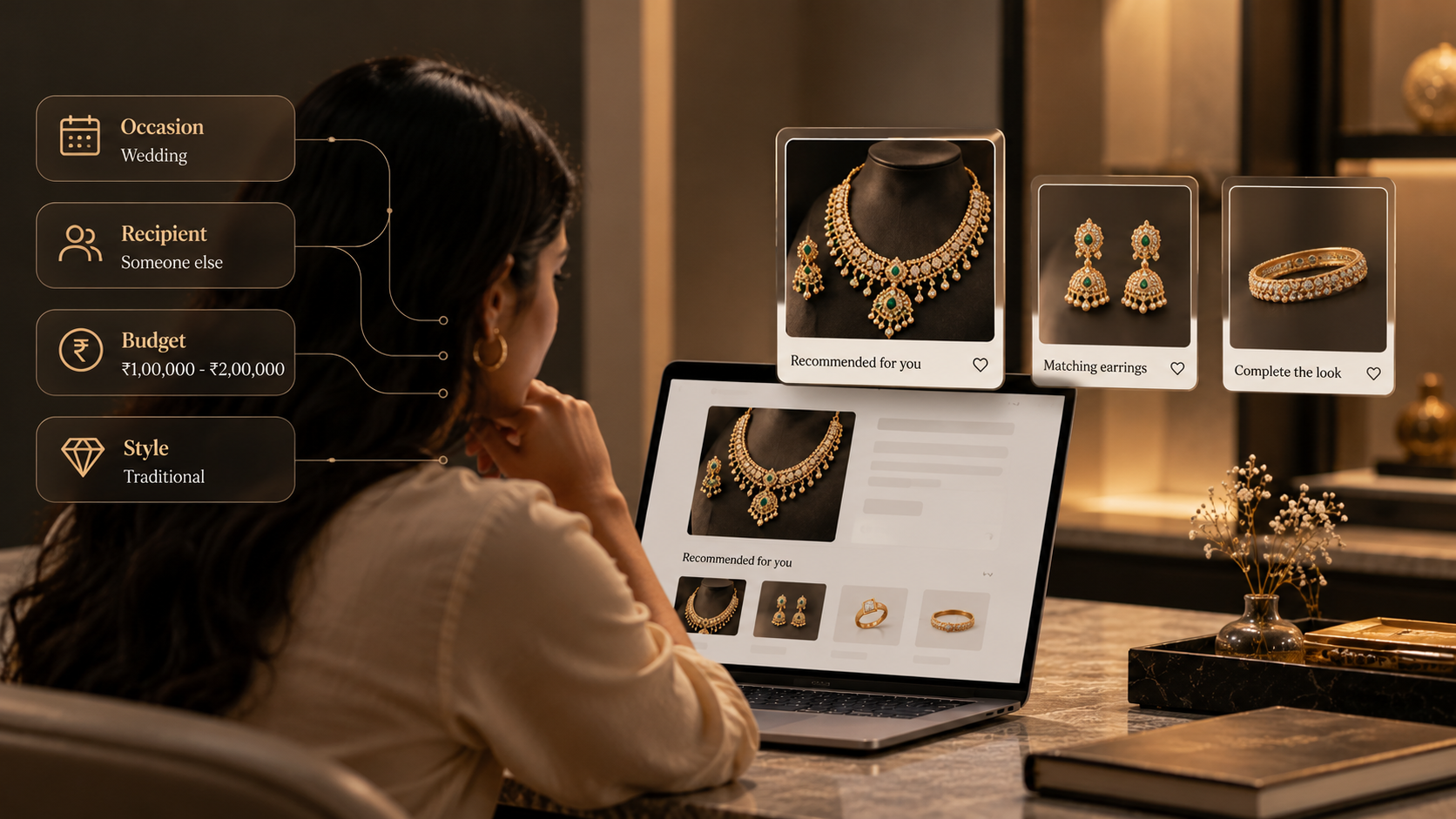
Occasion Is the Strongest Signal, and It Is Not in the Data
Jewellery purchases are often driven by events rather than continuous consumption.
A wedding, anniversary, engagement, festival, birthday, or milestone in a family member's life can determine what a customer needs, how much they intend to spend, and which designs they consider appropriate.
Yet conventional ecommerce data frequently records product views, cart additions, orders, and payment details without recording the occasion behind the purchase.
That creates a gap between what the retailer knows and what the recommendation engine can use.
Consider two customers browsing gold necklaces at the same time. One is preparing for a wedding and wants a substantial traditional design. The other is looking for an anniversary gift and prefers something understated that can be worn regularly.
Their browsing behaviour may look similar. Their actual requirements are different.
A recommendation system that relies primarily on viewed products may offer both customers nearly identical suggestions. An occasion-aware system can prioritise different designs, price ranges, and complementary products.
Retailers can begin capturing this information with lightweight, optional prompts:
- Occasion: Wedding, engagement, anniversary, festival, birthday, or everyday wear.
- Recipient: Self, partner, parent, child, or another person.
- Style: Traditional, contemporary, minimalist, or statement.
- Intended use: Daily wear, occasional wear, gifting, or bridal wear.
These signals can be collected through category pages, guided discovery, campaign landing pages, or conversations with store staff. They do not all need to be collected at once.
The goal is to capture enough context to improve the next recommendation without adding unnecessary friction to the shopping experience.
For jewellery retailers operating across ecommerce and physical stores, this information becomes particularly valuable when it can be retained, with appropriate consent, and used to support a consistent customer experience across channels.
Budget Is a Harder Constraint Than Taste
In many product categories, recommendations can introduce customers to alternatives at different price points. In jewellery, budget is often established before browsing begins.
A customer may have a fixed amount for an anniversary gift, a wedding purchase, or a monthly savings goal. The amount may be influenced by the occasion, family expectations, gold rates, making charges, and the weight or gemstone requirements of the piece.
A recommendation that ignores this constraint can be technically relevant but commercially useless.
Suppose a customer is looking for a gold necklace within a defined budget. Showing a visually similar necklace at twice that price does not necessarily encourage an upgrade. It may simply make the customer feel that the catalogue has nothing suitable.
Jewellery pricing also introduces additional complexity. The final price can depend on metal weight, purity, current gold rates, making charges, gemstones, and other product-specific factors. Two designs that look similar in photographs may have very different final prices.
This makes static price assumptions particularly risky for retailers whose product prices change with metal rates.
A useful recommendation system should therefore apply budget constraints before ranking products. It should prioritise products that are both relevant and realistically affordable, using current pricing wherever possible.
For example, the system could recommend:
- Designs that fit the customer's stated budget.
- Similar alternatives with different weights or design details.
- Complementary pieces that fit the remaining budget.
- Higher-priced alternatives only when there is a meaningful reason to present them.
The distinction is important. Taste helps rank suitable options. Budget helps determine which options belong in the consideration set in the first place.
A relevant recommendation is not simply a product the customer might like. It is a product they might realistically buy.
What Actually Works Instead
Jewellery recommendation engines need to combine product understanding with purchase context. Instead of relying exclusively on behavioural similarity, they can use several complementary methods.
1. Attribute and occasion similarity
Product attributes provide a useful foundation even when a customer has no purchase history.
Relevant attributes may include metal type, purity, gemstone, design style, weight, price, setting, intended wearer, and occasion suitability. A customer browsing contemporary diamond earrings, for example, can be shown related designs that share meaningful characteristics.
Occasion context helps refine the results further. A bridal necklace and an everyday gold chain may share some product attributes, but they serve different needs.
Attribute-based recommendations can work for new visitors because they do not require a large history of previous purchases.
2. Budget-bounded recommendations
Budget should shape the products that qualify for recommendation, rather than being treated as a minor ranking preference.
If a customer specifies a price range, the system should filter or prioritise products that fall within it. Where prices are dynamic, the recommendation layer should use the latest available selling price rather than stale catalogue values.
This is especially important for gold jewellery, where metal-rate changes can affect product prices.
3. Complementary products that make sense
Jewellery naturally supports complementary recommendations, but the relationship needs to be meaningful.
A pair of earrings may complement a necklace. A pendant may work with a suitable chain. A bracelet may complete a coordinated set.
These relationships can be defined using product attributes, collection membership, design compatibility, merchandising rules, and actual customer behaviour where sufficient data exists.
The system should also account for products customers may already own or have purchased. Recommending matching earrings for a necklace can be helpful; recommending them when the customer bought the complete set last month may not be.
4. Guided discovery
When the system lacks sufficient information, it can ask a small number of relevant questions rather than guessing.
A guided jewellery discovery experience might ask about the occasion, intended recipient, budget, and preferred style. Based on the answers, it can narrow the catalogue and present a manageable set of relevant options.
This approach can be particularly useful for bridal jewellery, gifting, and other high-consideration purchases where the customer's requirements are specific.
5. Behavioural learning when enough data exists
Collaborative filtering and machine-learning models still have a role. They can identify useful patterns across customers, products, and transactions when the underlying data is sufficient.
The key is to combine behavioural learning with product attributes and explicit context, rather than expecting transaction history to explain every purchase.
A practical jewellery recommendation architecture uses the method best suited to the available evidence. It does not force every customer into the same algorithm.
The Cold-Start Problem Is the Normal State
In conventional recommendation systems, the cold-start problem describes the difficulty of making useful recommendations when a new user or product has little interaction history.
Jewellery retailers should treat this as a normal operating condition, not an edge case.
Many visitors are first-time customers. Returning customers may not have purchased in months or years. New collections may have little behavioural data, even when the designs are commercially promising.
Waiting for enough purchases to accumulate before recommending products leaves a substantial part of the catalogue and customer base underserved.
The solution is to make recommendations useful before behavioural history becomes available.
For new visitors, the system can rely on product attributes, current popularity, occasion-led discovery, price filters, and merchandising rules. For returning visitors, it can incorporate consented browsing history, saved products, previous interactions, and relevant customer preferences.
New products can be recommended through their attributes, collection relationships, and intended use before they generate substantial sales data.
Over time, behavioural signals can refine these initial recommendations. The system moves from a reasonable starting point to a more personalised experience as reliable evidence becomes available.
This layered approach is more practical than expecting every visitor to arrive with a rich purchase history.
Where a Human Still Beats the Model
Jewellery purchases often involve questions that a recommendation engine cannot answer from product data alone.
A salesperson may remember that a customer is shopping for a daughter's wedding, prefers lightweight designs, or needs a piece that complements an existing necklace. They may understand family expectations, cultural context, and the reason a customer rejected a design that looked suitable on paper.
This contextual understanding can be difficult to represent in a conventional product catalogue.
The objective of a recommendation system should not be to eliminate this human judgement. It should help the salesperson apply it more effectively.
For example, a jewellery retailer could use customer preferences and purchase context to prepare a shortlist before a store visit. Staff could see relevant product options, budget preferences, previously saved designs, and suitable complements, subject to appropriate consent and access controls.
A customer who begins browsing online could then receive a more coherent experience when visiting a showroom. A salesperson would have useful context without needing to reconstruct the entire buying journey from scratch.
The same principle applies to follow-ups. Rather than sending generic product suggestions, the retailer could share designs relevant to the occasion or preferences the customer has expressed.
The model handles product discovery and consistency. The salesperson contributes judgement, trust, and human understanding.
In high-consideration categories such as jewellery, that combination can be more valuable than attempting to automate the entire decision.
Measuring Recommendations Honestly
Recommendation systems are often evaluated using click-through rates, product views, or engagement. These metrics can help diagnose whether customers notice and interact with suggested products, but they do not establish that recommendations improve business outcomes.
A customer may click a recommended necklace without purchasing it. A product may receive more clicks simply because it is prominently positioned. A customer who was already planning to buy matching earrings may purchase them regardless of whether the recommendation engine suggested them.
Jewellery retailers need to distinguish engagement from incremental commercial value.
Useful metrics include:
- Attach rate: The proportion of eligible primary-product purchases that also include a relevant complementary product.
- Assisted revenue: Revenue associated with purchases where recommendations contributed to the journey, reported separately from proven incremental revenue.
- Conversion rate: The proportion of eligible shopping sessions or visitors that result in a purchase, measured consistently.
- Average order value: Whether recommendation exposure changes the value of completed orders.
- Recommendation acceptance rate: The proportion of recommended products that are saved, added to cart, or purchased.
- Return and cancellation rate: Whether recommendations lead to unsuitable purchases or increased post-purchase dissatisfaction.
Each metric has limitations. Attach rate can rise because of discounts or seasonal demand. Assisted revenue can overstate impact when a recommendation merely appears somewhere in a journey that would have converted anyway. Average order value can increase while conversion declines.
The most reliable approach is to compare eligible customers or sessions exposed to recommendations against a suitable control group, ideally through a randomised experiment. The retailer can then estimate whether recommendations caused an improvement rather than merely being associated with one.
Results should also be segmented by purchase intent, category, price band, occasion, and new versus returning visitors. A recommendation strategy that works for everyday earrings may not perform the same way for bridal sets.
The real measure of a recommendation engine is not how many products it gets customers to click. It is whether it helps customers make better purchases and creates measurable incremental value for the retailer.
Frequently Asked Questions
Do product recommendation engines work for jewellery ecommerce?
Yes, product recommendation engines can improve jewellery ecommerce when they account for product attributes, budget, occasion, and purchase intent. Traditional behavioural methods can help when sufficient data exists, but jewellery retailers should not rely on purchase history alone. A hybrid approach combining product similarity, contextual signals, merchandising rules, and behavioural learning is often more suitable.
Why does purchase history mislead in jewellery recommendations?
Jewellery is purchased infrequently, and many purchases are gifts for other people rather than expressions of the buyer's own taste. Long gaps between transactions also make it harder to infer current preferences from past purchases. Recommendation systems should therefore combine transaction history with relevant context, product attributes, and preferences explicitly provided by customers.
How should occasion be captured for jewellery recommendations?
Jewellery retailers can capture occasion through optional prompts on category pages, guided discovery tools, campaign landing pages, or showroom interactions. Useful options include weddings, engagements, anniversaries, festivals, gifting, and everyday wear. The information should be collected transparently, stored appropriately, and used to improve product relevance without adding unnecessary friction.
What is the best metric for jewellery product recommendations?
There is no single metric that captures recommendation performance completely. Attach rate, conversion rate, average order value, and recommendation-assisted revenue provide useful commercial signals, but each has limitations. Controlled experiments comparing recommendation exposure with a suitable control group provide stronger evidence of incremental impact.