
A festive campaign is not a bulk WhatsApp
The same festive message to every contact is the fastest way to be blocked. Segmentation, timing and consent for jewellery brands using WhatsApp properly.
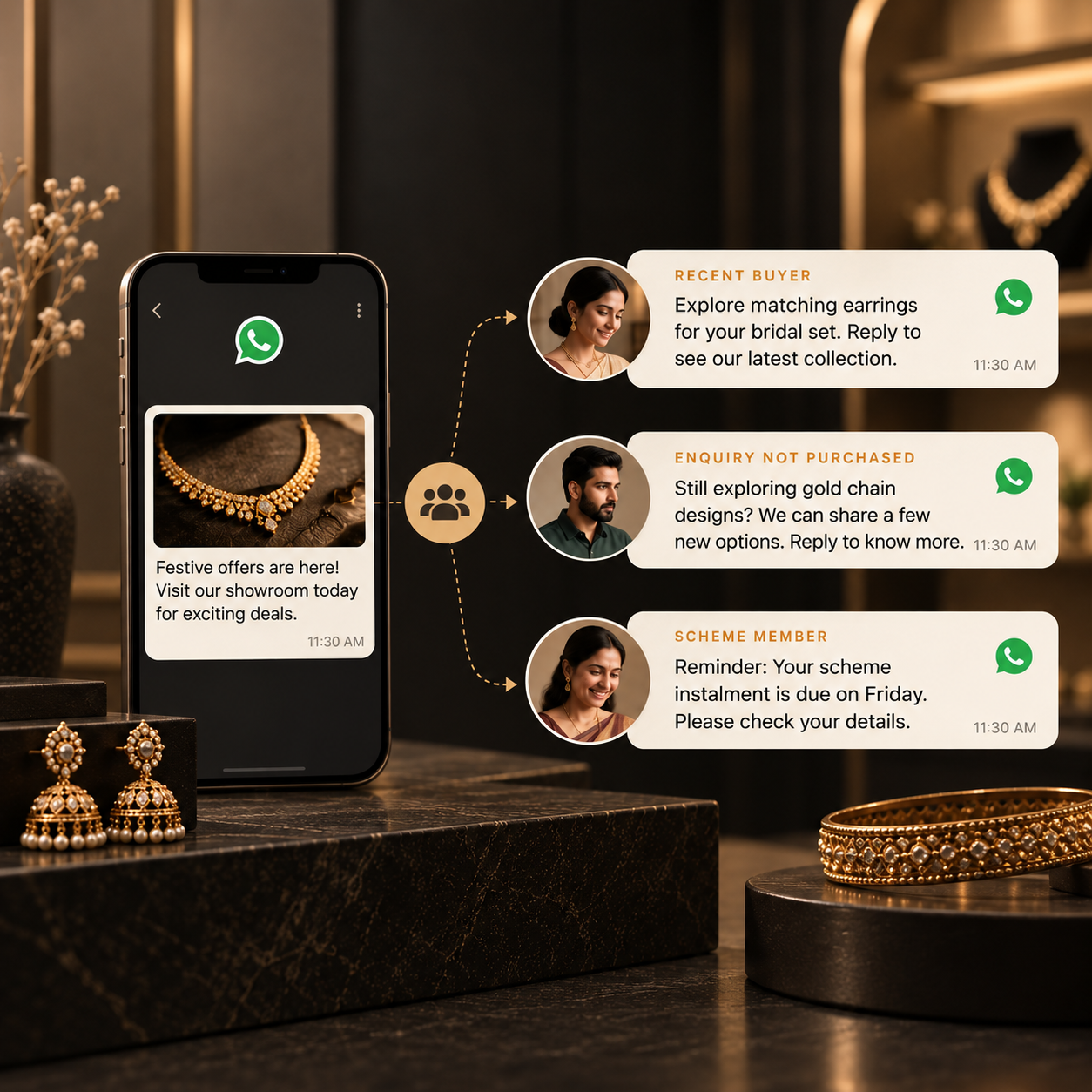
Three days before Dhanteras, the same message goes to twelve thousand contacts. The woman who bought a bridal set last month gets it. So does the man who enquired about a chain in 2021 and never came back. So does the customer with a scheme instalment due on Friday.
A fraction respond. A larger fraction block the number, and that is a door that does not reopen.
For jewellery retailers, festive WhatsApp marketing can be one of the most direct ways to bring customers back into stores. But sending more messages does not automatically produce more sales. When every customer receives the same offer, the campaign ignores the very information that makes jewellery retail different: purchase history, preferences, spending patterns, upcoming occasions and relationships built over years.
A successful festive WhatsApp campaign starts with customer relevance, not contact volume.
The objective is not to send twelve thousand messages. It is to give the right customers a compelling reason to visit, enquire or buy.
Why one message to everyone underperforms twice
A generic festive broadcast usually fails in two ways. First, it converts poorly because the offer may not match the recipient's needs. Second, repeated irrelevant messages can reduce customer trust, encourage blocks and make future communication less effective.
Consider three customers on the same jewellery store database.
- A customer who purchased a bridal set last month may be interested in matching earrings or a gift for an upcoming occasion.
- A customer who enquired about a gold chain two years ago may need a fresh reason to reconsider, provided the enquiry is still relevant and the customer has consented to receive marketing.
- A customer with a monthly savings scheme instalment due needs a clear account-related reminder, not a generic festive discount.
One message cannot serve all three equally well.
This is where customer segmentation for jewellery retail makes a practical difference. The billing system, CRM and enquiry records often contain enough information to create useful audience groups without purchasing additional data.
The commercial benefit is straightforward: fewer irrelevant messages, more meaningful conversations and better opportunities to attribute store visits and sales to a campaign.
Consent and the rules you are actually bound by
Before planning a festive WhatsApp campaign, a jeweller needs to understand both platform requirements and applicable Indian regulations.
WhatsApp Business messaging policies govern how businesses can communicate with customers, including requirements around permission, approved message templates in applicable business-initiated conversations, and the handling of customer requests to stop receiving messages. Businesses should verify the latest requirements for their specific WhatsApp Business setup before launching a campaign.
In India, applicable privacy and telecom rules may also affect how customer information is collected, used and contacted. The precise obligations depend on the type of communication, the channel and the business's implementation. Have your compliance or legal team verify the current requirements rather than assuming that a phone number collected at billing automatically authorises promotional messaging.
A practical checklist includes:
- Opt-in: Maintain evidence that the customer agreed to receive the relevant category of communication through WhatsApp.
- Purpose: Explain what kinds of updates the customer can expect, such as offers, product launches or scheme-related communications.
- Opt-out: Make it easy for customers to withdraw permission and ensure that opt-outs are respected across campaigns.
- Template approval: Use the appropriate approved WhatsApp message templates where required.
- Data hygiene: Keep contact records current, remove invalid numbers and avoid repeatedly messaging customers who have disengaged.
A customer sharing a number for a bill, delivery update or warranty record should not automatically be treated as permission for every future marketing campaign.
The principle is simple: a usable contact database is not just a list of numbers. It is a record of customer relationships and communication permissions.
Segments a jeweller already has
A jewellery retailer does not need dozens of complicated audience groups to begin. Five practical segments can make a festive campaign significantly more relevant.
1. Recent buyers
Customers who recently purchased jewellery may appreciate complementary products, care guidance or information about a new collection. Avoid immediately sending them another generic purchase offer.
For example, a customer who bought a bridal necklace might be interested in matching accessories or a related occasion-wear collection.
2. Active savings scheme members
These customers have an existing relationship with the store. Scheme-related communication should prioritise instalment dates, account information, maturity and applicable redemption details.
Promotional messages should remain distinct from important scheme communications.
3. High-value and repeat customers
Customers with a history of repeat purchases may respond to personalised collection previews, appointment invitations or information about new designs aligned with their previous interests.
High purchase value alone does not justify unrestricted contact. Marketing permission and customer preferences still matter.
4. Enquired but not purchased
These are customers who asked about a particular product, collection or price but did not complete a purchase.
Where the enquiry is still relevant and follow-up is permitted, a useful message could offer updated product information, a fresh design selection or an invitation to view similar pieces in store.
An enquiry from several years ago should not automatically trigger a campaign without checking its relevance and the customer's communication preferences.
5. Dormant customers
Customers who have not purchased for an extended period may need a different approach. A new collection, a relevant occasion or an invitation to rediscover the store could provide a reason to reconnect.
Define dormancy using actual purchase history rather than choosing an arbitrary period for every customer. Someone who buys bridal jewellery once in several years has a different purchase cycle from someone who regularly buys lightweight everyday jewellery.
The useful part is that most of these segments can be built from existing billing and CRM data. The challenge is connecting that data to a consistent campaign process.
Timing against the festive calendar
A festive WhatsApp campaign should be planned across the shopping season rather than treated as a single broadcast sent three days before Dhanteras.
The appropriate sequence depends on the local market, inventory, customer preferences and the festival calendar. A practical starting framework is:
Three to four weeks before the festival
Introduce new collections, festive designs or relevant product categories to customers who have opted in. This gives interested buyers time to browse, compare options and plan a store visit.
One to two weeks before the festival
Share more specific information, such as a collection preview, an appointment invitation or details of an applicable offer. Use separate messages for distinct customer groups instead of repeating the same creative to everyone.
A few days before Dhanteras
Prioritise genuinely useful information: store timings, appointment availability, collection highlights or a relevant reminder about an offer's actual validity.
Avoid manufacturing urgency through misleading scarcity claims or repeatedly sending the same message to non-responsive customers.
During and after the festive period
Respond to enquiries promptly, coordinate store appointments and follow up with interested customers where permission and context allow. After a purchase, a suitable service message may be more valuable than another immediate promotion.
This sequence is a planning framework, not a requirement to message every customer at every stage. Some customers may need only one relevant message. Others may respond to a collection preview and then continue the conversation with the store.
The objective is to make each communication useful enough to justify its place in the customer's inbox.
Scheme members are a separate conversation
Jewellery savings schemes require particular care because they involve ongoing financial commitments, instalment schedules and, depending on the scheme, maturity or redemption conditions.
A customer whose instalment is due on Friday should receive a clear reminder about the due date and the applicable payment process. That message should not be buried beneath a festive discount, a new collection announcement or a sales pitch.
Similarly, a maturity notification should explain the relevant date, available next steps and any conditions the customer needs to understand. The wording should reflect the actual scheme terms rather than imply benefits that may not apply.
Keep three communication purposes distinct:
- Service and account updates: Instalment reminders, payment confirmations, maturity information and other relevant account notifications.
- Festive promotions: Collection announcements, invitations and applicable offers for customers who have agreed to receive marketing.
- Customer support: Responses to questions about balances, redemption, eligibility or scheme conditions.
These communications may use the same underlying CRM, but they should have separate message logic, templates and reporting.
The distinction matters for another reason: a customer who needs an account update should be able to understand it immediately without sorting through promotional content. Separating service communications from marketing also makes campaign measurement and compliance management easier.
What a good jewellery message looks like
A good WhatsApp marketing message is specific, relevant, short and built around one clear action. It gives the customer a reason to respond without requiring them to decode a long sales pitch.
Here are three examples of how the same festive objective can be handled differently.
Example 1: A recent bridal jewellery buyer
Generic version
"Celebrate this festive season with our exclusive jewellery collection. Visit our showroom today for exciting offers!"
More relevant version
"Planning another celebration this season? We've added new designs that complement our bridal collection. Reply to explore the latest pieces or arrange a showroom visit."
The second message is more connected to the customer's likely interests. It should be sent only where the context and marketing permission make it appropriate.
Example 2: A customer who enquired about a gold chain
Generic version
"Festive offers are here! Visit us now for the best deals on gold jewellery."
More relevant version
"Still exploring gold chain designs? We can help you compare styles and available options from our latest collection. Reply if you'd like us to share a few selections."
This message offers assistance instead of assuming that an old enquiry means the customer is ready to purchase.
Example 3: A scheme instalment reminder
Generic version
"Make this Dhanteras special with our festive offers. Visit the store today!"
More appropriate version
"Reminder: Your jewellery scheme instalment is due on Friday, [date]. Please check your scheme details or contact our team if you need assistance."
The third example is deliberately different. It prioritises a clear, relevant account update over promotional language. The final wording should reflect the customer's actual scheme terms and the communication channel's applicable requirements.
For every message, ask three questions before sending it:
- Why is this customer receiving this message?
- What useful information or opportunity does it provide?
- What is the single next action the customer can take?
If the answers are unclear, the message probably needs another round of editing.
Measuring beyond delivered and read
Delivery and read receipts help describe message activity, but they do not establish whether a festive campaign generated business.
Jewellers should measure the full path from communication to customer action.
Useful metrics include:
- Reply rate: How many recipients responded with a question, appointment request or other meaningful engagement?
- Qualified enquiry rate: How many conversations developed into genuine purchase enquiries?
- Store visits attributed: How many customers visited after a campaign, using a consistent attribution method such as a campaign-specific appointment record or tracked offer code?
- Conversion rate: How many attributable enquiries or visits resulted in purchases?
- Revenue attributed: What sales can reasonably be connected to the campaign, while accounting for the limitations of attribution?
- Opt-out and block indicators: How many customers withdrew permission or blocked communication, where reliable reporting is available?
Blocks deserve attention because they can signal poor targeting, excessive frequency, unexpected messaging or a mismatch between customer expectations and campaign content. However, a block does not always prove that one particular message caused the decision.
WhatsApp reporting capabilities vary by account type, provider and integration. Not every business will have access to a complete block count, so retailers should distinguish between directly measured indicators and estimated signals.
A campaign dashboard should therefore combine available platform metrics with CRM outcomes, appointment records and point-of-sale transactions.
For example, if one customer segment produces fewer replies but a higher proportion of completed purchases, it may be more valuable than a segment that generates many low-intent conversations.
The goal is not to maximise the number of messages read. It is to understand which relevant communications lead to useful customer outcomes without damaging trust.
Automating without sounding automated
Personalised WhatsApp communication does not require a staff member to manually prepare every message. It requires automation that responds to real customer events and uses accurate data.
A jewellery retailer can begin with a few practical workflows.
A scheme milestone occurs. The CRM identifies an upcoming instalment or maturity date and initiates the appropriate account communication through the permitted messaging process.
A repair is ready. Once the repair status changes to ready for collection, the system sends the relevant customer an update with collection instructions.
A customer requests a callback. An enquiry is assigned to the appropriate store or team member, with a follow-up task and the original conversation context.
A relevant occasion approaches. Where the retailer has the necessary permission and reliable data, the system can schedule an appropriate customer communication tied to the occasion.
A customer makes a purchase. The system updates the purchase history and can trigger a suitable service follow-up, such as care information or an applicable warranty reminder.
The underlying process is straightforward: an event occurs, the system checks the customer record and communication rules, and the appropriate message or staff task follows.
However, automation should include safeguards. Check permissions before sending, avoid duplicate triggers, respect opt-outs, validate dates and account information, and provide a clear route to a human when a customer needs help.
Automation should remove repetitive work, not remove the judgement that makes customer communication valuable.
For multi-store jewellers, integrating billing, inventory, CRM and WhatsApp can also help ensure that a campaign reflects actual product availability and that customer enquiries reach the correct branch.
That is the difference between automating a bulk broadcast and building a connected customer engagement process.
Frequently asked questions
How often should a jewellery store message customers on WhatsApp?
There is no universal number of messages that works for every jewellery store. Frequency should depend on customer consent, communication preferences, campaign relevance and the purpose of each message. Start with a limited festive sequence, monitor replies and opt-outs, and reduce promotional frequency when engagement declines.
What consent is required for WhatsApp marketing in India?
Jewellery retailers should obtain and maintain appropriate permission for WhatsApp marketing, follow the applicable WhatsApp Business policies and verify the Indian privacy and telecom requirements relevant to their setup. A phone number collected for billing or service purposes should not automatically be treated as permission for promotional messages. Businesses should also provide a practical opt-out mechanism and respect withdrawal of consent.
How should jewellery customers be segmented for festive campaigns?
Start with recent buyers, repeat or high-value customers, scheme members, customers with relevant unconverted enquiries, and dormant customers. Use purchase history, stated preferences, enquiry context and scheme records to determine which communication is appropriate. Apply consent checks to every segment and keep account-related updates separate from promotional campaigns.
Should scheme reminders and promotions go through the same channel?
A jewellery retailer may use WhatsApp for both scheme-related updates and promotions, provided the applicable permissions, policies and requirements are met. However, the messages should have distinct purposes, templates and workflows so that instalment or maturity information is not confused with a sales offer. Keep account information accurate, clearly worded and consistent with the scheme terms.