
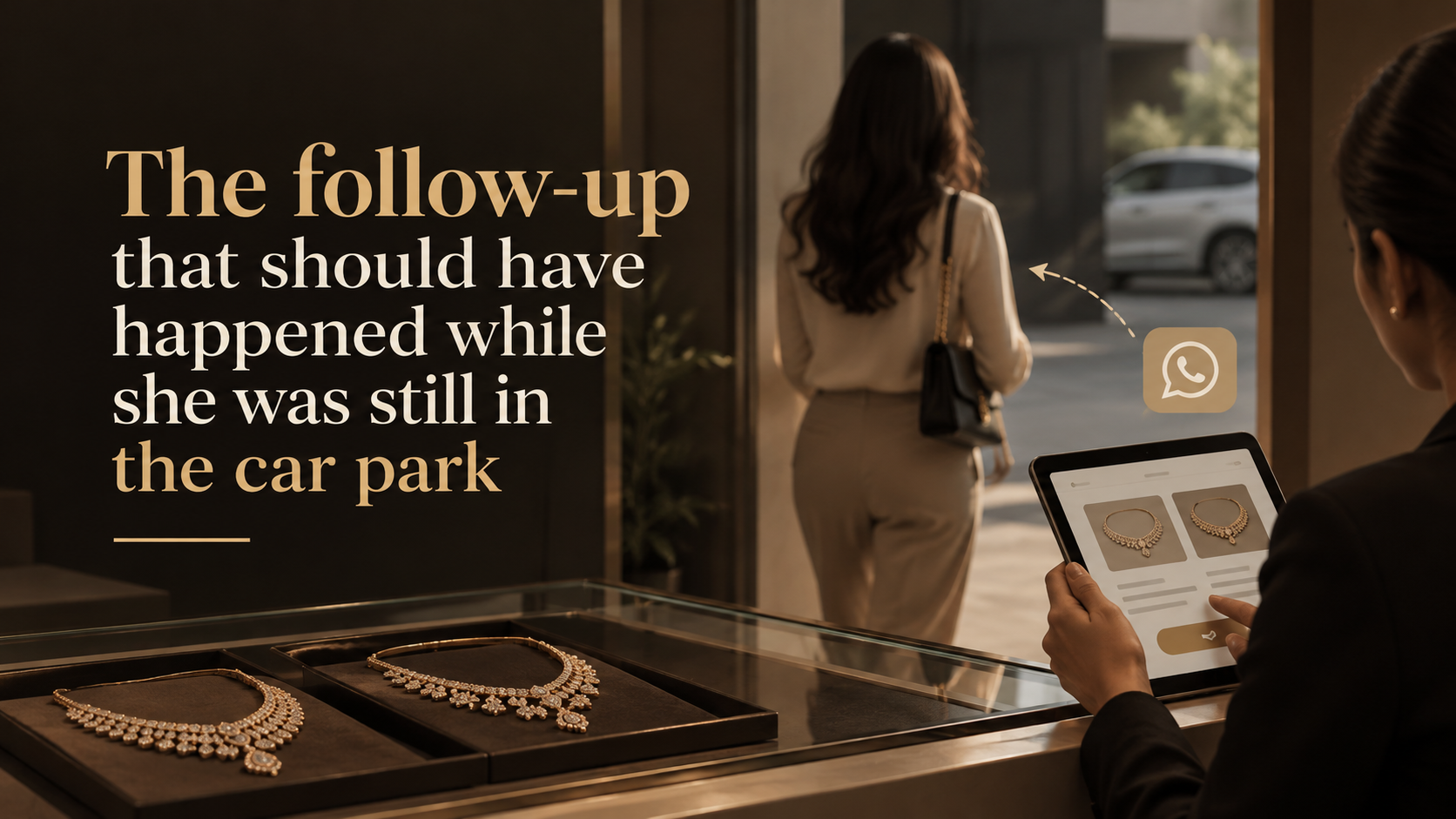
The follow-up that should have happened while she was still in the car park
A customer who leaves a jewellery showroom without buying is at her most interested in the next hour. Most follow-ups happen three days later, if at all.
She spent forty minutes in the showroom. She tried three necklaces, photographed two, asked about making charges, and said she would think about it.
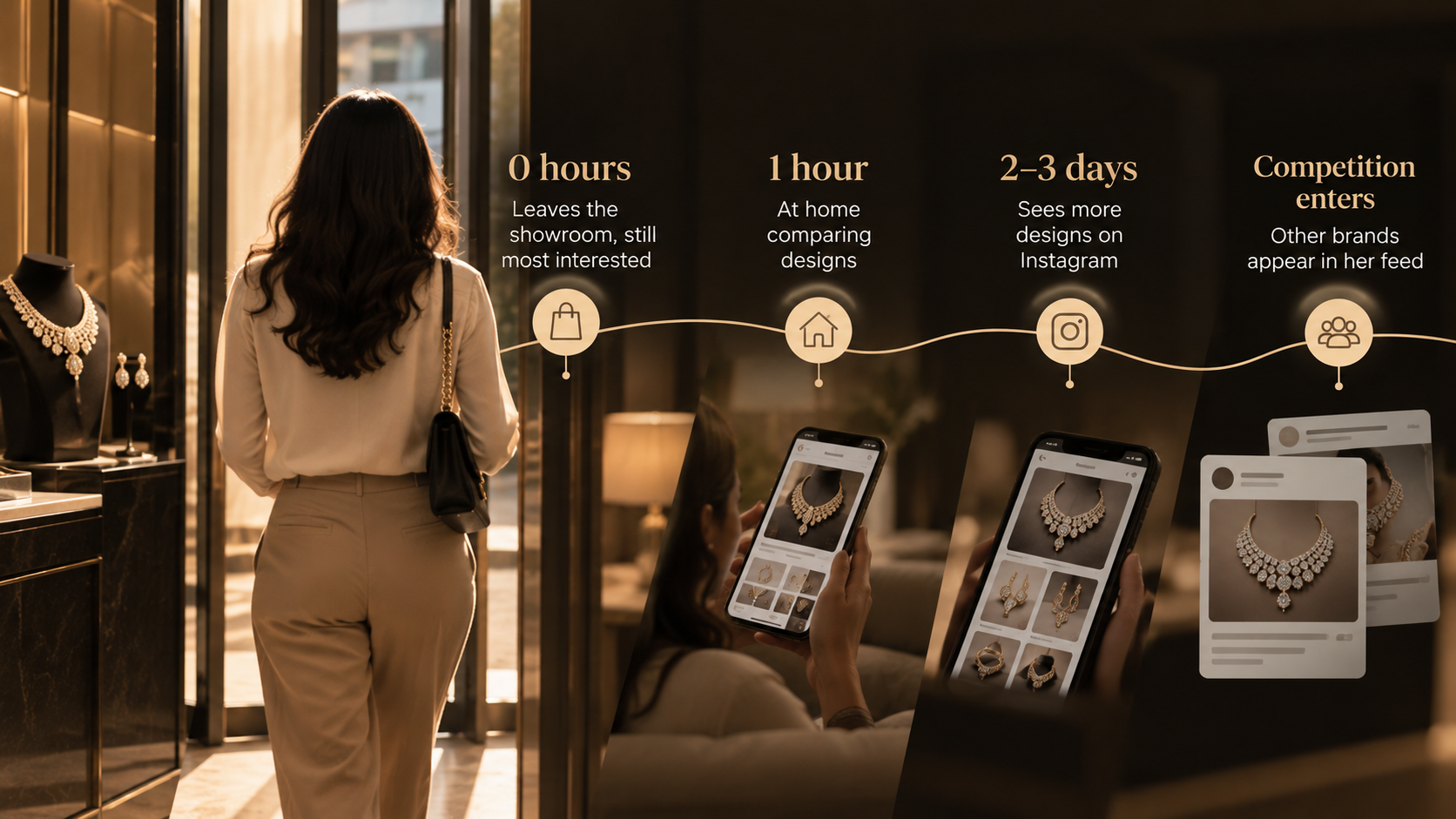
She is at her most interested right now, walking to the car. In an hour she will be at home comparing. By Thursday she will have seen four other designs on Instagram.
In most jewellery businesses, nothing happens at any point in that sequence.
The salesperson moves on to the next customer. The details of the conversation stay in someone's memory. There is no reminder, no message, and no clear owner for the enquiry. By the time anyone thinks to follow up, the customer has already moved on.
This is one of the most overlooked problems in jewellery retail. Stores invest in displays, inventory, advertising and trained salespeople to bring customers through the door. Yet the conversations that do not end in a sale often disappear without a second attempt.
A jewellery showroom follow-up system addresses that gap. It helps stores capture what customers showed interest in, respond while that interest is fresh, and continue the conversation without relying entirely on a salesperson's memory.
The decay curve on a showroom enquiry
A showroom enquiry is not a static lead sitting in a database. It is a conversation that changes with time.
Immediately after a visit, the customer remembers the pieces she tried, how they looked, what the salesperson explained and how she felt wearing them. She may still be deciding between two designs or calculating whether the purchase fits her budget.
That is the moment when a relevant follow-up can make a difference.
An hour later, she may be discussing the purchase with her family. That evening, she may be comparing prices, checking gold rates or looking at similar designs online. Over the next few days, competing jewellery brands can enter the picture through Instagram advertisements, WhatsApp messages and recommendations from friends.
The opportunity does not disappear at a fixed hour. Some customers need weeks to make a high-value purchase. But the immediate context of the showroom visit becomes harder to recover as time passes.
A message sent shortly after the visit can refer to the exact necklace she tried. A message sent four days later may have to begin by reminding her who the salesperson was.
Consider the difference.
A generic message says, "Thank you for visiting our showroom. Please let us know if you need anything."
A contextual message says, "Thank you for visiting us today. The second necklace you tried had the finer detailing you were looking for. I can share its updated price and a few similar designs if that helps with your decision."
The second message continues a conversation. The first merely acknowledges that one happened.
The objective is not to pressure a customer into buying sooner. It is to make sure the store remains useful while she is still deciding.
Why the follow-up does not happen
It is tempting to blame missed follow-ups on poor discipline. Salespeople are told to collect phone numbers, maintain registers, update spreadsheets and call customers later.
But a busy showroom creates a predictable operational problem.
A salesperson finishes a long conversation with a customer who leaves without purchasing. Another family walks in. Someone needs help with a billing query. A manager asks about a stock discrepancy. By closing time, the earlier enquiry has become one of several conversations the salesperson intends to revisit.
The salesperson may remember that the customer wanted a necklace for an anniversary. They may even remember the approximate budget. But the exact design, the customer's objection and the agreed next step can easily be forgotten.
Three failures usually sit underneath the missed follow-up.
First, the information is not captured. The customer's interest exists in conversation rather than in a usable record.
Second, nothing triggers the next action. Even when a phone number is recorded, there may be no task or reminder associated with it.
Third, ownership is unclear. If the salesperson becomes busy, takes leave or changes shifts, nobody necessarily knows who should contact the customer.
These are process failures, not simply individual failures.
A jewellery CRM system can help by connecting the enquiry record, follow-up schedule and responsible salesperson. Instead of expecting staff to remember every unfinished conversation, the system makes the next action visible.
The distinction matters. A reminder can prompt a salesperson to act, but it cannot recover information that was never recorded. Both capture and follow-up need to be part of the same process.
Capturing enough at the counter to follow up at all
The answer is not another lengthy form that slows down the showroom experience.
A salesperson should be able to record the essentials in seconds, ideally while the customer is still present or immediately after she leaves.
A useful showroom enquiry record contains five things:
- Customer name and contact number: Enough to identify the customer and contact her through an appropriate, consented channel.
- Products viewed: The specific necklace, ring, bracelet or other pieces she tried, preferably linked to product codes or photographs.
- Budget band: An approximate spending range, where the customer is comfortable sharing it.
- Occasion or purchase purpose: For example, a wedding, anniversary, festival, gifting or personal purchase.
- Next step: Whether she requested a price confirmation, another design, a family discussion or a follow-up at a particular time.
Not every field needs to be mandatory. A system that requires a salesperson to complete fifteen fields for every walk-in is likely to create resistance.
The priority is to capture enough context to make the next interaction relevant.
For example, a record might look like this:
| Field | Example |
|---|---|
| Customer | Priya |
| Product | Necklace, design N-204 |
| Budget | ₹1.5–2 lakh |
| Occasion | Anniversary |
| Open question | Comparing two designs |
| Next action | Share product details this evening |
| Owner | Assigned salesperson |
This small record changes what the store can do next.
The salesperson no longer needs to reconstruct the conversation from memory. Another authorised team member can understand the enquiry if ownership changes. The system can also associate the interaction with the relevant product and future sale.
For stores with large inventories, integration between the CRM and jewellery inventory system makes this more useful. Product codes, images, availability and pricing information can be retrieved without manually searching through the catalogue.
The aim is simple: capture enough to continue the conversation, not enough to document every word that was spoken.
What a good first follow-up contains
The first follow-up should demonstrate that the store remembers the customer and understands what she was considering.
It does not need elaborate copywriting. It needs context.
A good message generally includes three elements: a reference to the visit, something relevant to the customer's specific interest, and a helpful next step.
For example:
"Thank you for visiting us today. You were comparing the two diamond necklaces with finer detailing. I can share their specifications and updated quotations so you can compare them comfortably. Would you like me to send those across?"
This works because it connects directly to the showroom conversation. It also gives the customer a clear reason to respond without demanding a purchase decision.
Depending on the enquiry, a useful follow-up might include:
- Photographs or a short video of the exact pieces viewed.
- The relevant product specifications and a clear quotation.
- An explanation of making charges or other pricing components.
- Similar designs within the customer's stated budget.
- Confirmation of availability, if that information has been verified.
- An invitation to revisit the showroom or arrange another viewing.
Accuracy is essential. If the message quotes a gold price, making charge or product availability, that information should be current and verified. A misleading quotation can undermine the trust built during the original visit.
A generic "Thank you for visiting" message can still serve as an acknowledgement, but it should not be mistaken for a complete sales follow-up. If the customer has spent forty minutes discussing specific pieces, the store should use that context.
The first message should make it easier for her to take the next step, whatever that step happens to be.
Automated, not impersonal
Automation is often misunderstood as sending the same message to every customer at a predetermined time.
That approach may reduce the effort required to send messages, but it does little to improve the quality of the interaction.
A better jewellery follow-up workflow divides the work between the system and the salesperson.
The system handles the operational tasks: recording the enquiry, assigning ownership, creating reminders, tracking whether a message was sent and flagging enquiries that remain unanswered.
The salesperson handles the human tasks: understanding the customer's preferences, answering questions, recommending suitable designs and deciding how to continue the conversation.
The two roles complement each other.
For example, when an enquiry is marked as a showroom visit without a purchase, the CRM can create a follow-up task for the assigned salesperson. A message template can be populated with relevant product details, while the salesperson reviews it before sending.
For straightforward enquiries, approved automation may handle an acknowledgement or other appropriate communication. For questions about price, customisation, design changes or purchase decisions, a salesperson should remain involved.
The workflow should also respect communication preferences and applicable consent requirements. Customers should not receive repeated promotional messages simply because their details were captured during a showroom visit.
The most effective automation is often invisible to the customer. She experiences a store that remembers her preferences, responds promptly and does not make her repeat the same conversation.
Automation should remove the administrative delay, not remove the salesperson from the relationship.
The second and third touch
Not every customer will reply to the first message. Silence does not always mean disinterest.
She may be travelling, discussing the purchase with her family, waiting for payday or simply not ready to decide. The store needs a follow-up sequence that allows the conversation to continue without turning it into persistent solicitation.
A practical starting point is a three-touch sequence, adjusted to the customer's stated timeline and preferences.
Touch one: Shortly after the visit.
Send the relevant product details, quotation or answer promised during the showroom conversation. This is the most direct continuation of the visit.
Touch two: After a reasonable interval.
If there is no response, follow up with something useful rather than repeating the same message. This could be an answer to an outstanding question, an alternative design within the budget or a clarification about availability.
Touch three: A final, low-pressure check-in.
If the customer remains unresponsive, ask whether she would like further assistance or prefer to reconnect later. If she does not respond, close or pause the active follow-up sequence.
The exact intervals should depend on the purchase context. A customer buying a wedding necklace for an event next week may have a different timeline from someone exploring designs for a future anniversary. A reasonable starting point for testing might be the same day, two or three days later, and approximately a week after the visit, provided that timing is appropriate for the customer.
There should also be clear stop conditions. A customer who asks not to be contacted should be removed from the sequence. Someone who has already purchased should not continue receiving messages intended for undecided buyers. A customer who requests more time should have that preference recorded.
Jewellery is a category where trust is part of the sale. The purpose of repeated follow-up is to remain available, not to make the customer feel watched.
Handing an enquiry between staff
A showroom enquiry should not disappear when the salesperson who handled it is unavailable.
This is especially important in multi-shift stores, busy festive periods and jewellery businesses with several branches. The customer may have spent considerable time with one employee, but the store should not depend entirely on that employee's availability to continue the relationship.
A reliable handover process answers three questions:
- Who owns the enquiry?
- What has already been discussed?
- What action is due next, and by when?
The CRM should preserve the conversation history, products viewed, quotations shared, unresolved questions and agreed next step. If the assigned salesperson is absent, the enquiry can be reassigned to an authorised colleague or escalated to a manager.
For example, if a customer asks for a revised quotation on Sunday and the original salesperson is off duty, another team member should be able to see the request and respond without asking the customer to explain everything again.
Ownership should remain explicit even after reassignment. Otherwise, two employees may contact the same customer independently, or each may assume the other person has handled the follow-up.
For multi-store jewellery retailers, this process becomes even more valuable when the CRM is connected to the central customer record and inventory system. An enquiry originating at one branch can be handled by an authorised team member at another, subject to the business's access rules and customer preferences.
The principle is straightforward: the relationship belongs to the business, even when an individual salesperson starts it.
Measuring what was recovered
A follow-up process should be judged by what it recovers, not simply by how many messages it sends.
A dashboard showing hundreds of outgoing WhatsApp messages may indicate activity. It does not establish whether the activity is creating showroom visits or sales.
Jewellery retailers should start with three connected measurements.
1. Enquiry-to-visit and visit-to-sale conversion
Track how many recorded enquiries result in showroom visits and how many showroom visits eventually result in purchases. For showroom walk-ins, the second measure is particularly useful because it highlights the outcome of visits that did not convert immediately.
Define the denominator carefully. If the store is measuring showroom follow-up, use eligible showroom enquiries or non-converting visits rather than mixing them with unrelated website leads.
2. Follow-up completion and response
Measure the percentage of eligible enquiries contacted within the intended time window, the time taken to make the first follow-up, and the response rate to those communications.
These metrics help identify whether the process is failing because enquiries are not being captured, tasks are overdue or messages are not relevant enough to generate a response.
3. Revenue attributable to follow-up
Track purchases associated with previously recorded showroom enquiries and examine which customers returned or purchased after follow-up. Record the original enquiry source, follow-up activity and eventual transaction wherever possible.
Attribution requires care. A customer may have purchased anyway, returned after several visits or interacted with other marketing channels. A sale following a message does not automatically mean the message caused the sale.
Over time, retailers can compare conversion rates for eligible enquiries that received timely follow-up with those that did not, while accounting for differences in customer intent and enquiry quality. This provides a more credible indication of whether the process is improving outcomes.
The first objective is operational consistency. Once every eligible enquiry is captured and assigned, the store can begin identifying which follow-up approaches actually work.
Without measurement, follow-up remains an initiative that sounds sensible. With measurement, it becomes a process the business can improve.
Frequently asked questions
How soon should a jewellery store follow up after a showroom visit?
A jewellery store should ideally follow up within a few hours of a showroom visit when the customer has not purchased and has agreed to further contact. The first message should refer to the specific designs viewed, answer an outstanding question or provide information promised during the visit. The timing should reflect the customer's preferences and the urgency of the purchase.
What should be recorded when a customer leaves without buying?
Record the customer's name and contact details, the jewellery pieces viewed, approximate budget, purchase occasion, outstanding questions and agreed next step. Assign the enquiry to a responsible salesperson and record when follow-up is due. Collect only the information needed to continue the conversation and handle it in accordance with the customer's consent and applicable privacy requirements.
Should jewellery follow-ups be automated or personal?
Jewellery follow-ups should combine automation with personal communication. A CRM can capture enquiries, schedule reminders, assign ownership and prepare relevant message templates, while the salesperson provides recommendations and answers individual questions. Automation improves consistency, but the messages should remain relevant to the customer's actual showroom experience.
How many times should a jewellery lead be followed up?
A jewellery store can begin with up to three relevant follow-up touches: an initial message after the visit, a useful follow-up after a reasonable interval, and a final low-pressure check-in. The timing should reflect the customer's purchase timeline and communication preferences. Stop immediately if the customer opts out, and pause the sequence when she asks for more time or indicates that further contact is unnecessary.