
What a jewellery search engine has to know that a generic one does not
Generic search matches words against a catalogue. Jewellery search has to understand weight, purity, occasion and a price that changes every morning.
A generic search engine indexes text and matches strings. Given a catalogue of T-shirts, this is often adequate because a T-shirt is reasonably well described by the words on its product page.
A jewellery catalogue is different. The thing a customer is looking for may be described by a word that appears nowhere in the product data — an occasion, a regional name, a budget, or the person receiving the gift. The product that answers her search may be sitting in inventory under nothing more than a design code, a metal weight, and a product category.
Closing that gap is not simply a matter of better keyword matching. It requires a search engine that understands the attributes, terminology, pricing rules, and shopping behaviour specific to jewellery.
For jewellery retailers investing in e-commerce, this distinction matters. When customers cannot find the right product, they may assume the store does not carry it, even when the exact piece is available. Jewellery website search must connect customer intent with actual inventory, not just match words on a screen.
The Query a Jeweller Sees That a Retailer Never Does
Jewellery customers rarely search using only the formal product names assigned by a catalogue manager. They often begin with an occasion, a relationship, a budget, or a visual idea rather than a clearly defined product category.
Consider how an Indian customer might search for jewellery online:
- “Meri sister ki shaadi ke liye gold earrings”
- “Under 20k lightweight necklace for daily wear”
- “Mummy ke liye anniversary gift”
- “Office wear ke liye simple gold chain”
- “Traditional jhumki for a lehenga”
- “2 gram ki bali under 15,000”
- “Bridal jewellery set for a South Indian wedding”
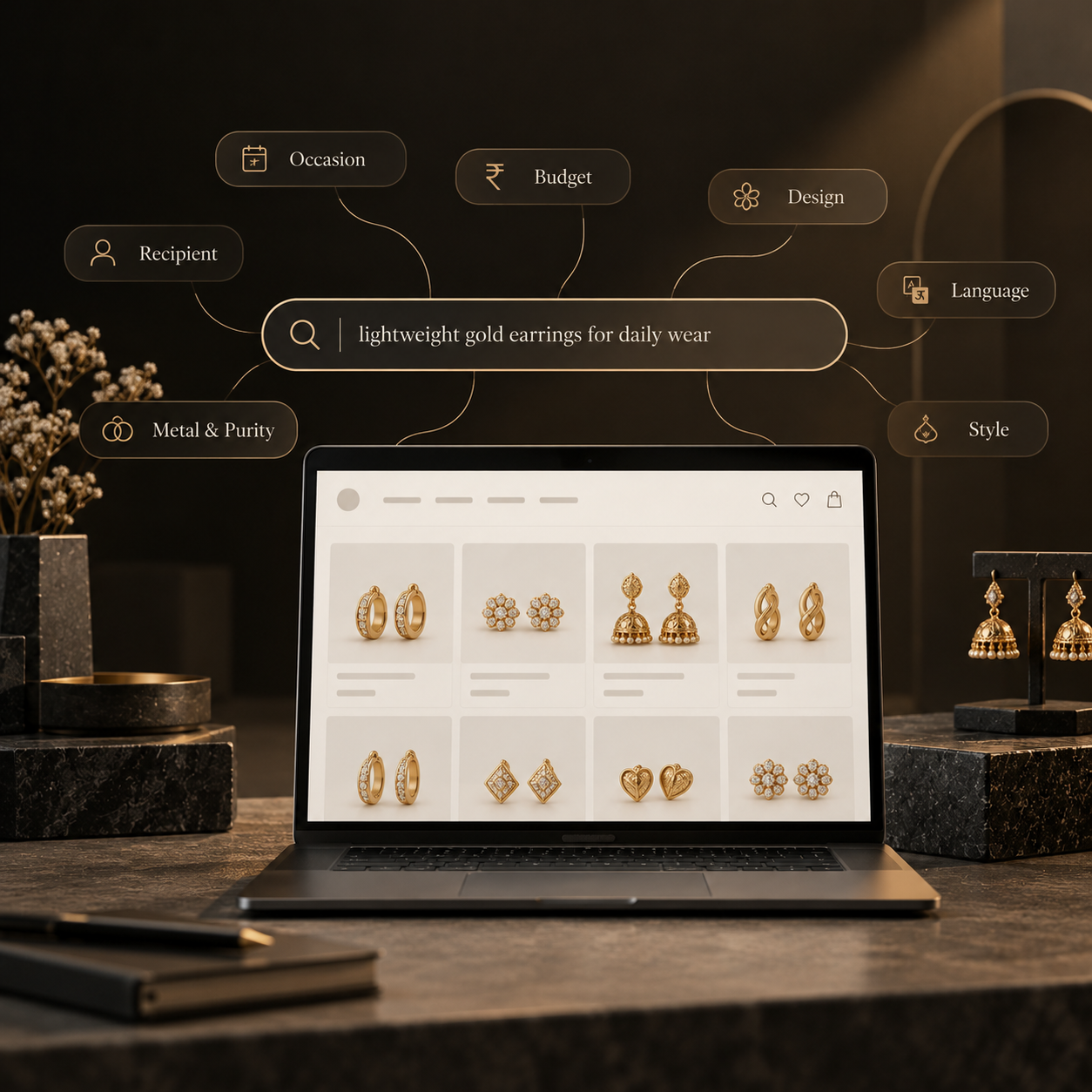
These queries combine multiple types of intent. The customer may specify the recipient, occasion, style, material, weight, or budget in a single sentence. Some of these details may exist in the catalogue, while others need to be interpreted from the context.
A conventional search system may recognise “gold earrings” but ignore “sister ki shaadi ke liye.” It may return every gold earring in the catalogue without distinguishing bridal designs from lightweight everyday pieces.
A jewellery-focused search engine should interpret the complete query and translate it into useful product filters and ranking signals.
For example, a search for “lightweight gold earrings for daily wear under ₹20,000” could prioritise products that meet the budget, have a low gold weight, suit everyday styling, and are currently available.
This does not mean guessing what every customer wants. It means recognising the different signals in a query and using available product information to produce more relevant results.
Structured Attributes Must Be Searchable, Not Just Displayed
Many jewellery websites display important product details on product pages but do not make those details available to the search engine.
A customer might be able to see a necklace's gold purity, weight, stone type, and making charges after opening its product page. However, searching for “18K rose gold necklace under 10 grams” may fail because those attributes are not part of the search index.
That is a catalogue architecture problem, not merely a search interface problem.
A well-designed jewellery search system should index the attributes that influence product discovery.
Important jewellery product attributes include:
- Metal and purity: Gold, silver, platinum, 14K, 18K, 22K, and other supported purity grades.
- Weight: Gross weight, net metal weight, and relevant weight ranges.
- Metal colour: Yellow gold, white gold, rose gold, and two-tone designs.
- Product type: Rings, necklaces, bangles, bracelets, earrings, chains, pendants, and bridal sets.
- Stone details: Diamond, ruby, emerald, pearl, and other stone types, along with relevant characteristics such as carat weight.
- Certification: Applicable hallmarks and certification details, such as BIS hallmarking or diamond grading certificates where available.
- Design and style: Antique, contemporary, temple, minimalist, floral, geometric, and other descriptive styles.
- Making charges: Fixed or percentage-based charges, where applicable, and relevant price bands.
- Availability: Sellable quantity, store availability, and whether a product is available for online purchase.
These attributes should be represented in consistent, structured fields rather than being buried in product descriptions.
For instance, “22 carat,” “22K,” and “22-carat gold” may refer to the same purity category. Normalising these values allows the search engine to recognise equivalent expressions without depending on the exact wording used by the customer.
Structured attributes also make faceted navigation more useful. Customers can narrow results by purity, price, weight, metal colour, or product type without repeatedly rewriting their searches.
For multi-store jewellery businesses, the catalogue should also distinguish product-level attributes from store-level inventory. A design may exist in the catalogue but be unavailable at the customer's preferred location.
Price Is a Filter Over a Moving Target
Jewellery pricing introduces a complication that many generic e-commerce search systems do not handle naturally: the price of a product may change even when the product itself does not.
For gold jewellery, the final selling price can depend on the applicable gold rate, metal weight, purity, making charges, stone value, taxes, discounts, and the retailer's pricing rules. The exact calculation varies by product and business.
Suppose a customer searches for “gold chain under ₹50,000” in the morning. The website indexes the product at ₹49,500. Later, the applicable gold rate changes, and the selling price rises to ₹50,400.
If the search engine continues using the old indexed price, it may show a product that no longer meets the customer's budget.
The reverse can happen as well: a product that has become affordable may remain excluded because its indexed price has not been updated.
This is why jewellery search should not rely blindly on static prices stored in a search index.
A more reliable architecture separates product discovery from the authoritative pricing logic:
- Index product attributes such as weight, purity, design, and category.
- Maintain current pricing data using the retailer's pricing engine or approved price-update process.
- Apply budget filters against the appropriate current selling price.
- Validate the final price before displaying the result or allowing the customer to proceed.
Depending on the catalogue size and the frequency of price changes, this can involve synchronised price fields, incremental index updates, or real-time price validation.
The objective is straightforward: customers searching by budget should receive results that genuinely match their spending limit.
For retailers using live gold rates and integrated point-of-sale systems, search must work with the same pricing rules that govern the rest of the business.
Synonyms Are Not Enough
A thesaurus can help a search engine understand that two words are related. Jewellery discovery needs more than a list of synonyms because similar-looking terms can refer to different product categories, design structures, or customer preferences.
Consider the difference between a jhumka and a chandbali. Both may be traditional earrings, but they are not interchangeable designs. A customer searching for a chandbali should not receive a catalogue dominated by jhumkas simply because the system associates both with traditional Indian earrings.
Now consider these queries:
- “Jhumka earrings”
- “Jhumki style earrings”
- “Traditional jhumki for wedding”
- “Lightweight chandbali”
- “Antique gold-look earrings”
A basic synonym dictionary may connect “jhumka” and “jhumki,” but it may not understand that “lightweight” is a constraint, “for wedding” provides occasion context, and “antique” describes a design preference rather than necessarily the product's age or metal composition.
Semantic search helps bridge this gap by interpreting meaning and relationships between terms. It can retrieve relevant products even when the customer's wording differs from the catalogue description.
However, semantic matching should complement, not replace, structured filtering.
A practical jewellery search architecture combines three approaches:
- Exact matching for design codes, SKUs, certification numbers, and precise product identifiers.
- Attribute-based retrieval for budget, weight, purity, metal colour, and other explicit constraints.
- Semantic retrieval for occasions, design preferences, descriptive language, and queries that do not map neatly to catalogue terminology.
The final results should respect hard constraints. A semantically similar product that exceeds the stated budget or has the wrong metal purity is not a good match.
The goal is not to return products that sound related. It is to find products that satisfy the customer's intent.
Language as It Is Actually Typed
Indian jewellery customers do not always search in formal English or standard Hindi. They switch between languages, use Roman script for Hindi words, shorten expressions, and spell regional terms in different ways.
A single customer might search for “gold bali,” “सोने की बाली,” “sone ki bali,” or “sona bali.” Depending on the catalogue and the search system, all four expressions could point towards the same product category.
Other examples include:
- “Shaadi jewellery set”
- “शादी के लिए हार”
- “Daily wear ki chain”
- “Moti wali earrings”
- “Kundan set for bride”
- “Payal under 5k”
These queries mix English product terminology, Hindi vocabulary, transliterated words, and budget expressions.
A jewellery website that supports only exact English keywords creates unnecessary friction for customers who know what they want but describe it differently.
Language support should therefore be treated as a core search requirement, not an optional enhancement.
A capable system should consider:
Transliteration: Recognise commonly used Roman-script versions of Hindi and other supported Indian languages.
Code-mixing: Interpret queries that combine English product names with Hindi phrases, such as “lightweight necklace shaadi ke liye.”
Script variation: Support relevant searches in Devanagari and other scripts appropriate to the retailer's customer base.
Spelling variation: Account for common misspellings, phonetic variations, and regional differences in jewellery terminology.
Language-aware ranking: Prefer products that match the actual product intent rather than treating every translated or related term as equally relevant.
These capabilities require careful testing against real customer queries. Regional vocabulary varies, and transliteration is not always one-to-one. The search system should avoid silently treating genuinely different jewellery terms as identical.
For retailers serving customers across India, language-aware search can make the catalogue accessible to a much wider audience without requiring every customer to learn the terminology used by the merchandising team.
Ranking When Every Result Is Technically in Stock
Availability is an essential first step in jewellery search, but it is not enough to determine which products customers should see first.
Unlike many mass-market retail products, jewellery often consists of unique designs, limited quantities, or individual pieces. Two products can both be available while differing significantly in relevance, profitability, freshness, and purchase likelihood.
Imagine a customer searches for “minimal gold pendant for everyday wear.” The catalogue contains hundreds of available pendants.
Showing every available pendant in an arbitrary order forces the customer to do the work that the search engine should be doing.
A jewellery-specific ranking model can consider several signals:
- Query relevance: How closely the product matches the customer's requested style, category, and attributes.
- Constraint satisfaction: Whether it fits the stated budget, purity, weight, and other requirements.
- Availability: Whether the item is genuinely available for the relevant sales channel or store.
- Customer behaviour: Whether similar searches have led to product views, wishlists, cart additions, or purchases.
- Stock age: Whether older inventory deserves additional exposure, provided it remains relevant to the query.
- Business priorities: Merchandising campaigns, seasonal collections, or margin considerations within appropriate relevance limits.
- Store proximity: Whether a product is available at a relevant location when local fulfilment matters.
These signals should not be treated equally in every situation.
If a customer specifies a strict budget, a product above that budget should not outrank an eligible product simply because it offers a higher margin. Likewise, a low-stock item should not be promoted as readily available if it cannot be sold through the customer's selected channel.
A sensible ranking approach applies hard constraints first and uses ranking signals to order the remaining candidates.
Commercial objectives can then influence results without undermining the customer's explicit requirements.
For jewellery retailers with multiple stores or franchises, this also creates an opportunity to connect online product discovery with local inventory. Search can help customers discover designs that are actually available for purchase rather than showing products that exist only in a central catalogue.
Zero Results Is a Product Decision, Not an Error Page
A zero-result search does not always mean the retailer lacks the product. Sometimes the item exists under a different name, has incomplete attributes, is indexed incorrectly, or falls outside a filter because the price or inventory data is outdated.
Even when no exact match exists, the search experience does not need to end with a blank page.
Consider a customer searching for “rose gold bracelet under ₹15,000.” If the catalogue contains no products meeting every condition, the website could offer:
- Similar rose gold bracelets in a nearby price range.
- Other bracelet designs within the original budget.
- Relevant products with a similar style or finish.
- An option to widen the budget or remove one filter.
- A way to enquire about availability or request assistance, if the retailer supports it.
The system should explain which constraint is preventing results where that can be determined reliably. For example, it might say that no matching products are currently available under the selected budget.
Importantly, alternatives should preserve as much of the original intent as possible. Showing unrelated gold necklaces because the bracelet search failed is unlikely to help.
Search analytics can also reveal why zero-result queries occur. Repeated searches for a missing design category may indicate a merchandising opportunity, while frequent failures for known SKUs may indicate a catalogue or indexing problem.
For jewellery e-commerce, zero-result handling is therefore both a user-experience decision and a source of commercial insight.
The objective is not to pretend every query has an exact match. It is to give the customer a useful next step instead of a dead end.
Measuring Whether the Search Is Working
A jewellery search engine should be evaluated by what customers do after searching, not simply by whether it returns a list of products.
Search analytics help retailers identify where discovery succeeds, where customers struggle, and which changes are likely to improve conversion.
The following metrics provide a useful starting point.
1. Search-to-product-view rate
The percentage of search sessions that lead to at least one product detail view. A low rate may indicate irrelevant results, poor ranking, or a mismatch between the query and the catalogue.
2. Search-to-add-to-cart rate
The percentage of search sessions that result in a cart addition. This helps establish whether search is bringing customers closer to a purchase rather than merely generating clicks.
3. Search conversion rate
The percentage of search sessions that lead to a completed purchase, measured with a clearly defined attribution window. This connects search performance with commercial outcomes.
4. Zero-result rate
The percentage of searches that return no matching products. This should be segmented by query type, language, category, and other useful dimensions to identify recurring discovery problems.
5. Search refinement rate
The frequency with which customers modify their queries or filters after seeing the initial results. Frequent refinements may suggest that the first result set is not sufficiently relevant, although refinement can also reflect normal comparison shopping.
6. Search exit rate
The percentage of search sessions that end without a meaningful next action. A high rate can indicate that customers are struggling to find suitable products.
7. Revenue per search session
The revenue attributed to sessions that use search. This provides a commercial view, but it should be interpreted alongside traffic mix, order value, and other factors that may affect revenue.
Retailers should compare these metrics over time and across categories rather than treating any single number as definitive proof of success.
It is also important to record the original query, applied filters, results shown, product interactions, and subsequent purchases in a privacy-conscious analytics setup.
With this information, jewellery businesses can identify missing search terms, improve product metadata, tune ranking rules, and prioritise catalogue improvements based on actual customer behaviour.
Frequently Asked Questions
Why does generic site search perform poorly on jewellery catalogues?
Generic site search typically focuses on matching words rather than interpreting jewellery-specific attributes and customer intent. Jewellery searches often involve a combination of budget, purity, weight, occasion, recipient, design style, and regional terminology. Without structured product data and language-aware matching, a search engine can miss relevant products that are already available in the catalogue.
What product attributes should a jewellery search engine index?
A jewellery search engine should index product category, metal type, purity, weight, metal colour, stone details, design style, certification information, making charge bands, and current availability where relevant. It should also support reliable price filtering using the retailer's applicable pricing rules. Structured attributes make it easier to match specific queries and provide useful product filters.
How should a jewellery website handle searches in Hindi or transliterated text?
A jewellery website should support relevant Hindi and regional-language terms in their native scripts, commonly used Roman-script transliterations, spelling variations, and mixed-language queries. Language normalisation and semantic matching can connect customer wording with standard catalogue terminology. The system should still preserve meaningful distinctions between different jewellery styles, materials, and product categories.
What should a jewellery site show when a search returns no results?
A jewellery website should offer relevant alternatives, nearby budget ranges, related designs, or suggestions to remove or modify restrictive filters. It should also investigate whether the failure resulted from missing product attributes, outdated pricing, inventory issues, or unsupported terminology. A helpful zero-result experience gives customers a clear next step instead of ending their shopping journey.
Conclusion: Jewellery Search Must Understand More Than Keywords
The challenge of jewellery e-commerce search is not simply the size of the catalogue. It is the gap between how customers describe the jewellery they want and how retailers represent the products they sell.
Customers search by occasion, budget, relationship, design, language, and personal preference. The catalogue, meanwhile, stores products as structured attributes, design codes, prices, and inventory records.
A jewellery-specific search engine connects these two perspectives through structured data, current pricing, semantic understanding, language support, relevance-based ranking, and continuous performance measurement.
For jewellery retailers building or improving their online stores, search deserves the same architectural attention as product management, inventory synchronisation, and pricing.
When customers can describe what they want in their own words and find a relevant product quickly, the catalogue becomes easier to explore and the path from discovery to purchase becomes shorter. That is the difference between a website that merely contains jewellery and one that helps customers discover it.