
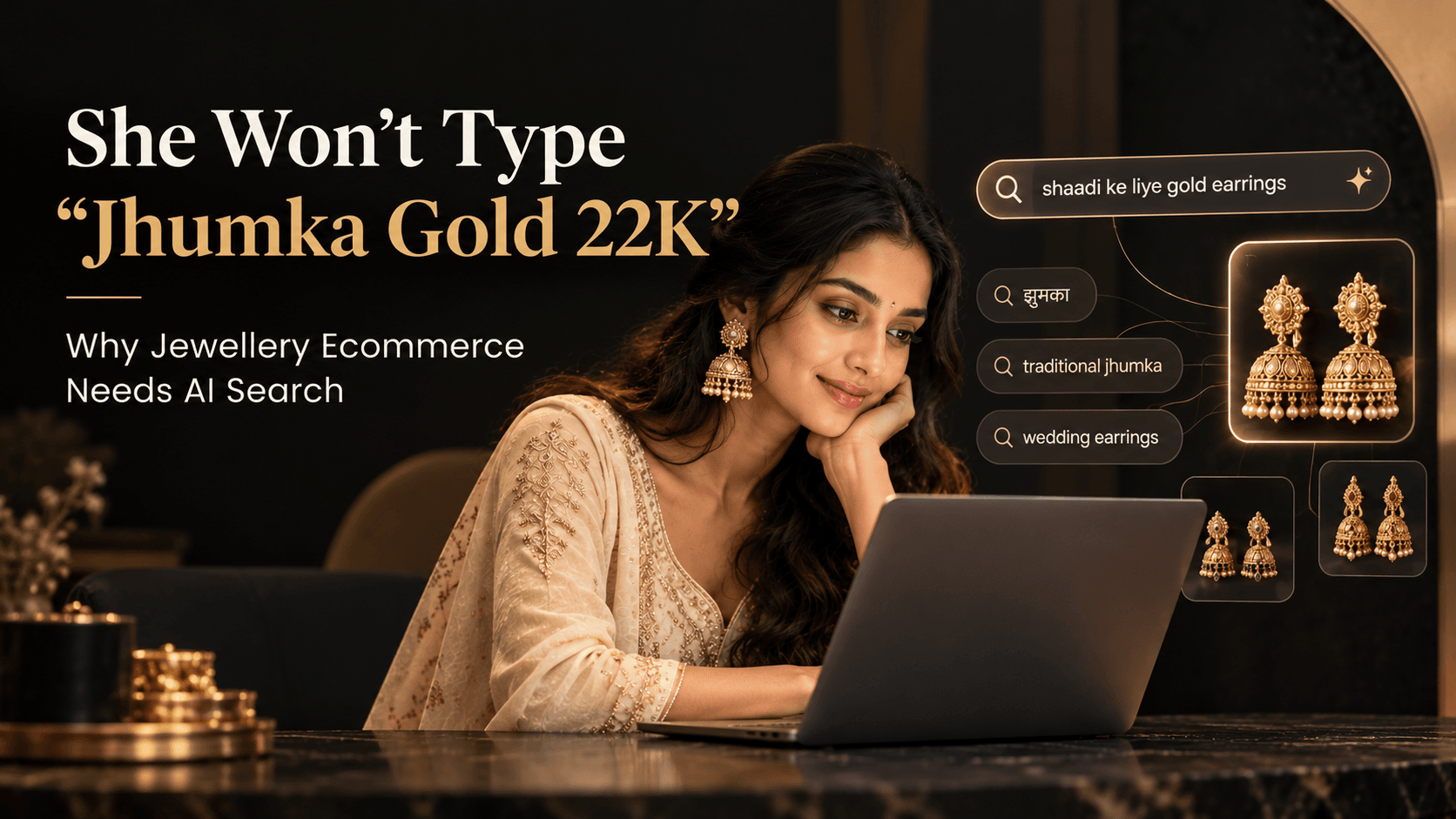
She Won’t Type “Jhumka Gold 22K”
Shoppers search "shaadi ke liye gold earrings" and "झुमका", not your SKU names. How AI search reads intent and language so customers find what you stock.
A customer visits your jewellery website looking for a pair of gold jhumkas for an upcoming wedding. She types “shaadi ke liye gold earrings,” tries “traditional jhumka,” and finally searches “झुमका.”
Your catalogue has exactly what she wants. But the product is listed as “22K Yellow Gold Temple Drop Earrings.”
She leaves without finding it.
The problem is not your collection. It is the gap between how your customer describes jewellery and how your website understands a search query.
For jewellery brands investing in digital commerce, this is an important product discovery challenge. Customers do not always know a product's technical name, metal specification, or catalogue category. They know what they like, what they need it for, and how much they want to spend.
AI search for jewellery ecommerce aims to bridge that gap by understanding the meaning behind a query, not just the words used to describe it.
Why Jewellery Customers Search Differently
Jewellery is an emotional and highly contextual purchase. A customer might be shopping for a wedding, a festival, a birthday gift, or an everyday accessory. Her search can reflect personal taste, cultural familiarity, occasion, and budget—all within a few words.
Consider these queries:
- “Lightweight gold earrings for daily wear”
- “A traditional necklace for my mother's anniversary”
- “Diamond ring under ₹50,000”
- “Bridal bangles matching a red lehenga”
- “Simple mangalsutra for office wear”
Each query communicates more than a product category.
The customer looking for lightweight earrings has a practical preference. The shopper looking for a necklace for her mother has a gifting context. The customer searching for bangles to match a lehenga is describing a style and coordination requirement.
Yet a traditional jewellery catalogue is usually structured around product names, categories, metal purity, weight, gemstones, and other attributes.
That structure is necessary for managing inventory and presenting accurate product information. The challenge is connecting it with the varied language customers use while shopping.
When search depends too heavily on exact wording, a relevant product can remain invisible even when it is available in the catalogue.
Where Traditional Jewellery Website Search Falls Short
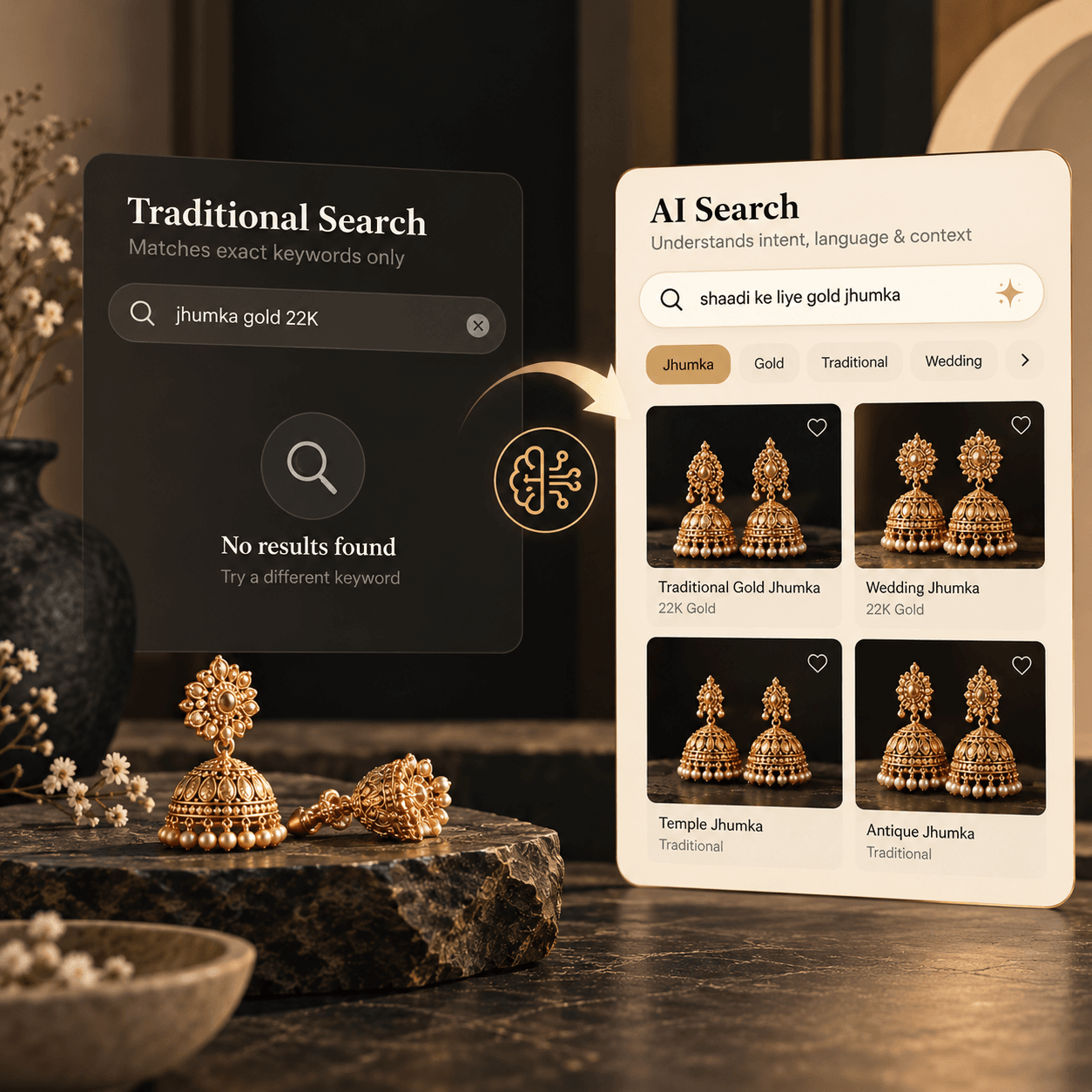
Keyword-based search remains useful. A shopper who knows the exact product name or SKU can often find what she needs quickly.
Problems arise when the customer's language differs from the catalogue's vocabulary.
1. Exact keyword matching
A shopper searches for “jhumka,” while the product title uses “gold drop earrings.” Depending on the search configuration and available synonyms, the relevant product may not appear prominently.
2. Regional language variations
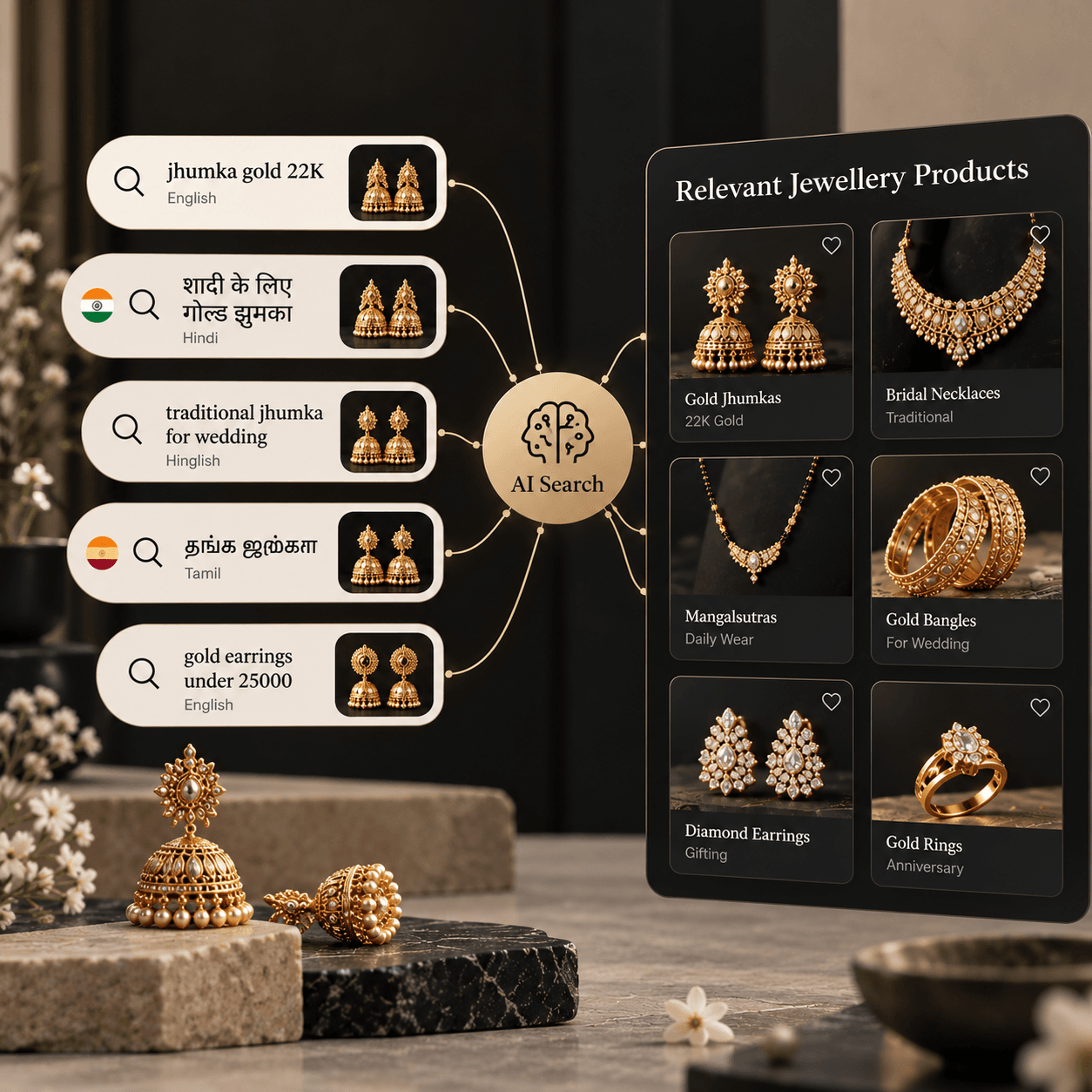
Customers may search in English, Hindi, Hinglish, or regional languages. They may also use transliterations, alternate spellings, or familiar local terms.
A search system that recognises only a narrow set of keywords can struggle to connect these expressions to the correct product category.
3. Occasion-based shopping
“Jewellery for my sister's wedding” describes an occasion rather than a specific product. The customer may expect help discovering suitable earrings, necklaces, or bangles.
A search engine that only matches product titles may miss the context unless the catalogue and search configuration account for it.
4. Descriptive and conversational queries
Customers often describe the design they imagine rather than specify every technical attribute.
For example, “a simple gold chain for everyday use” gives the system useful clues about product type and intended use without providing a precise catalogue name.
5. Unhelpful zero-result pages
When a query returns no useful products, customers must guess alternative terms or restart their search.
A zero-result page does not automatically mean a lost sale. However, repeated search friction is worth investigating, particularly when relevant products already exist in the catalogue.
For ecommerce leaders, the question is not whether keyword search should disappear. It is whether search can accommodate the way real customers express their needs.
What Makes AI Search Different?
AI-powered search can use techniques such as natural language processing, semantic search, synonym mapping, and relevance ranking to interpret a query and connect it with suitable products.
The distinction is straightforward.
Traditional keyword search primarily looks for matches between the words in a query and searchable product information. Modern keyword engines can also support synonyms, typo tolerance, and other improvements, so this is not a strict division between two technologies.
Semantic search attempts to understand meaning and relationships between words. Natural-language search allows shoppers to express a request in a more conversational way.
Imagine a customer searches:
“Show me traditional gold jhumkas for a wedding under ₹25,000.”
An intelligent search system could interpret the request as several signals:
- Product type: Jhumka earrings
- Material preference: Gold
- Style: Traditional
- Occasion: Wedding
- Budget: Up to ₹25,000
It can then use those signals to retrieve and rank suitable products, provided the relevant catalogue data and search capabilities are available.
The customer does not have to translate her shopping request into the exact terminology used by the product team.
That is the value of natural language product search: reducing the effort required to express a preference and find relevant products.
Multilingual Jewellery Search: Let Customers Speak Naturally
India's jewellery market serves customers with diverse languages, dialects, and regional shopping vocabularies.
A customer may be comfortable browsing an English-language website but naturally describe a product in Hindi or Hinglish. Another may search using a regional expression or write a Hindi word in the Latin alphabet.
For example:
| Customer query | Intended product discovery |
|---|---|
| Jhumka gold 22K | 22K gold jhumka earrings |
| सोने की चूड़ियाँ | Gold bangles |
| Naak ki pin | Nose pin |
| Diamond ki bali | Diamond earrings |
| Shaadi ke liye necklace | Necklace suitable for a wedding |
These examples illustrate possible search interpretations, not guaranteed translations or product matches. Actual results depend on the system's language coverage, query interpretation, catalogue attributes, and relevance ranking.
Effective multilingual jewellery search goes beyond translating a few words. It connects different expressions to the product information that matters.
For example, a customer might search for “कान की बाली,” while another types “earrings.” Both queries can potentially lead to relevant earring products even if the catalogue uses English product titles.
For jewellery brands serving multiple regions, this creates an opportunity to make digital discovery more accessible without requiring every shopper to adopt the same vocabulary.
Customers should not have to change the way they speak just to find the jewellery they want.
Beyond Translation: Understanding Shopping Intent
Multilingual search helps interpret different languages. Intent-aware search goes further by identifying the preferences and context expressed in a query.
Consider three searches:
- “Gold earrings”
- “Lightweight gold earrings for office”
- “Traditional gold earrings for my sister's wedding”
All three relate to earrings, but the expected results may differ significantly.
The first expresses a broad product preference. The second adds a practical use case and a lightweight requirement. The third introduces an occasion and gifting context.
An intent-aware search experience can use such signals to improve product relevance.
For jewellery ecommerce, useful signals include:
Product attributes: Jewellery type, metal, purity, gemstone, design, and price.
Occasion: Weddings, festivals, anniversaries, birthdays, gifting, or everyday wear.
Budget: A price ceiling or preferred spending range.
Style: Minimal, traditional, contemporary, bridal, statement, or heritage-inspired designs.
Product relationships: Similar designs, matching sets, and complementary pieces where the catalogue supports those relationships.
These capabilities should be tested rather than assumed. A system may understand the words in a query without reliably filtering products by occasion, weight, or budget.
The objective is to retrieve relevant products, not simply to make the search experience appear intelligent.
AI Search Is Only as Good as Your Product Data
Even an advanced search system needs reliable product information.
If a product lacks its metal purity, uses inconsistent category labels, or has no useful design attributes, the search engine has less information to work with.
This is why AI search should be considered alongside catalogue quality and product information management.
Before implementing an AI search solution, jewellery brands should review five areas:
- Consistent attributes: Standardise fields such as jewellery type, metal, purity, gemstone, and price.
- Descriptive product information: Add meaningful design, style, and occasion attributes where appropriate.
- Synonyms and terminology: Map common variations, alternate spellings, and regional vocabulary to relevant catalogue concepts.
- Accurate availability: Where inventory integrations are supported, apply appropriate stock and store-availability rules to search results.
- Search analytics: Review unsuccessful queries and irrelevant results to identify gaps in the catalogue or search configuration.
The best approach combines structured product data with intelligent query interpretation.
AI should improve access to the catalogue, not replace the discipline required to maintain it.
How to Measure the Impact of AI Search
Introducing AI search is not the business objective. Making product discovery more effective is.
Ecommerce teams should establish baseline measurements before implementation and evaluate changes after launch.
Important metrics include:
Search success rate: How often does a search lead to relevant product discovery or a meaningful next action?
Zero-result rate: What proportion of searches return no products?
Search-to-product click-through rate: How often do shoppers click a product after submitting a search?
Search-assisted add-to-cart rate: How frequently do search interactions lead to products being added to a cart?
Search-assisted conversion rate: How often do sessions involving search result in a purchase?
Query reformulation rate: How frequently do customers change their search terms before finding useful results?
Definitions matter. For example, a search can return products without genuinely satisfying the customer's request. A low zero-result rate alone is therefore not proof of good search quality.
Teams should also segment performance by language, product category, query type, device, and customer journey where sufficient data is available.
A practical starting point is to collect common customer queries, create a test set of representative searches, and assess whether the right products appear near the top. Repeat the evaluation after changes to catalogue data, synonym rules, or search configuration.
This makes it possible to identify specific improvements rather than relying on vague claims about AI.
What Jewellery Brands Should Look for in an AI Search Solution
Before selecting a solution, ecommerce leaders should ask six practical questions.
Does it understand jewellery terminology? Test product names, regional terms, alternate spellings, gemstones, metal purity, and design vocabulary.
Can customers search in multiple languages? Test actual Hindi, Hinglish, and relevant regional-language queries instead of relying solely on a feature checklist.
Does it understand shopping intent? Evaluate queries involving occasion, budget, style, and product attributes.
Can it work with the existing catalogue? Understand integration requirements, product indexing, data mapping, and ongoing synchronisation.
Can the team measure relevance? Look for useful reporting on unsuccessful queries, product clicks, and search-assisted shopping activity.
Does it fit the existing storefront? Search should support the customer's journey from discovery to product evaluation and purchase without introducing unnecessary complexity.
A pilot using real catalogue data and representative customer queries is often more informative than a generic demonstration. It helps reveal how the solution performs against the terminology and product structure of the actual business.
How Jewelstack Approaches AI Search for Jewellery Ecommerce
Jewelstack is a jewellery-focused technology division of Bytive, offering a digital commerce ecosystem that includes luxury ecommerce, omnichannel commerce, POS, B2B platforms, digital gold, and an AI Search Layer.
Its website describes three relevant elements of its AI search approach: multilingual search, intent-aware discovery, and a jewellery-specific intelligence layer designed around gemstones, metals, regional designs, and trade vocabulary.
The platform presents examples of searches across Hindi, English, and regional terminology, alongside discovery based on context, synonyms, style, and occasion. These are the capabilities Jewelstack highlights in its own product positioning. Actual performance should be evaluated against a retailer's catalogue and representative search queries.
For jewellery businesses, the broader principle is important: search technology should reflect the way their customers discover jewellery, rather than treating every product catalogue as interchangeable.
If your team is evaluating AI search for jewellery ecommerce, start with the searches your customers already make. Identify where relevant products are missed, which language variations create friction, and what information is missing from your catalogue.
Then assess whether an AI search layer can address those gaps within your existing ecommerce experience.
Explore the Jewelstack ecosystem at https://jewelstack.ai/ to learn more about its jewellery-specific technology solutions.
Conclusion: Your Customers Know What They Want. Search Should Help Them Find It.
A customer searching for “jhumka gold 22K” should not need to know whether your catalogue calls the product a temple earring, a traditional drop earring, or a gold jhumka.
She may search in Hindi, describe an occasion, specify a budget, or simply explain the design she has in mind.
Each query is an attempt to communicate a preference.
AI-powered, multilingual, intent-aware search can help jewellery brands connect those expressions with accurate product information and relevant results. Its effectiveness depends on catalogue quality, language coverage, implementation, and continuous measurement.
The opportunity is not to add AI to a search bar simply because the technology exists. It is to remove unnecessary friction from a customer's path to the right piece of jewellery.
The best jewellery search experience does not teach customers how to search. It understands what they mean.
Frequently asked questions
Why does jewellery website search fail so often?
Because it matches keywords rather than meaning. A customer searches for an occasion, a regional name or a description — "shaadi ke liye earrings", "jhumka", "something under fifty thousand" — while the catalogue is stored under design codes and formal product names. The piece she wants is in stock; the search box simply has no way to connect her words to it.
How should a jewellery site handle searches in Hindi or transliterated text?
It needs to treat jhumka, jhumkaa, jhumki and झुमका as the same intent rather than four different strings. That means mapping regional and transliterated vocabulary to products, not translating the query. Indian customers routinely mix scripts and languages in one search, and a system that handles only one of them returns nothing for perfectly reasonable queries.
What is the difference between keyword search and AI search for jewellery?
Keyword search looks for the words you typed in the text it has indexed. AI search interprets what you meant — the occasion, the recipient, the budget, the style — and matches that against structured product attributes such as weight, purity, stone and metal colour. The second can answer a question whose words appear nowhere in the product data.
What should a jewellery website show when a search returns nothing?
Never a bare "no results" page. A zero-result page in jewellery is a customer leaving, not a dead end. Show the closest matches on the attributes that were understood, offer to relax the narrowest filter, and record the query — repeated zero-result searches are the clearest demand signal a catalogue produces.
How do you measure whether jewellery site search is working?
Track the share of searches returning no results, the rate at which a search leads to a product view, and how often customers refine a query before finding something. Overall search volume says nothing useful on its own; a falling zero-result rate alongside a rising search-to-product-view rate is what improvement looks like.