

Photographs sell the piece. Variants sell the order.
Great jewellery photography brings a customer to the page. Catalogue structure decides whether she can order what she actually wants.
The photography budget is never questioned. The catalogue structure is rarely discussed.
A jewellery brand invests in professional photography, carefully styled collections, premium product pages and a storefront designed to create desire. Yet a customer can arrive on a beautifully shot page, decide she wants the same design in 18KT rose gold instead of 14KT yellow gold, select her size and discover that the product page cannot express what she wants.
She leaves.
The analytics record a bounce on a page that did its job perfectly. The photograph created desire. The catalogue failed to convert it into an order.
This is one of the overlooked problems in jewellery e-commerce. Brands invest heavily in how products look online, but often give less attention to how products are represented, organised and sold through their digital catalogues.
Jewellery product photography creates interest. Product variants turn that interest into a purchase. Without a structured catalogue connecting designs, variants, inventory and product attributes, even a visually excellent jewellery website can lose customers at the point of decision.
What the Photograph Does and Where It Stops
A photograph answers an important question: Is this beautiful enough for me to consider buying it?
It communicates craftsmanship, proportion, finish, stone arrangement and visual appeal. In jewellery, where customers often cannot physically inspect a product before purchasing, high-quality imagery plays a critical role in establishing confidence.
But a photograph cannot reliably answer every question a customer asks before placing an order.
Can this ring be purchased in size 16? Is the design available in 18KT rose gold? Does the white-gold version use the same diamonds? Is the selected variant within the customer's budget? Is the exact combination available in stock?
These are not photography problems. They are catalogue and product-data problems.
A single jewellery design might be offered in multiple purities, metal colours, ring sizes, stone configurations and weight ranges. Customers expect to explore these options without feeling that they are navigating entirely different products.
When the catalogue cannot represent these choices clearly, the customer encounters friction. She may see a desirable design but cannot confidently identify the version she wants or establish whether it is available.
The solution is not necessarily more photography. It is a product structure that connects the visual representation to the actual choices available for purchase.
Design, Variant and Piece: Three Different Things
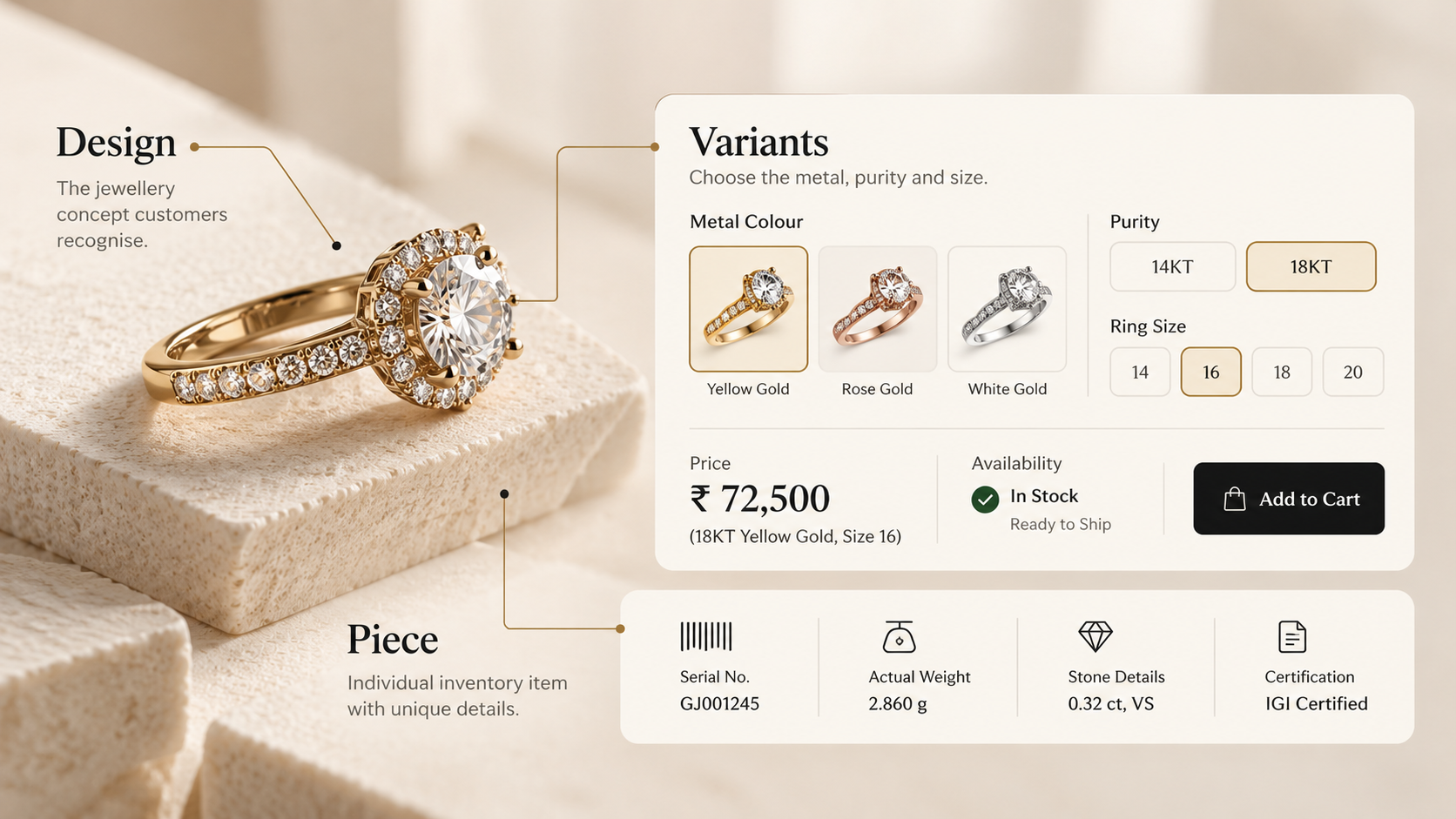
A jewellery catalogue needs to distinguish three concepts that are often incorrectly treated as the same record: the design, the variant and the individual piece.
Understanding this hierarchy is the foundation of a scalable jewellery e-commerce catalogue.
1. Design — the underlying product identity
A design represents the jewellery concept customers recognise: a particular ring, necklace, bracelet or pair of earrings. It has a design code, a name, a product category and shared visual identity. Multiple sellable versions can belong to the same design.
2. Variant — a specific configuration
A variant represents a purchasable configuration of a design, such as 18KT yellow gold in ring size 16 or 18KT rose gold in ring size 18. Its attributes, pricing rules, SKU and availability must be represented accurately.
3. Piece — the physical inventory item
A piece is an individual physical item held in inventory, where item-level tracking is required. It may have its own serial number, RFID tag, actual weight, stone details, location and inventory status.
Consider a ring design offered in three metal colours, two purities and eight sizes. If every combination is supported, that design can have up to 48 variants.
Those 48 variants do not necessarily represent 48 different designs. Nor do they automatically represent 48 physical pieces in stock.
This distinction matters for inventory management, product discovery, pricing, merchandising and omnichannel operations. A customer should be able to explore one design, select a valid configuration and see accurate availability without the system confusing a design with a physical item.
The exact hierarchy may vary by jewellery category and business model. A made-to-order ring, for example, may support configurations that do not exist as pre-manufactured inventory pieces. The data model must accommodate that distinction rather than assuming every possible variant already exists in stock.
Shooting Every Variant Is Not the Answer
Once a catalogue supports multiple combinations, the instinctive response is often to photograph every variant.
The numbers quickly become difficult to manage.
Suppose a jewellery brand has 4,000 designs, each with an average of 48 possible variants. That produces 1,92,000 potential configurations.
Photographing every configuration separately could require an enormous investment in studio time, product handling, image processing, storage and ongoing updates. The problem becomes more expensive when metal finishes, stone settings or product specifications change.
And the cost does not end after the first shoot. New designs arrive, existing products are revised and discontinued variants must be removed from sale.
A better approach is to decide which information genuinely requires a separate visual representation.
Use representative photography when the design remains visually consistent. Use variant-specific imagery when the difference materially affects the customer's decision.
For example:
- Representative product photography: One primary image can represent a ring design when its available sizes do not materially change its appearance.
- Metal-colour swatches: Clear swatches can communicate yellow, rose and white gold, provided the swatches accurately represent the available finishes.
- Variant-specific images: Separate images are appropriate when a stone arrangement, setting, motif or other visible feature changes significantly.
- Digital rendering: Carefully controlled rendering can help show alternative metal finishes or configurations when the result is sufficiently accurate for the intended use.
- Detail and scale images: Close-ups, side profiles and on-hand photographs can communicate craftsmanship, proportions and setting details that a standard front-facing image cannot.
Rendering should not imply that a stone, finish or setting exists when it does not. Likewise, a colour swatch is not a substitute for accurate product specifications.
The objective is not to minimise the number of photographs at any cost. It is to use photography where it creates value and structured data where information must be searchable, comparable or operationally reliable.
What Must Be Structured Data Rather Than a Picture
If a customer needs to filter, compare, calculate or verify an attribute, that attribute should exist as structured product data wherever applicable.
A product image may visually suggest that a ring contains diamonds, but it cannot reliably establish the diamond's specifications, certification details or the actual weight of the physical piece.
A structured jewellery catalogue should account for the following information.
Attribute | Why it matters |
|---|---|
Product category | Enables navigation and relevant category filters |
Metal type and purity | Distinguishes gold, platinum and applicable purity options |
Metal colour | Supports variant selection and filtering |
Net and gross weight | Supports comparison, pricing and operational records |
Stone details | Records stone type, quantity, weight and other applicable specifications |
Size and dimensions | Helps customers assess fit and product proportions |
Certification | Communicates applicable certification details and references |
SKU and design code | Supports product identification and integration |
Price components | Supports transparent pricing and business-specific pricing calculations |
Variant availability | Prevents unavailable configurations from being presented as immediately purchasable |
Inventory location | Supports store availability and fulfilment where integrated |
Not every field belongs at the same level. A design may have shared attributes, a variant may have a defined metal colour and size, and an individual piece may have an actual measured weight or unique certificate reference.
This distinction is especially important for jewellery pricing. Where prices depend on live gold rates, actual weight, purity, stone value, making charges or other business rules, the catalogue must connect the relevant data to the pricing engine. A photograph cannot supply those inputs.
Similarly, certification should be represented with the appropriate issuer, reference and scope rather than inferred from an image or generic product description.
Structured data makes product information more useful to customers and more dependable for the business systems that consume it.
Naming and Codes That Survive Growth
A design code may appear to be a small operational detail. At scale, it becomes one of the foundations of catalogue reliability.
Consider a brand that uses codes such as RNG-18K-RG-016 to represent a ring, 18KT rose gold and size 16.
Such a code can be convenient for humans to interpret, but encoding every attribute into the SKU creates its own problems. What happens when the size changes? What happens when the product's classification changes? What happens when the same design is available in multiple channels or is manufactured by a different supplier?
A more robust approach is to separate stable identity from changeable attributes.
- Design code: Identifies the underlying jewellery design.
- Variant SKU: Identifies a specific sellable configuration.
- Piece or inventory ID: Identifies an individual physical item when required.
- Attributes: Store purity, colour, size, stone specifications and other characteristics as structured fields.
- Relationships: Link variants to their parent design and physical pieces to the appropriate inventory records.
The codes can remain readable where that is useful, but the system should not depend on decoding a string to discover the product's essential attributes.
A stable internal identifier also makes it easier to integrate the catalogue with a POS, ERP, inventory management platform, marketplace or e-commerce storefront. External systems can map their identifiers to the canonical product records without forcing the brand to redesign its entire catalogue whenever an integration changes.
At ten thousand designs, inconsistencies that once looked harmless become expensive. Duplicate records, conflicting SKUs, inconsistent purity labels and broken parent-child relationships can create problems across search, reporting, inventory and order fulfilment.
A naming convention helps. A consistent data model and validation rules are what make that convention enforceable.
Collections, Occasions and the Merchandising Layer
A jewellery design can belong to multiple collections without becoming multiple products.
A gold necklace might appear in a bridal collection, a festive edit, a gifting guide and a lightweight jewellery collection. These groupings serve different merchandising purposes, even though the underlying product remains the same.
This is why merchandising should be modelled separately from the core product hierarchy.
The product structure answers questions such as:
- What is this product?
- Which variants can be purchased?
- What attributes describe it?
- Where is it available?
The merchandising layer answers different questions:
- Which products belong in the bridal collection?
- What should appear in the Diwali campaign?
- Which designs should be promoted as everyday wear?
- Which products should appear in a curated gifting selection?
Treating every collection as a separate product category can result in duplication, inconsistent descriptions and fragmented inventory references. A better model allows one design to appear in several collections through explicit relationships, tags or merchandising rules.
This also makes seasonal campaigns easier to manage. A product can move between curated collections without creating a new product record or disrupting its SKU, order history or inventory links.
Collections should help customers discover jewellery. They should not dictate how the underlying catalogue is stored.
Structure and Search Are the Same Investment
Product search is only as good as the information available to it.
A customer searching for a lightweight 18KT gold necklace should be able to discover products based on relevant attributes, not just whether those words happen to appear in the product title or description.
If purity, weight range, product type and metal colour exist only in photographs or inconsistent free-text descriptions, the search engine has no dependable way to interpret them.
Structured catalogue attributes enable more useful capabilities:
- Attribute-based filtering: Narrow results by purity, metal colour, product category, size or weight range.
- Relevant search: Match customer intent to product attributes, synonyms and category-specific terminology.
- Product recommendations: Compare meaningful characteristics instead of relying only on broad visual or behavioural similarities.
- Variant-aware results: Present relevant designs while respecting the customer's selected configuration and availability.
- Consistent merchandising: Apply rules based on product attributes without manually maintaining separate lists.
AI-based search does not remove the need for a structured catalogue. Natural-language processing can interpret what a customer means, but the system still needs reliable product information against which to evaluate that intent.
A search for a ring under a particular budget, in a specific purity and available in a particular size depends on data that can be queried consistently.
This is why catalogue architecture and search should be planned together. The same attributes that make products easier to manage internally also make them easier to discover externally.
Fixing a Catalogue That Has Already Grown Messy
For an established jewellery business, rebuilding the catalogue from scratch is rarely the best first move. A large catalogue may contain years of product records, historical orders, existing SKUs, inventory mappings and integrations that cannot simply be discarded.
A controlled migration is usually more practical.
Step 1: Audit the existing catalogue.
Identify duplicate designs, inconsistent naming conventions, missing attributes, mixed design and variant records, invalid SKUs and products whose availability does not match inventory. Establish which systems currently own product, pricing and stock information.
Step 2: Define the target hierarchy.
Agree on the rules for designs, variants and physical pieces. Define the required attributes for each category and decide which attributes are mandatory, optional or conditional. Rings, necklaces, earrings and loose gemstones may require different fields.
Step 3: Establish canonical identifiers and mapping rules.
Decide how existing product codes, variant SKUs, POS identifiers and ERP references will map to the new structure. Preserve the relationships needed for historical orders and reporting.
Step 4: Migrate category by category.
Start with a manageable product category, validate the new records and test the storefront experience. Check search, filtering, variant selection, pricing and inventory synchronisation before extending the approach to other categories.
Step 5: Validate the customer journey and integrations.
Test whether customers can select the intended configuration, whether displayed prices follow the correct rules and whether inventory updates behave as expected across connected systems.
Step 6: Enforce the structure at entry.
Introduce validation rules, controlled attribute values, duplicate checks and clear responsibilities for product-data maintenance. Without these controls, the catalogue can gradually return to its previous state.
The migration should be treated as a business and data-quality project, not merely a storefront redesign. Depending on catalogue size, data quality, integration complexity and operational requirements, the work may take months rather than weeks.
The most important outcome is not a cleaner spreadsheet. It is a catalogue that remains consistent as the business adds designs, stores, sales channels and product options.
Frequently Asked Questions
How should a jewellery product catalogue be structured?
A jewellery product catalogue should separate the underlying design, its sellable variants and individual physical inventory pieces where item-level tracking is required. Shared design information should be stored once, while variant-specific attributes such as purity, metal colour and size should be recorded separately. Structured attributes, stable identifiers and reliable inventory relationships make the catalogue easier to search, maintain and integrate with other business systems.
Do all jewellery variants need their own photographs?
No. Variants that differ only in attributes such as size may not require separate photographs if their appearance is materially unchanged. Distinct metal finishes, stone arrangements or settings may justify variant-specific images, swatches or accurate digital renders. The objective is to represent meaningful visual differences honestly while keeping product information and availability accurate.
What is the difference between a design, a variant and a piece?
A design is the underlying jewellery concept, such as a particular ring or necklace. A variant is a specific purchasable configuration of that design, defined by attributes such as purity, colour or size. A piece is an individual physical item in inventory, which may have its own serial number, actual weight, certificate reference or store location. A made-to-order variant may exist without a corresponding pre-manufactured piece in stock.
How do you clean up a jewellery catalogue that has grown inconsistently?
Start by auditing existing product records, identifying duplicates, missing attributes and inconsistent identifiers. Define the target data hierarchy, map existing SKUs and integrations, and migrate one product category at a time. Validate pricing, search, variants and inventory before expanding the migration. Finally, introduce mandatory fields, controlled values and ongoing data-quality checks so inconsistencies do not return.