
Why jewellery carts get abandoned at the making charge
Jewellery carts are abandoned at a specific moment: when a cost appears that was not visible on the product page. What causes it and how to remove the surprise.
She has chosen the piece. She knows roughly what gold costs because she checks the rate. She has decided how much she is willing to spend.
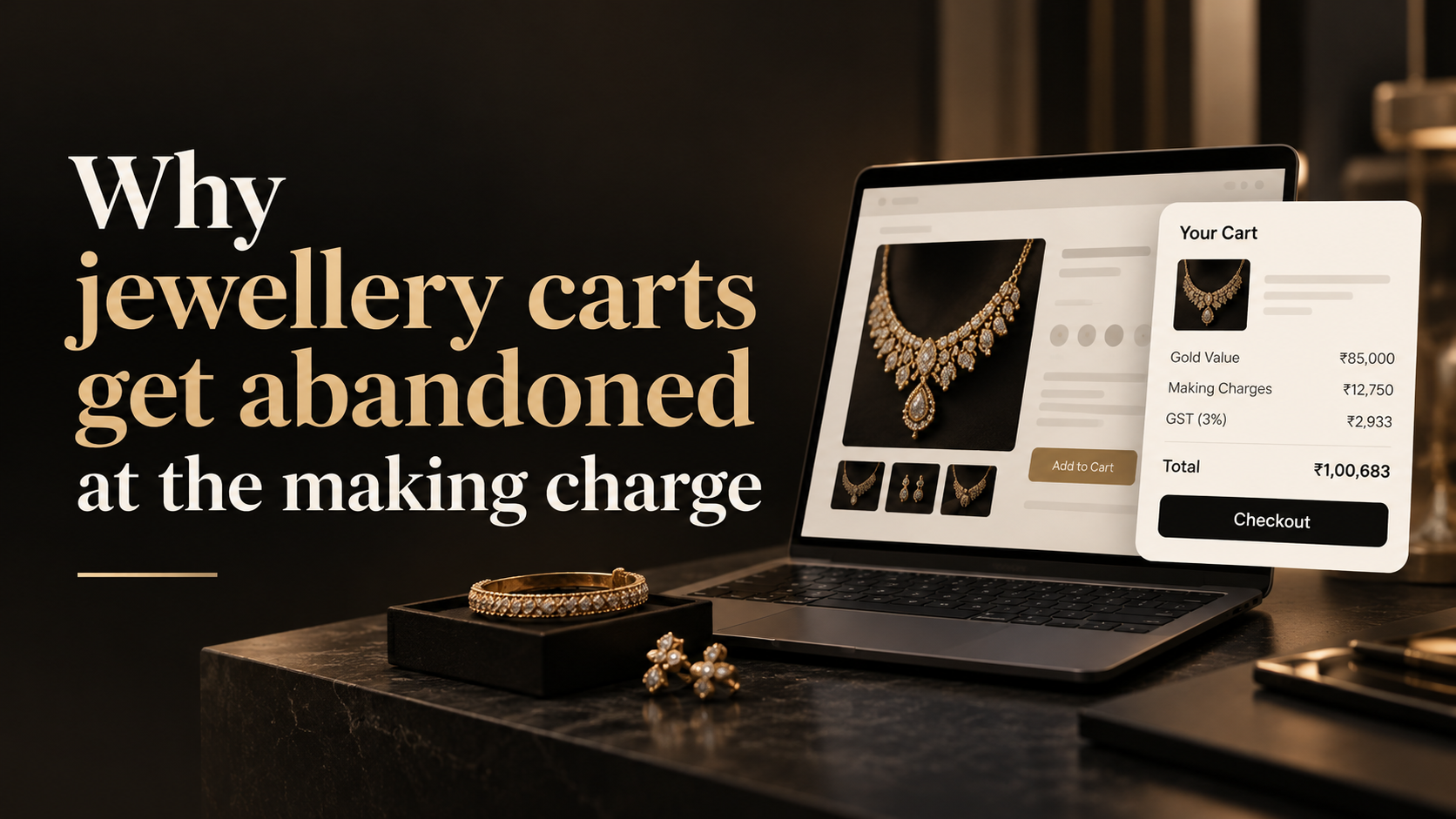
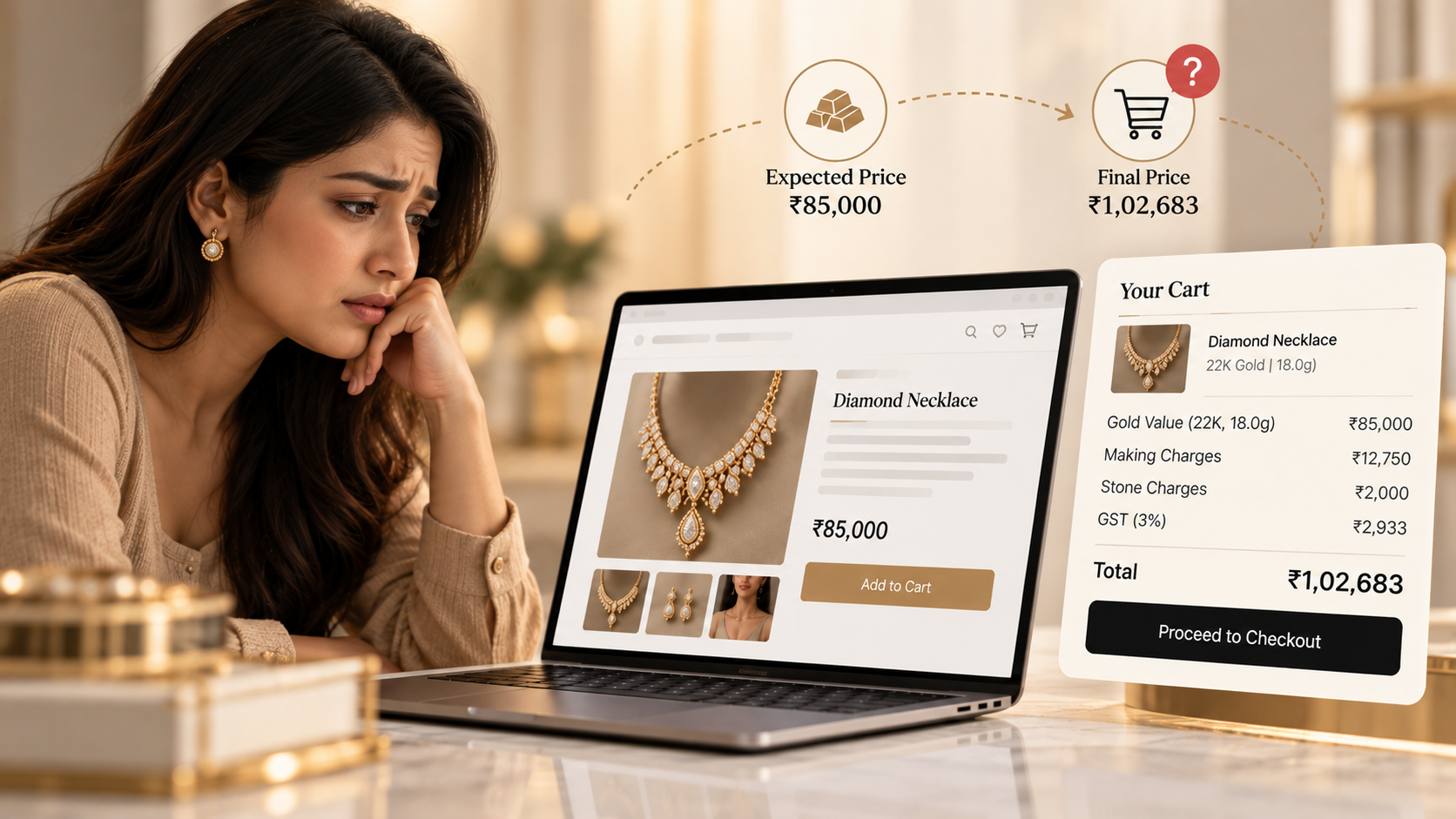
Then the cart adds a making charge she had not seen, GST on top of that, and a total several thousand rupees above the number in her head. She does not necessarily think the jewellery is overpriced. She thinks she was not told the full cost.
That is a different problem from price, and it has a different fix.
For jewellery ecommerce businesses, cart abandonment is not always a sign that customers cannot afford a product. Sometimes, it is a sign that the price they expected and the price they were asked to pay were two different numbers.
This distinction matters in a category where customers evaluate gold purity, weight, craftsmanship, stones, making charges, hallmarking and resale value before committing to a purchase. A jewellery website must do more than display attractive products. It must explain the financial decision clearly enough for customers to feel confident completing it.
The solution is not necessarily to reduce making charges or offer another discount. It is to remove the uncertainty that appears when customers discover the actual price too late.
The Moment Abandonment Actually Happens
Price sensitivity and price surprise are not the same thing.
A customer who sees a gold necklace priced at ₹85,000 and decides it is outside her budget has encountered a price objection. A customer who expects to pay ₹85,000 but discovers a final bill of ₹94,000 at checkout has encountered a price-trust problem.
The first customer may need a more affordable product, a lighter design or a different payment option. The second needs a clear explanation of the amount she is being asked to pay.
Treating both situations as a discount problem can lead jewellery retailers to reduce margins without addressing the underlying cause of abandonment.
Consider a customer browsing a gold ring online. She compares designs, checks the weight and mentally estimates the cost using the current gold rate. When she reaches the cart, she discovers that making charges, stone costs and taxes have increased the final amount beyond her expectations.
At that moment, she must reassess the purchase. She may return to the product page, compare another retailer, look for a cheaper design or leave altogether.
The additional cost is not necessarily unreasonable. The problem is that she is encountering it after she has already invested time in choosing the product.
Jewellery cart abandonment often begins before checkout, when the product page fails to establish a credible expectation of the final price.
For jewellery brands, the practical response is to measure where customers leave the buying journey and whether those exits follow a change in the displayed price.
Making Charges: The Cost That Feels Like a Fee
Making charges are one of the most important components of a jewellery purchase, yet they can be among the least understood.
Gold has a recognisable market rate. Customers can check it independently and use it to estimate the value of the metal in a piece. Making charges are different. They represent the cost of craftsmanship and manufacturing, and their calculation can vary by design, product category, production method and retailer.
Depending on the product and pricing model, making charges may be calculated as a percentage of the gold value, a rate per gram or a fixed amount. Intricate designs, detailed finishing and specialised craftsmanship can also affect the cost.
The difficulty is not that making charges exist. It is that customers may not understand what they are paying for.
When a customer sees a gold chain advertised at a price that appears closely aligned with the gold rate, an additional making charge can feel like an unexpected markup. If the website does not explain the calculation, she has little information with which to evaluate it.
A jewellery retailer can address this in three ways:
- Explain the charge: Briefly describe what making charges cover, including craftsmanship and manufacturing.
- Show the calculation: Display the applicable rate, percentage or fixed amount instead of presenting an unexplained figure.
- Make comparisons meaningful: Where relevant, help customers understand why two pieces with similar gold weights can have different prices.
For example, a lightweight, intricately designed necklace may have a different making-charge structure from a simpler necklace of comparable weight. Explaining that difference gives customers a reason to understand the price rather than assume it is arbitrary.
This does not mean every product needs a long explanation. A concise label, a visible amount and an optional information panel can provide sufficient context without interrupting the buying journey.
The objective is not to persuade every customer that every making charge is justified. It is to ensure customers can understand the price before deciding whether the product is worth it.
Showing the Breakup Before the Cart
The product page is where jewellery retailers should establish the customer's price expectations.
If the product page shows only a headline price while the cart reveals the actual components, the customer must reconstruct the cost at the point when she expects to complete the purchase.
A more transparent product page presents the available price components together.
For a gold jewellery product, the breakup may include:
- Gold weight and applicable gold rate.
- Gold value, with the calculation method explained.
- Making charges.
- Stone or diamond charges, where applicable.
- Other applicable product or service charges.
- Applicable GST.
- Final payable price.
The exact components will vary depending on the product, pricing model and applicable tax treatment. The displayed breakup should reflect the retailer's actual billing logic rather than rely on a generic calculation.
Consider an illustrative gold jewellery product:
| Price component | Amount |
|---|---|
| Gold value | ₹50,000 |
| Making charges | ₹7,500 |
| Stone charges | ₹2,000 |
| Subtotal before GST | ₹59,500 |
| Illustrative GST at 3% | ₹1,785 |
| Total payable | ₹61,285 |
Illustrative example only. Actual prices and tax treatment depend on the product, transaction and applicable rules. The example assumes 3% GST on the entire stated subtotal; retailers should apply the correct tax treatment to the actual transaction.
The advantage of this presentation is not simply that it provides more information. It allows the customer to understand the final price while she is still evaluating the product.
This also addresses a common concern among jewellery retailers: will transparency encourage customers to negotiate over making charges?
Some customers may ask questions about the breakup, but that is not necessarily a disadvantage. A question asked before the purchase gives the retailer an opportunity to explain the value. An unexplained charge discovered at checkout may instead result in a lost sale.
Transparency does not eliminate price objections. It helps distinguish genuine affordability concerns from objections caused by incomplete information.
The product page should establish the expected total. The cart should confirm it, not reveal a different financial reality.
The Gold Rate Question Customers Are Silently Asking
When customers shop for gold jewellery online, they often want to know whether the displayed price reflects the current gold rate.
This question becomes especially important when rates change frequently and customers follow the market before making a purchase.
A website that displays a gold rate without explaining its timing can create uncertainty. Is it today's rate? Was the product priced yesterday? Will the rate change when the customer reaches checkout?
Jewellery ecommerce platforms can answer these questions by making their pricing logic visible.
Useful information includes:
- The applicable gold rate.
- The date and time at which the rate was last updated.
- The purity or gold category to which the rate applies.
- Whether the product price is fixed or recalculated using a live rate.
- Whether the displayed price is indicative or the final payable amount.
A timestamp is particularly useful because it communicates when the information was last refreshed. However, a timestamp alone is not proof that the rate is live or accurate. The underlying pricing system must update the displayed information reliably.
For retailers with multiple physical stores, the pricing architecture may need to account for differences in approved rates, product availability and store-level business rules.
This is where a connected ecommerce platform becomes important. If the website, point-of-sale system and pricing engine operate on inconsistent data, the customer may see one amount online and encounter another when speaking to a store representative.
A connected system can help maintain consistent pricing rules across digital and physical channels, subject to the retailer's configuration and update processes.
For customers, the result is straightforward: fewer unanswered questions about which rate is being used and why the price is what it is.
Hallmarking, Certification and the Other Reassurance Costs
Price transparency answers one question: how much will I pay?
It does not answer every question that matters when buying jewellery online.
Customers may also want to know whether the gold is hallmarked, what purity is being offered, whether diamonds or gemstones have supporting certification, and what documentation accompanies the purchase.
When these details are difficult to find, customers must decide whether to continue buying without complete reassurance or leave the website to investigate further.
Neither outcome is ideal.
Jewellery product pages should present relevant trust information close to the product specifications and purchase controls. Depending on the product, this may include:
- Gold purity and applicable hallmarking information.
- Details of the applicable hallmark or identification marks.
- Diamond or gemstone certification, where available and relevant.
- Information about the invoice and purchase documentation.
- Warranty, repair and after-sales service terms.
- Exchange and buy-back conditions, where offered.
These details should be accurate and specific to the item being sold. Retailers should not imply that every gemstone is independently certified or that every product carries identical guarantees.
The presentation also matters. A page filled with certification logos, badges and promotional claims can become difficult to navigate.
A better approach is to show the most relevant information immediately and place supporting details behind clearly labelled links or expandable sections.
The aim is to make reassurance accessible without turning the product page into a compliance document.
Exchange and Buy-Back as a Conversion Lever
Buying jewellery is not always a final, irreversible decision in the customer's mind.
A customer may wonder whether she can exchange a piece later, upgrade to another design or receive value for the jewellery if her preferences change. These questions can influence whether she feels comfortable purchasing online.
A clear exchange or buy-back policy can reduce some of that uncertainty, provided the retailer genuinely offers the service and explains its conditions.
Yet these policies are often placed in the footer, inside a long terms-and-conditions page or behind several navigation steps.
That makes important purchase information difficult to discover at the moment it could help.
Jewellery retailers should consider presenting a short summary of the applicable policy on the product page, with a link to the full terms.
The summary should clarify relevant conditions, such as:
- Whether the product is eligible for exchange or buy-back.
- How the value is calculated.
- Whether making charges, stones or taxes are excluded from any valuation.
- Whether deductions, fees or other conditions apply.
- Whether the service is available online, in-store or both.
Exchange value should never be presented as guaranteed unless the retailer's actual policy supports that claim.
For omnichannel jewellery brands, the ability to explain these policies consistently across the website and physical stores is particularly important. A customer should not discover that the terms communicated online differ from what the store team explains later.
When customers understand their options before purchasing, they can evaluate the commitment with a clearer picture of the associated risks.
Checkout Fields That Cost You the Sale
Even after the customer accepts the price, the buying journey can introduce new obstacles.
In jewellery ecommerce, these obstacles matter because the customer may already have spent time comparing specifications, understanding the price breakup and evaluating the retailer's credibility.
A checkout process that asks for unnecessary information can undo that progress.
Common friction points include:
Mandatory account creation. Customers who want to make a single purchase may not want to create a password or complete a lengthy registration process. Guest checkout, where feasible, gives them a simpler option.
Too many address fields. Collect the information required for delivery and invoicing, but avoid asking for redundant details or requesting them earlier than necessary.
Late delivery information. Estimated delivery timelines, shipping charges and relevant delivery restrictions should be visible before the customer commits to payment.
Unclear payment options. Display supported payment methods and explain any applicable conditions before the final step.
Unexpected charges. Shipping, gift packaging or other applicable fees should not appear for the first time on the final payment screen.
Repeated price changes. If the price depends on a changing gold rate, the platform should explain when the price is confirmed and notify the customer if a material change occurs before the order is placed.
Jewellery brands should also avoid forcing customers to repeat information they have already supplied.
The goal is not to remove every checkout step. Jewellery purchases may legitimately require additional information for invoicing, delivery, compliance or fraud prevention. The goal is to ensure every requested field has a clear purpose.
A shorter checkout is useful, but a predictable checkout is just as important.
What to Measure
An overall cart-abandonment rate tells a jewellery retailer that customers are leaving. It does not explain why.
To identify the actual problem, retailers need to measure the buying journey in stages.
| Funnel stage | What to measure | What it may reveal |
|---|---|---|
| Product view | Product-page engagement and add-to-cart rate | Whether the design, product information or initial price is compelling |
| Price evaluation | Interaction with price-breakup details and changes in displayed totals | Whether customers are investigating or reacting to pricing |
| Cart view | Cart-to-checkout progression | Whether the total price, fees or delivery terms create friction |
| Checkout | Checkout initiation and step-by-step completion | Whether forms, account requirements or payment steps cause exits |
| Payment | Payment attempts and successful transactions | Whether payment failures or final-stage uncertainty prevent completion |
| Post-purchase | Cancellations, returns and support enquiries | Whether customers understood the price and product terms correctly |
These measures should be segmented where practical by device, traffic source, product category, price range and new versus returning customers.
For example, if customers frequently add products to their carts but leave immediately after viewing the final total, the retailer should investigate whether the cart introduces charges or information that were absent from the product page.
If customers reach payment but do not complete the transaction, the cause may instead involve payment failures, delivery concerns or checkout friction.
The distinction is important because the appropriate intervention depends on where the customer encounters the problem.
Retailers can also test specific changes rather than redesigning the entire website at once. A controlled experiment could compare a product page with a clearly visible price breakup against the existing presentation, measuring add-to-cart and purchase completion rates.
The experiment should track the full purchase journey, not just clicks on the price details. Greater engagement with pricing information is useful only if it helps customers make informed decisions and does not create additional friction.
The broader objective is to connect customer behaviour to a specific improvement that can be measured.
Frequently Asked Questions
Why do customers abandon jewellery carts more than other retail carts?
Jewellery purchases often involve higher financial commitments and more complex pricing than everyday retail purchases. Customers may need to evaluate gold purity, weight, making charges, taxes, certification and exchange policies before feeling confident about a transaction. Unexpected charges or unclear product information can increase hesitation, particularly when the final price differs from the amount the customer anticipated.
Should making charges be shown on the product page?
Yes. Jewellery ecommerce websites should display making charges or explain how they are calculated before customers reach the cart. Showing the charge alongside gold value, stone costs, applicable taxes and the final payable amount helps customers evaluate the complete price. Transparency may not eliminate price objections, but it can reduce confusion caused by charges revealed late in the buying journey.
Does showing the live gold rate improve jewellery conversion?
Displaying a current gold rate, its timestamp and the applicable pricing rules can help customers understand how a jewellery product is priced. However, showing a live rate alone does not guarantee higher conversion rates. The benefit depends on pricing accuracy, clear product-level calculations and consistency between the website, checkout and physical stores.
How detailed should a jewellery price breakup be online?
A jewellery price breakup should provide enough detail for customers to understand the final amount without overwhelming the product page. Depending on the item, this generally includes gold weight and value, making charges, stone charges, other applicable charges, GST and the total payable. An expandable explanation can provide further calculation details while keeping the main buying experience clear and uncluttered.