

Your franchise is not a separate business. Your systems think it is.
Franchise showrooms need their own accounts and their own margins, but the brand needs one view of stock and one customer record. Where the line should sit.
A franchise partner owns their stock, their margin and their P&L. That is the arrangement, and it is not negotiable.
But the customer who walks into their showroom believes she is walking into your brand. She expects the piece she saw on your website to be findable, the price to be the price, and the purchase she made in another city to be known here.
Both of those things are true at once, and most systems can only express one of them.
This is where jewellery franchise operations become complicated. The brand needs visibility across its retail network, but a franchise partner needs control over their own commercial operations. One needs a unified customer experience; the other needs clearly defined ownership of inventory, revenue, and local decisions.
The answer is not to centralise everything. Nor is it to let every outlet operate as an isolated business.
The challenge is to build a connected jewellery retail system that understands the difference between seeing something, controlling it, and owning it.
That distinction should shape how franchise jewellery inventory software is designed, how data moves between stores, and what the brand and its partners agree to before the first sale.
What the franchise partner legitimately owns
A franchise model works because the partner operates a business under an established brand rather than simply managing another company-owned outlet.
That commercial independence must be reflected in the technology.
Stock ownership
If a franchise partner purchases jewellery inventory and carries the associated commercial risk, the system must identify that inventory as belonging to the partner's business.
The brand may need to know that a particular necklace is available at the partner's showroom. That does not automatically give the brand ownership of the necklace or the right to sell it without authorisation.
A useful system records the relevant details separately:
- The product and its identifying attributes.
- The physical location where it is held.
- The legal or commercial entity that owns it.
- Its availability and reservation status.
- Any restrictions on its sale or transfer.
This allows the brand to improve stock visibility without confusing visibility with ownership.
Local margins and profit and loss
A franchise partner needs accurate records of their own sales, costs, returns, discounts, and other relevant financial transactions.
The partner's P&L should reflect the commercial arrangement under which the store operates. The central brand may require reporting for franchise oversight, but that does not mean every internal financial record should automatically be accessible to every other outlet.
The system should distinguish between the information needed for brand-level reporting and the information that belongs to the individual franchise business.
Staff and day-to-day operations
The partner may be responsible for hiring staff, assigning store-level permissions, managing daily activities, and following local operating procedures.
The brand can define minimum operational standards, such as approved product information, billing processes, and inventory controls. Within those boundaries, the partner needs the ability to run the showroom.
Good franchise technology supports independent operations within agreed rules. It does not confuse central oversight with central ownership.
What the brand cannot give up
Although franchise partners operate their own businesses, the brand still has assets and responsibilities that extend across the network.
Some information must remain consistent if the customer is to experience one recognisable jewellery brand.
The product catalogue
A brand should not have to maintain an entirely different product identity at every outlet.
Product names, design identifiers, images, descriptions, purity specifications, and other approved product attributes should follow a common structure. Individual stores can maintain their own stock records against that shared catalogue.
This matters when a customer searches online for a particular design and wants to locate it at a franchise store.
If the website calls the item one thing and the store uses a different product identifier, the business may struggle to connect the customer's request with the actual piece.
A shared catalogue establishes a common product language without requiring every outlet to own the same inventory.
Brand-level pricing rules
Jewellery pricing can involve gold rates, purity, net weight, stone value, making charges, taxes, and authorised discounts.
The brand needs a defined framework for how these elements are calculated and presented. Franchise partners may have agreed flexibility, but the boundaries should be explicit.
Without a common pricing framework, the same design can produce inconsistent quotations across stores or channels.
The goal is not necessarily identical final prices in every circumstance. It is consistent application of the agreed rules, including documented exceptions.
Customer identity and brand continuity
A customer who purchases jewellery in Jaipur may later visit the same brand in Delhi. She should not have to explain her entire purchase history if the business has an appropriate way to recognise her and access authorised records.
The brand therefore needs a customer identity and relationship model that can support cross-store service.
However, customer identity is not the same as unrestricted access to personal information. Access must be consistent with the business arrangement, the customer's expectations, applicable privacy requirements, and the purposes for which information was collected.
Brand-wide reporting
The brand needs to understand performance across the franchise network.
That might include product demand, inventory availability, sell-through, ageing stock, order fulfilment, and store-level sales.
These reports support decisions about product allocation, marketing, expansion, and operational improvements.
The brand should not need to take ownership of every franchise transaction simply to understand what is happening across the network.
Where most systems force a bad choice
Many retail architectures begin with one of two assumptions: every store belongs to one organisation, or every store should operate independently.
Franchise networks fit neatly into neither model.
Failure mode one: one database, no meaningful separation
A shared database can provide a common view of products and transactions. But if the application does not distinguish between ownership, permissions, and commercial entities, it can expose information to the wrong people or allow unauthorised actions.
A franchise manager might see another partner's sales details. A store could potentially initiate a transaction against stock it does not own. Reports might combine company-owned and franchise-owned inventory without distinguishing the underlying businesses.
The issue is not that shared databases are inherently unsuitable. It is that shared infrastructure without proper access controls and ownership rules creates unnecessary risk.
Failure mode two: separate installations, no useful visibility
At the other extreme, every franchise store operates a completely separate system.
This protects local operations from other outlets, but creates another set of problems. Product information can drift, inventory becomes difficult to locate across stores, and head office may rely on spreadsheets or manual reports.
Cross-store orders become dependent on phone calls. Online availability becomes harder to maintain. A customer transaction in one city may not be visible to an authorised service team in another.
The business has preserved separation at the cost of coordination.
The architectural problem
Neither extreme addresses the central requirement: the brand needs a connected operational view while each franchise partner retains defined commercial rights.
A better architecture starts by defining what each business owns, what it can access, what it can change, and which actions require approval.
Only then should the technology determine how databases, APIs, integrations, and reporting layers support those rules.
Visibility without ownership
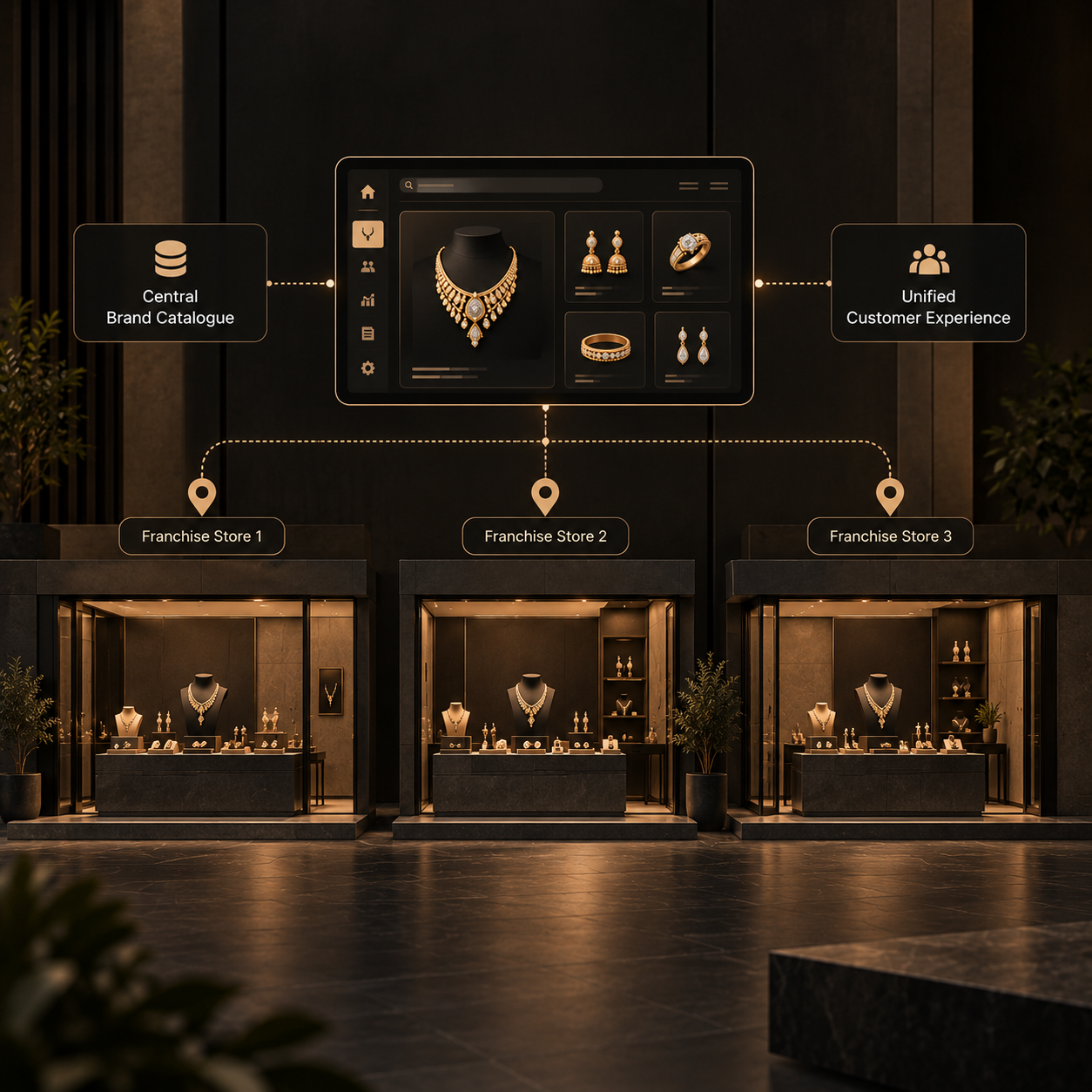
The architectural answer is to separate the record of an item from the rights associated with that item.
In a well-designed system, a jewellery piece can be visible to authorised users across the network while remaining commercially owned by one particular entity.
This can be implemented using a shared inventory service, a centralised ledger, or another architecture that maintains consistent ownership and transaction records. The important part is the data model and its enforcement, not whether the system uses one physical database or several.
Give every stock record an ownership identity
An inventory record should be able to distinguish between:
- The product or individual jewellery piece.
- The store or location holding it.
- The entity that owns it.
- Its current availability and reservation status.
- The transactions that have changed its state.
- The users and systems authorised to act on it.
For example, a diamond ring might be held at Franchise Store A but visible to the brand's central ecommerce team.
The website can display that the ring is available for a customer enquiry or eligible order. However, the order workflow must respect the franchise agreement and the store's authority to release the item.
The brand can see the stock without treating it as company-owned inventory.
Separate permissions from ownership
A user may be allowed to view an item without being allowed to reserve, transfer, discount, or sell it.
Likewise, head office may be allowed to view consolidated inventory reports without being permitted to alter every store's financial records.
Permissions should be defined by role, location, entity, and action. Sensitive operations should have appropriate approval and audit requirements.
Maintain a traceable inventory history
Inventory changes should be recorded as identifiable events rather than unexplained updates to a quantity.
A sale, return, transfer, reservation, or stock adjustment should have a corresponding record and an appropriate business context.
This is particularly valuable when a franchise partner and the brand need to reconcile a transaction or investigate a discrepancy.
The result is a connected inventory network where visibility is broad enough to support customers and operations, while ownership and authority remain clearly defined.
The customer record across franchise boundaries
Consider a customer who buys a gold necklace from a franchise store in Mumbai and later visits a company-owned store in Bengaluru.
She wants assistance with the purchase, perhaps to review its details or ask about an applicable service.
The company-owned store needs enough information to help her. But which business is responsible for the customer relationship, and what information may the second store access?
There is no universal answer that applies to every franchise agreement. The system must support the model the brand and its partners have agreed to.
Recognise the customer without exposing everything
A central customer identity can help connect authorised interactions across locations. The system might recognise that two transactions belong to the same customer while controlling which store employees can view the details of each transaction.
For example, an employee may need to verify the purchase date and item details to assist with a service request. They may not need access to the customer's entire transaction history or unrelated personal information.
The data model should distinguish between customer identity, transaction ownership, service permissions, and marketing permissions.
Define the relationship contractually
Before implementation, the brand and franchise partner should establish:
- Which entity collects and maintains customer information.
- The purpose for which customer information may be used.
- Which entities can access customer profiles and transaction records.
- Whether cross-store service is permitted and under what conditions.
- Who handles customer requests, corrections, and complaints.
- Which marketing communications are permitted.
- How information is protected when the franchise relationship ends.
These arrangements should be reviewed against applicable privacy and data-protection requirements, including India's Digital Personal Data Protection framework where relevant.
Simply storing every customer record in a central CRM does not resolve the legal or commercial questions surrounding access and use.
A unified customer experience requires coordinated identity and service processes, not unrestricted sharing of personal data.
Settlement when a sale crosses stores
Now consider a more complicated situation.
A customer visits the brand's ecommerce website and orders a necklace. The website identifies that the item is available at Franchise Store A, but the order is placed through the brand's online channel.
Who receives the revenue? Who pays for fulfilment? Which entity records the sale? What happens if the customer returns the item?
These are commercial questions as much as technical ones.
Separate the order channel from the stock owner
The website being the sales channel does not automatically determine who owns the inventory or which entity should receive the commercial proceeds.
The system needs to record the order, the stock owner, the fulfilment location, the selling entity, and the applicable commercial agreement.
Those fields allow the business to determine how the transaction should be accounted for and settled.
Define the settlement model
Depending on the agreement, the transaction might involve:
- A commission or fulfilment fee paid to the franchise partner.
- A wholesale or inter-entity stock transaction.
- A referral arrangement for a store-generated sale.
- Another agreed allocation of revenue, costs, and margin.
These models are not interchangeable. The correct treatment depends on the actual contractual arrangement and applicable accounting and tax requirements.
The software should implement the agreed model rather than assume that every cross-store transaction follows the same formula.
Handle returns and adjustments consistently
A complete settlement workflow must also account for cancellations, refunds, returns, discounts, shipping costs, and disputes.
For example, if a customer returns a necklace that was originally owned by Franchise Store A, the system needs to establish where the item goes, which inventory balance changes, and how the original settlement is adjusted.
A reliable workflow records the original transaction and its subsequent adjustments, preserving a traceable history.
This prevents the brand and franchise partner from having to reconstruct commercial events manually at the end of the month.
Pricing autonomy inside brand rules
Jewellery pricing is particularly sensitive because the final price may depend on changing metal rates, product characteristics, store policies, and negotiated commercial terms.
A franchise partner may need some flexibility in how they sell. The brand, meanwhile, needs to protect its pricing methodology and customer experience.
The system should distinguish between the pricing formula and the permissions to modify its inputs or outputs.
Centralise the rules, define the exceptions
The brand can configure approved pricing components, such as:
- Applicable gold-rate sources and effective times.
- Purity and weight calculations.
- Making-charge rules.
- Stone-value treatment.
- Applicable taxes and charges.
- Discount limits and approval thresholds.
- Rules for promotional pricing.
The partner's authorised flexibility should be defined explicitly. For instance, a discount beyond an agreed threshold may require approval from a designated manager.
The system should record the calculated price, any permitted modification, and the approval where required.
Make pricing consistent across channels
The ecommerce website, POS, and relevant customer-facing tools should use compatible pricing logic.
If a customer receives an online quotation and visits a franchise store, the business should be able to explain any difference through a defined rule rather than an unexplained discrepancy.
Rate changes also need careful handling. The system should establish when a rate becomes effective and how existing quotations, reservations, and orders are treated.
The specific rules depend on the brand's policies and commercial agreements. The technology's role is to apply those rules reliably and retain an audit trail.
How Jewelstack fits into a connected franchise architecture
For jewellery brands operating company-owned stores, franchise outlets, and ecommerce, the challenge is not simply implementing another POS or inventory application.
It is ensuring that the systems supporting those channels represent the business accurately.
Jewelstack focuses on jewellery commerce and connected retail operations. For a brand planning or improving a franchise network, the technology discussion should begin with the existing inventory model, POS and ecommerce integrations, pricing workflows, and the commercial boundaries between entities.
From there, the business can identify which records should be shared, which actions require authorisation, and how cross-store transactions should be recorded and reconciled.
The resulting architecture may use a common inventory service, connected systems, or a hybrid design. The right approach depends on the brand's existing infrastructure and operational requirements.
What matters is that the platform can represent three things separately:
- Ownership: Which business owns the inventory, transaction, or commercial interest?
- Visibility: Which people and systems may view the information?
- Authority: Which people and systems may change records or initiate actions?
When those distinctions are built into the operating model, a brand can improve network-wide coordination without erasing franchise autonomy.
Frequently asked questions
Should franchise jewellery stores use the brand's inventory system?
Franchise jewellery stores can use a shared brand inventory system if it supports store-level permissions, clear ownership records, and the commercial terms of the franchise agreement. The system should provide the brand with appropriate visibility while allowing each partner to manage its own inventory and authorised operations.
Who owns customer data in a jewellery franchise?
Customer data responsibilities depend on the franchise agreement, the actual processing arrangements, and applicable privacy law. The brand and franchise partner should document who determines how the information is used, who can access it, and how customer requests and marketing permissions are handled. Central storage alone does not determine legal ownership or grant unrestricted access.
How are margins settled when a franchise piece sells on the brand website?
The settlement depends on the agreed commercial model, including stock ownership, the selling entity, fulfilment responsibilities, and any applicable commission or fees. The system should record the order, inventory owner, fulfilment location, and settlement adjustments so both parties can reconcile the transaction. The contract and accounting treatment should determine the actual allocation of revenue and margin.
Can franchise partners set their own jewellery prices?
Franchise partners can have pricing flexibility where the franchise agreement and applicable law permit it. The brand may establish approved pricing formulas, discount thresholds, and authorisation requirements, with the system enforcing those rules and recording exceptions. The exact balance between central controls and local discretion should be agreed before implementation.
Conclusion: One brand does not mean one owner
A franchise jewellery network contains businesses with different commercial responsibilities, even when customers experience them as one brand.
The technology should reflect that reality.
A franchise partner should be able to own inventory, manage local operations, and maintain its agreed financial independence. The brand should be able to maintain product consistency, coordinate customer service, apply agreed pricing rules, and understand performance across the network.
Neither objective requires the other to disappear.
The right franchise jewellery inventory software separates ownership from visibility, permissions from access, and order channels from commercial settlement. It gives each party the information and control it needs while making cross-store operations possible.
The real goal is not to make every franchise store one business. It is to make every store part of one connected retail experience, with ownership and accountability clearly defined.