
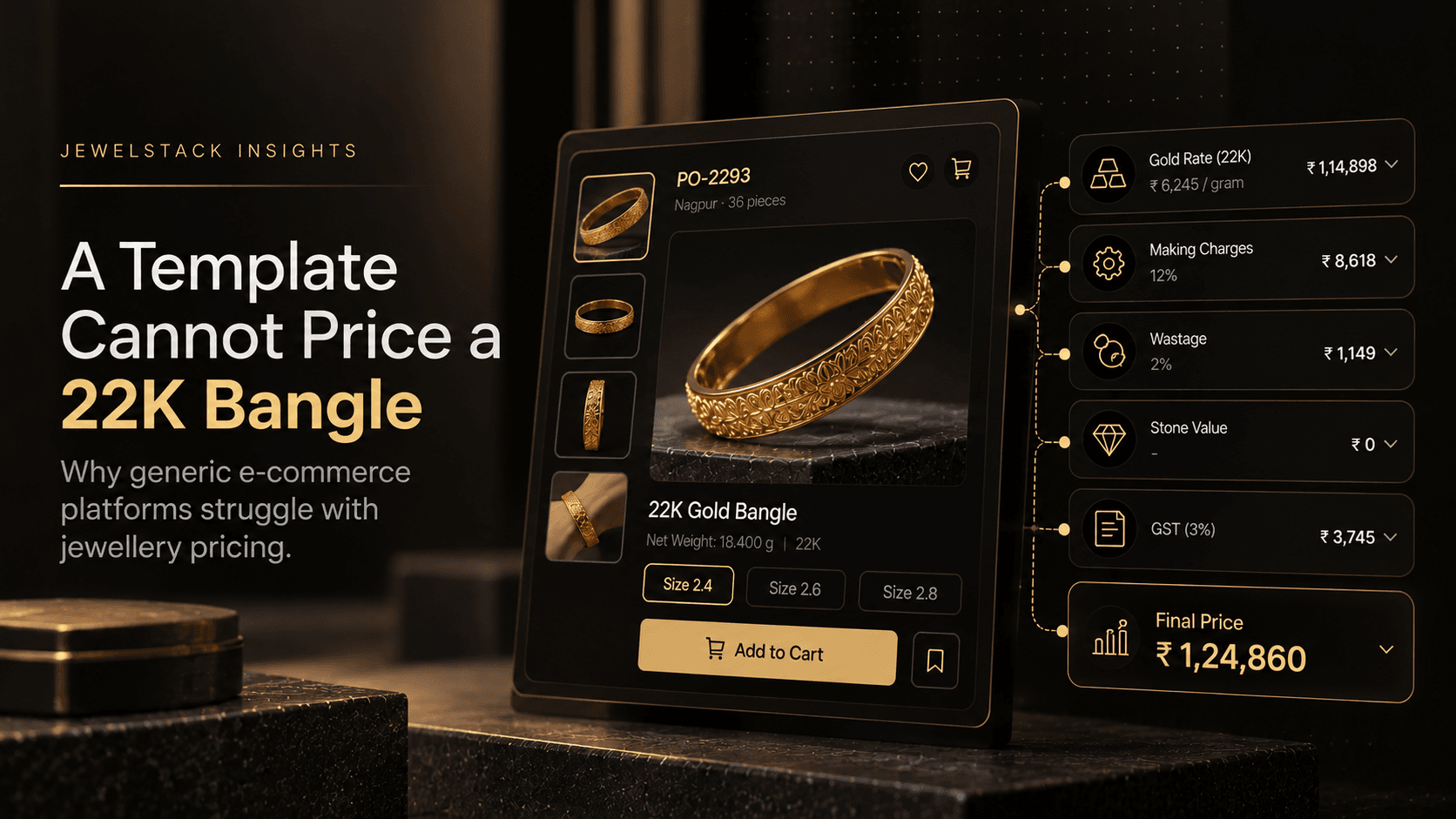
A template cannot price a 22K bangle
A 22K bangle is priced by weight, gold rate, making charges and stones. Why generic templates break on jewellery pricing, and when to go custom.
A jewellery website can look premium, load quickly and display beautiful product photography. But if it cannot calculate the correct price of a 22K gold bangle when the gold rate changes, the design is not the real problem. The underlying commerce system is.
Unlike many conventional retail products, jewellery is not always sold at a fixed price.
The price of a gold bangle may depend on its net weight, gold purity, current metal rate, making charges, wastage, stone value and applicable taxes. Change one of these inputs, and the final selling price may need to change too.
For a jewellery brand selling hundreds or thousands of products online, maintaining these calculations manually can become difficult to manage.
This is where the difference between a generic ecommerce template and a jewellery-focused commerce platform becomes important.
A jewellery website should do more than display products. It should understand how those products are priced, configured and sold.
Why Generic Ecommerce Templates Can Fall Short for Jewellery
Generic ecommerce platforms are designed to support many products, from clothing and electronics to home accessories and beauty products.
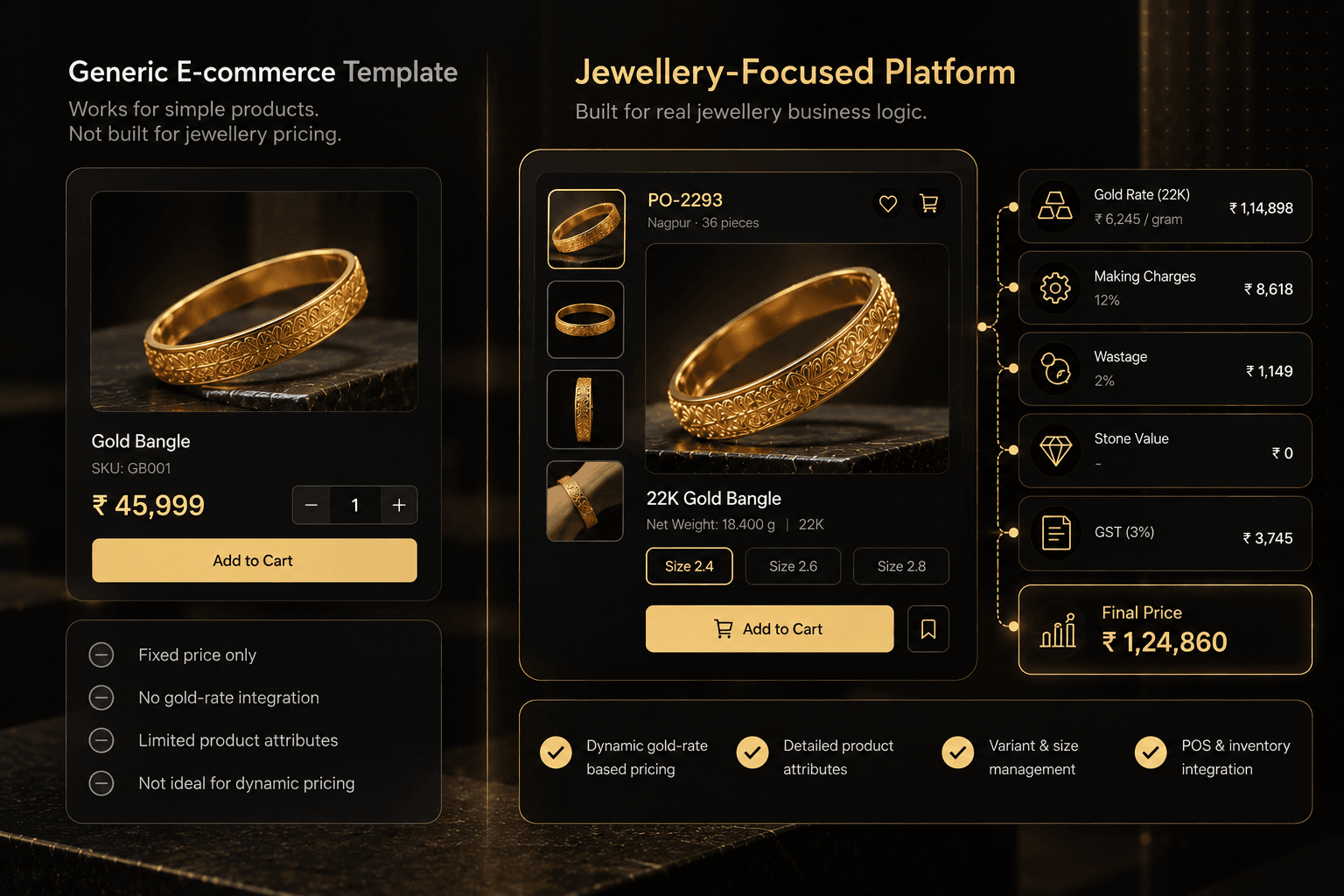
Their standard product models often revolve around a familiar structure: product name, SKU, variant, quantity, price and stock availability.
That structure works well for many businesses. Jewellery, however, can require additional product attributes and pricing rules that are not naturally represented by a single fixed-price field.
Consider a 22K gold bangle.
Its selling price might depend on:
- Net gold weight
- Applicable 22K gold rate
- Making charges
- Wastage or other retailer-defined charges
- Diamond, gemstone or other material value, where applicable
- Discounts and applicable taxes
A conventional template may display the final price perfectly well once someone enters it. The challenge is calculating, updating and maintaining that price correctly across the catalogue.
Some generic platforms can support jewellery pricing through plugins, custom code or third-party integrations. The limitation is not that every template is incapable of selling jewellery. It is that the required functionality may not be available natively and can require additional engineering, configuration and ongoing maintenance.
For a growing jewellery brand, that distinction matters.
A Jewellery Price Is a Calculation, Not Just a Number
Imagine a customer browsing a 22K gold bangle on your website.
The product has a net gold weight of 18 grams. Your business maintains a gold rate for 22K jewellery, applies a making charge and calculates any other applicable charges according to its pricing policy.
The final price must reflect the correct inputs and the rules your business follows.
When the applicable gold rate changes, the price may need to be recalculated. If the making charge differs by design, that rule must also be applied correctly.
The same logic becomes more involved when a catalogue includes:
- 18K, 22K and 24K gold products
- Different weights and product variants
- Diamond and gemstone jewellery
- Different making-charge structures
- Product-specific wastage or other charges
- Fixed-price fashion jewellery alongside weight-based products
A jewellery commerce system should be able to represent these differences without forcing the team to maintain every selling price as an isolated manual entry.
The exact calculation depends on the retailer's commercial rules. The technology should support those rules rather than assume that every product follows the same formula.
What Happens When the Gold Rate Changes?
Gold-rate changes illustrate why jewellery pricing requires more than a static product catalogue.
Suppose your team maintains hundreds of gold jewellery products on an online store. If the applicable rate changes, someone may need to review or update a large number of product prices.
Manual updates introduce several risks:
Delayed price updates: Some product pages may continue displaying an older price while others have already been updated.
Inconsistent calculations: Different employees may apply making charges, wastage or rounding rules differently.
Catalogue maintenance overhead: Repricing a large product catalogue can consume time that could be spent on merchandising and customer experience.
Reduced pricing transparency: Customers and sales teams may find it difficult to understand how a displayed price was calculated.
A properly designed jewellery pricing engine can store the relevant inputs and rules separately, recalculate affected products when those inputs change, and publish updated prices according to the retailer's approval and publishing workflow.
This does not mean every price must automatically change the moment a metal rate changes. Some retailers may require approval, scheduled updates or product-specific exceptions.
The important point is that the system should make pricing consistent, explainable and manageable.
Custom Jewellery Website vs. Ecommerce Template: What Is the Difference?
The right choice depends on the complexity of your business, not simply on whether your brand wants a premium-looking website.
A template may be entirely suitable for a jewellery retailer with a relatively small catalogue, manually maintained prices and straightforward product variants.
A custom or extended commerce solution becomes more relevant when pricing, product configuration, integrations and operational workflows exceed what the standard setup handles efficiently.
1. Product and Variant Management
A template typically provides standard product fields and variant options.
A jewellery-focused implementation may need to represent gold purity, net and gross weight, stone specifications, design codes, certificates and other product-specific attributes.
The system should distinguish between a design with several variants and a unique physical piece with its own inventory identity.
2. Dynamic Jewellery Pricing
A basic store can display a price entered by the merchant.
A more advanced jewellery commerce system can calculate prices from structured inputs and configurable rules, where supported by the platform or its integrations.
Depending on the retailer's requirements, these inputs may include metal rates, weight, purity, making charges, wastage, stone value and applicable taxes.
The goal is to avoid treating every product price as a disconnected number that must be maintained independently.
3. Product Configuration
Some jewellery brands sell standard catalogue products. Others allow customers to choose a metal colour, diamond specification, ring size or other configuration.
When product options affect price, availability or fulfilment, the commerce system must represent those relationships correctly.
A simple variant selector may be enough for one business. Another may require custom product configurators and pricing logic.
4. POS, Inventory and ERP Integration
For brands with physical showrooms, the website may need to connect with an existing POS, ERP or inventory management system.
That connection can synchronise relevant product data, sales, stock availability and other business information, depending on the integration.
Without a clearly defined architecture, a custom-looking website can still operate as a disconnected channel.
5. Long-Term Flexibility
A template can reduce initial development effort and help a business launch quickly.
However, a business with complex pricing rules, multiple stores, bespoke integrations or evolving product workflows may eventually need extensive customisation.
The decision should consider the initial cost, ongoing maintenance, integration complexity, ownership of business logic and the effort required to introduce future changes.
When Is a Template Enough for a Jewellery Brand?
A template-based ecommerce website may be a sensible choice if:
- Your catalogue is relatively small and straightforward.
- Product prices are mostly fixed and manually maintained.
- Product variants do not require complex calculations.
- Your existing POS and inventory systems do not need deep integration.
- Your immediate priority is launching a digital storefront quickly.
A template is not inherently a poor choice. It can be an effective starting point when its capabilities match the business requirements.
Before selecting one, verify whether essential features are native, available through reliable extensions or dependent on custom development.
The goal is to avoid paying for unnecessary complexity while ensuring that critical business rules are handled correctly.
When Should You Consider a Custom Jewellery Ecommerce Platform?
A custom or extensively extended solution deserves serious consideration when the website must support more sophisticated jewellery-specific workflows.
Dynamic pricing across a large catalogue
If product prices depend on metal rates, weight, purity, making charges or other configurable inputs, the platform should support the required calculations and repricing workflow.
Complex diamond and gemstone catalogues
If products require detailed grading information, certificates, stone attributes or configuration-dependent pricing, a standard product model may require significant extension.
Multiple showrooms and sales channels
If the website must coordinate with multiple stores, POS systems or an ERP, the integration architecture becomes an important part of the decision.
Custom customer journeys
Some jewellery brands need appointment booking, store-specific availability, bespoke orders, product customisation or other experiences beyond standard add-to-cart and checkout workflows.
Business-specific integrations
If your business depends on existing pricing engines, inventory systems, customer platforms or other internal software, the solution must support those dependencies reliably.
In these cases, custom development can provide greater control over business logic and integration design. It also brings responsibility for testing, maintenance, security and future upgrades.
The best solution is the one that fits the actual complexity of your business, rather than the one with the longest feature list.
What Should a Jewellery Brand Evaluate Before Choosing a Platform?
Before committing to a template or a custom build, evaluate the following areas.
Pricing accuracy: Can the system represent your actual jewellery pricing rules, including product-specific exceptions?
Rate updates: How are gold rates updated, and what triggers product-price recalculation?
Approval and publishing: Can the team review changes before new prices become visible to customers?
Product data: Does the catalogue support the jewellery-specific attributes your team needs?
Inventory integration: Can the platform communicate with your existing POS, ERP and stock management systems?
Performance and scalability: Can it handle your catalogue size, product images, traffic and transaction requirements?
Maintenance and ownership: Who will maintain integrations, pricing rules and custom functionality when your business changes?
Total cost of ownership: What will the solution cost to build, operate, extend and maintain over time?
A lower initial development cost does not automatically mean a lower long-term cost. Equally, a custom platform is not automatically better value than a well-configured template.
A requirements-led evaluation helps you make the right decision.
How Jewelstack Approaches Jewellery Commerce
Jewelstack focuses on technology for jewellery retailers, including digital commerce and connected jewellery business workflows.
For a brand evaluating its next ecommerce platform, the starting point should be how the business actually operates.
How are product prices calculated? Which system owns the gold-rate inputs? How are product variants represented? Does the website need to connect with an existing POS or ERP? Which parts of the customer journey need to be customised?
These questions help determine whether a template, an extended platform or a custom-built solution is the most appropriate fit.
The objective is to build a digital storefront that supports the retailer's product catalogue and commercial rules, rather than forcing the business to work around the limitations of its technology.
Explore Jewelstack to learn more about jewellery technology solutions and discuss your ecommerce requirements with the team.
The Right Jewellery Website Starts With the Right Commerce Logic
A premium jewellery website should offer more than attractive photography, elegant typography and a smooth checkout experience.
It should represent products accurately, apply the retailer's pricing rules consistently and support the operational workflows behind every transaction.
For some jewellery brands, a template will provide everything they need. For others, dynamic pricing, complex product configurations and multi-system integrations will justify a more customised approach.
The important decision is not whether templates are good or bad. It is whether the technology can handle the way your jewellery business sells.
A 22K bangle is not just another product in a catalogue. Its price reflects the materials, calculations and business rules behind it. Your ecommerce platform should be capable of handling that complexity.
Frequently Asked Questions
Can a template-based website sell gold jewellery?
Yes. A template can display and sell gold jewellery, especially when products have fixed, manually maintained prices. Dynamic pricing may require suitable plugins, integrations or custom development.
Can Shopify or another generic ecommerce platform support live gold pricing?
Depending on the platform, extensions and available integrations, live or rate-based jewellery pricing may be possible. Verify how the solution calculates prices, updates product variants and handles exceptions before choosing it.
What is dynamic pricing in jewellery ecommerce?
Dynamic pricing uses defined inputs and business rules to calculate or update product prices. These inputs may include metal rates, weight, purity, making charges, wastage, stone value and applicable taxes.
When should a jewellery brand choose a custom website?
Custom development may be appropriate when the business requires complex pricing logic, specialised product configuration, multi-store integration or customer workflows that standard platform features cannot adequately support.
Is a custom jewellery website always better than a template?
No. A template can be the better choice for a business with straightforward requirements. Custom development becomes more attractive when the additional flexibility and integration capabilities justify the higher implementation and maintenance responsibilities.
What is the most important feature of a jewellery ecommerce platform?
There is no single feature for every business. However, accurate product representation, reliable pricing, inventory consistency, secure checkout and compatibility with existing systems are important considerations when evaluating a platform.