
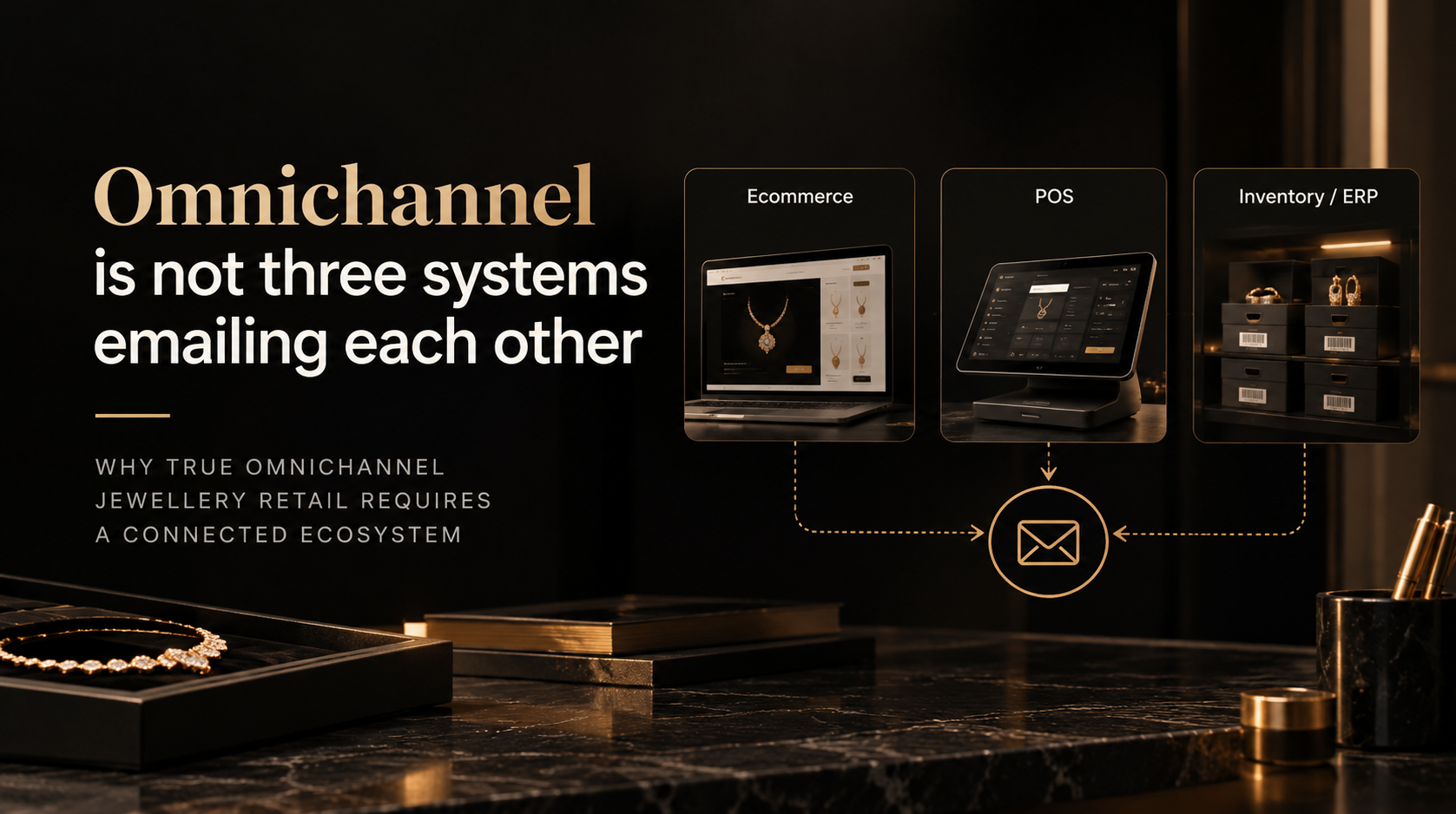
Omnichannel is not three systems emailing each other
Most jewellery brands calling themselves omnichannel are running multichannel with a nightly export. The difference, and why it decides what a customer can.
Most jewellery brands that describe themselves as omnichannel are running multichannel with a nightly export. The showroom has its system. The website has its own. A file moves between them at two in the morning, and for the remaining twenty-two hours each one believes something slightly different about the same piece of stock.
That distinction sounds academic until a customer asks a question neither system can answer: can I see this ring in your Bandra store on Saturday? Multichannel can tell her what was true at 2 a.m. Omnichannel can tell her what is true now.
For jewellery retailers, the difference affects more than website availability. It influences how stores fulfil orders, how prices remain consistent, how customer relationships move between channels, and how confidently the business can make decisions.
Omnichannel jewellery retail is not about connecting three systems. It is about making every channel operate from consistent business information.
Multichannel: more than one place to buy
Multichannel retail means giving customers multiple ways to discover and purchase jewellery. A brand might operate an ecommerce website, a network of showrooms, a mobile application, and social commerce channels.
Each channel can serve its purpose without being fully connected to the others.
The website maintains an online product catalogue. Showrooms manage physical stock through their POS or inventory software. Customer enquiries may sit in a CRM, an email inbox, or a WhatsApp conversation. Data moves between these systems through scheduled exports, manual updates, or separate integrations.
This is a legitimate stage in a retailer's digital development. A business can start with independent channels, learn how customers use them, and expand its digital operations gradually.
The limitation appears when customers and transactions move between channels.
Consider a necklace with a single available unit. The showroom sells it at 11 a.m., but the website receives its next inventory update overnight. Until that update arrives, the website may continue accepting orders for a product that is no longer available.
The reverse can happen, too. A customer reserves a ring online, but the showroom's system does not recognise the reservation. A sales associate sees the piece as available and sells it to someone else.
Neither channel necessarily has a malfunctioning interface. Each is working with the information available to it.
That is the defining weakness of disconnected multichannel retail: every channel can operate correctly in isolation while the overall business produces an incorrect result.
Omnichannel: one business the customer meets in several places
Omnichannel retail takes a different approach. Instead of treating every channel as an independent operation, it coordinates them through shared business data, clear rules, and connected workflows.
For a jewellery retailer, this means building consistency around three particularly important areas: stock, customer information, and pricing.
One inventory view. A showroom sale, online order, reservation, or stock transfer should update the appropriate inventory records and the availability presented to other channels. The system must account for reservations and competing transactions, not merely copy quantities between databases.
One connected customer record. A customer who enquires online and visits a showroom should not have to explain the same requirement from the beginning. Subject to appropriate identity matching and permissions, the sales team should be able to access relevant enquiries, preferences, and purchase history.
Consistent pricing rules. A product's displayed price should follow the retailer's defined pricing logic, whether the customer is browsing online or speaking with a sales associate. For jewellery, this may involve gold rates, purity, metal weight, making charges, stone values, and applicable taxes.
This does not mean that every business must replace its existing POS, ERP, ecommerce platform, or CRM with a single application.
The channels can remain separate applications. What changes is how they obtain information, process transactions, and respond to business events.
The website becomes a view into the wider retail operation. The showroom becomes another. Neither should independently invent the current state of the business.
The test that settles which one you are running
A jewellery retailer does not need an architecture review to begin identifying the gap between multichannel and omnichannel operations. Four practical questions can reveal a great deal.
1. Can a store sell a piece that has been reserved online?
If the showroom POS cannot recognise an active reservation, the business needs a clear reservation and inventory-control mechanism. A connected system should prevent conflicting commitments or flag them before the sale is completed.
2. Does a showroom purchase appear in the customer's web account?
If online and offline purchases remain isolated, the retailer lacks continuity in its customer experience. Connected order records and reliable customer matching can help bring the purchase history together.
3. Does a gold-rate change reach both channels consistently?
If the website and showroom use different pricing inputs or update schedules, they may show different prices for the same item. The retailer needs defined pricing ownership and a controlled process for publishing updates.
4. Can anyone see stock across every store and the online channel in one place?
If employees must message store managers or open multiple systems to find a product, inventory visibility remains fragmented. A consolidated view should show availability by location and account for reservations, transfers, and other relevant stock states.
A retailer that answers no to several of these questions may have multiple sales channels, but it has not yet achieved the level of operational coordination customers expect from omnichannel retail.
The goal is not to achieve a perfect score on a checklist. It is to identify which disconnected workflows create the greatest risk and address those first.
Why a nightly sync is not a small gap
A nightly inventory export can be useful when a retailer is starting out. It is relatively straightforward to implement, and it may be sufficient for products whose availability rarely changes.
Jewellery retail, however, can involve high-value products, unique pieces, store-level stock, reservations, and prices that change during the business day. In those conditions, the time between updates matters.
Imagine that the website receives its last inventory update at 2 a.m. The showroom sells a ring at 10 a.m. If the next scheduled update arrives at 2 a.m. the following day, the website could be working with a stock position that is almost a full day old.
The disagreement window is determined by the actual sync schedule and the time of the transaction. In this example, a sale at 10 a.m. leaves a potential sixteen-hour gap before the next scheduled update. The precise exposure depends on how the integration handles intervening updates, orders, and reservations.
Within that window, several things can happen:
- An online customer may attempt to purchase an item already sold in-store.
- A showroom employee may promise an item that has been reserved online.
- Customer support may quote availability based on an outdated stock record.
- Store teams may spend time checking physical inventory to resolve uncertainty.
- Reports may show different stock positions depending on which system is consulted.
Pricing introduces another dimension. If the retailer's pricing rules depend on changing gold rates, the business must ensure that updates are applied consistently across the website and POS. A nightly file alone cannot guarantee that both channels are using the same current inputs.
The answer is not simply to run the export every hour instead of every night. More frequent batch processing reduces the potential delay but does not eliminate conflicts between transactions.
A stronger design combines timely updates with clear data ownership, reservation rules, transaction handling, error recovery, and reconciliation.
For unique or high-value jewellery, availability should be treated as a business decision backed by reliable stock information, not just a quantity copied from another system.
The integration tax
Connecting two systems can be manageable. Connecting five or six systems through separate, direct integrations can create a much more complicated operating environment.
Suppose a retailer has an ecommerce platform, POS, ERP, CRM, and inventory application. Each system may need to exchange information with several others.
If every system connects directly to every other system, the number of potential pairwise connections grows rapidly. With five systems, a fully connected arrangement could involve ten unique system pairs. With eight systems, that number rises to twenty-eight.
The calculation follows the formula (n(n-1)/2), where (n) is the number of systems. These are illustrative counts for a fully connected arrangement, not a claim that every pair requires a separate connector in a well-designed retail architecture.
The problem is not the mathematics alone. Every integration creates something that must be documented, tested, monitored, secured, and maintained.
A POS update may require changes to an ecommerce connector. An ERP upgrade may affect stock feeds, order processing, and reports. Different integrations may handle retries, validation, and failures in different ways.
As the retailer adds stores, sales channels, or business applications, the cost of maintaining these dependencies can increase.
A more maintainable architecture establishes clear integration boundaries. Systems communicate through documented interfaces, shared services, or an integration layer where appropriate. Business events follow agreed formats, and failures can be traced without investigating every application independently.
This does not mean an integration layer automatically solves every problem. Poorly designed central services can become bottlenecks, and additional infrastructure introduces its own operational responsibilities.
The objective is to reduce unnecessary dependencies and make the relationships between systems easier to understand, test, and change.
What omnichannel actually requires underneath
A reliable omnichannel architecture starts with a simple principle: every important business fact needs a defined source of truth or an explicit ownership policy.
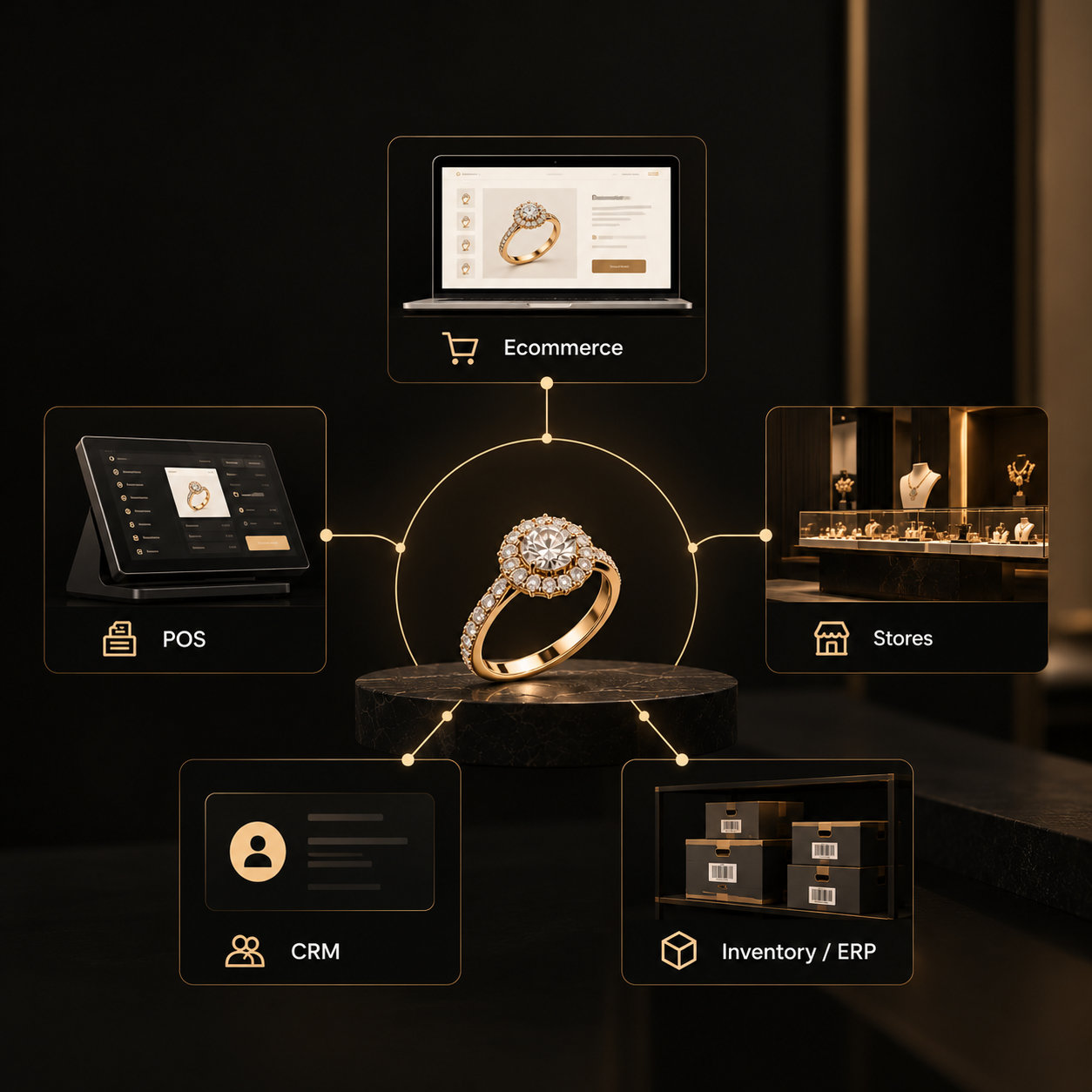
For a jewellery retailer, that includes stock, customer information, pricing, orders, and store-level availability.
A trusted inventory model
The business must define how physical stock, reserved stock, available-to-sell stock, returns, and transfers are represented.
Depending on the existing architecture, the ERP or inventory platform may own the authoritative records, while a separate service calculates availability for online and store channels.
The important point is that every channel uses a consistent availability model and that simultaneous sales or reservations are handled safely.
Shared pricing logic
If product prices depend on gold rates, purity, weight, making charges, stone values, or retailer-specific rules, the business needs a consistent way to calculate and publish those prices.
The pricing logic may live in the existing ERP or POS, or in a dedicated pricing service. The correct choice depends on the retailer's current systems and requirements.
Price changes also need defined effective times and appropriate controls so that the website and showroom do not unknowingly apply conflicting rules.
Connected customer and order records
Customer identity, enquiries, purchases, and fulfilment status must be linked wherever the business needs continuity between channels.
This requires more than copying customer names into another database. The architecture must account for duplicate records, customer matching, permissions, and how changes are propagated.
Reliable integration and recovery
APIs, events, and message queues can help systems exchange information. However, reliable operation also requires monitoring, safe retries, duplicate-message handling, and reconciliation.
If a showroom sale is recorded successfully but an inventory update fails, the business should be able to identify the discrepancy and recover without creating another sale or losing the original transaction.
A useful omnichannel platform therefore does more than move data. It coordinates business events and makes the state of important transactions visible.
What it changes for the customer
The strongest evidence of omnichannel capability is not an architecture diagram. It is a customer being able to move between channels without losing continuity.
Consider a customer searching for a diamond ring online.
She finds a design she likes but wants to examine it in person before buying. The website shows availability at a nearby showroom, based on the retailer's inventory and reservation rules. She requests a visit or reservation, and the store receives the relevant information.
When she arrives, the sales associate can retrieve the enquiry and product details. The customer does not have to start again or wait while the team contacts other branches to locate the ring.
She completes the purchase in-store. The POS records the sale, the inventory position updates through the agreed workflow, and the order can appear in her connected purchase history.
The same principle can support other journeys:
- Reserve online, collect in-store: The customer checks availability and reserves a piece for collection under the retailer's reservation policy.
- Buy in-store, review online: The customer can access the purchase record through a connected account, where supported.
- Find a product at another branch: Staff can check stock across locations and coordinate a transfer or collection.
- Receive consistent pricing: Online and offline channels use the same approved pricing rules for the relevant product and transaction.
Not every retailer needs to launch every journey at once. The important step is ensuring that each journey works reliably across the systems involved.
What it changes for the business
For a jewellery retailer, operational consistency can matter as much as customer convenience.
When stock records and reservations are coordinated, the business can reduce avoidable sales lost to unavailable products and reduce the time employees spend confirming stock manually.
When pricing rules are consistent, finance and operations teams have a clearer basis for reviewing transactions and understanding how product prices were calculated. Gold-rate changes, making charges, and other pricing inputs can be governed through a defined process rather than separate updates across channels.
When customer and order records are connected, management can evaluate the relationship between online enquiries, showroom visits, and completed sales more reliably. Reporting still requires agreed definitions and sound data quality, but teams have a stronger foundation for understanding performance across channels.
There is also a maintenance benefit. A documented integration architecture makes it easier to identify where a problem occurred, introduce a new store, and change a system without unnecessarily disrupting the entire retail operation.
These outcomes are not automatic. They depend on the quality of implementation, the accuracy of the underlying data, and whether employees follow the operating processes.
The objective is to make the business more dependable: fewer conflicting stock positions, more consistent pricing, clearer customer journeys, and more trustworthy reporting.
For jewellery brands expanding across ecommerce and physical retail, this is the practical value of omnichannel architecture.
Frequently asked questions
What is the difference between omnichannel and multichannel jewellery retail?
Multichannel jewellery retail offers customers multiple buying channels, such as a website and physical showrooms, which may operate independently. Omnichannel connects the relevant data and workflows so inventory, pricing, orders, and customer interactions remain consistent as customers move between channels.
Is a nightly inventory sync good enough for a jewellery business?
A nightly sync may be sufficient for some low-change inventory scenarios, but it can leave jewellery retailers working with outdated availability during the day. Where unique items, reservations, and simultaneous online and showroom sales are involved, timely updates and reliable transaction controls are generally more appropriate.
Does omnichannel mean replacing the existing POS?
No. Omnichannel does not necessarily require replacing the existing POS. A retailer can retain its current POS and ERP if they can support the required workflows through reliable integrations, consistent data ownership, and appropriate inventory and pricing controls.
How long does it take a jewellery brand to move from multichannel to omnichannel?
The timeline depends on the number of stores, the capabilities of existing POS and ERP systems, data quality, integration complexity, and the number of customer journeys being introduced. A focused pilot may be delivered before a full multi-store rollout, but the implementation team should estimate the schedule after assessing the current architecture and scope.