
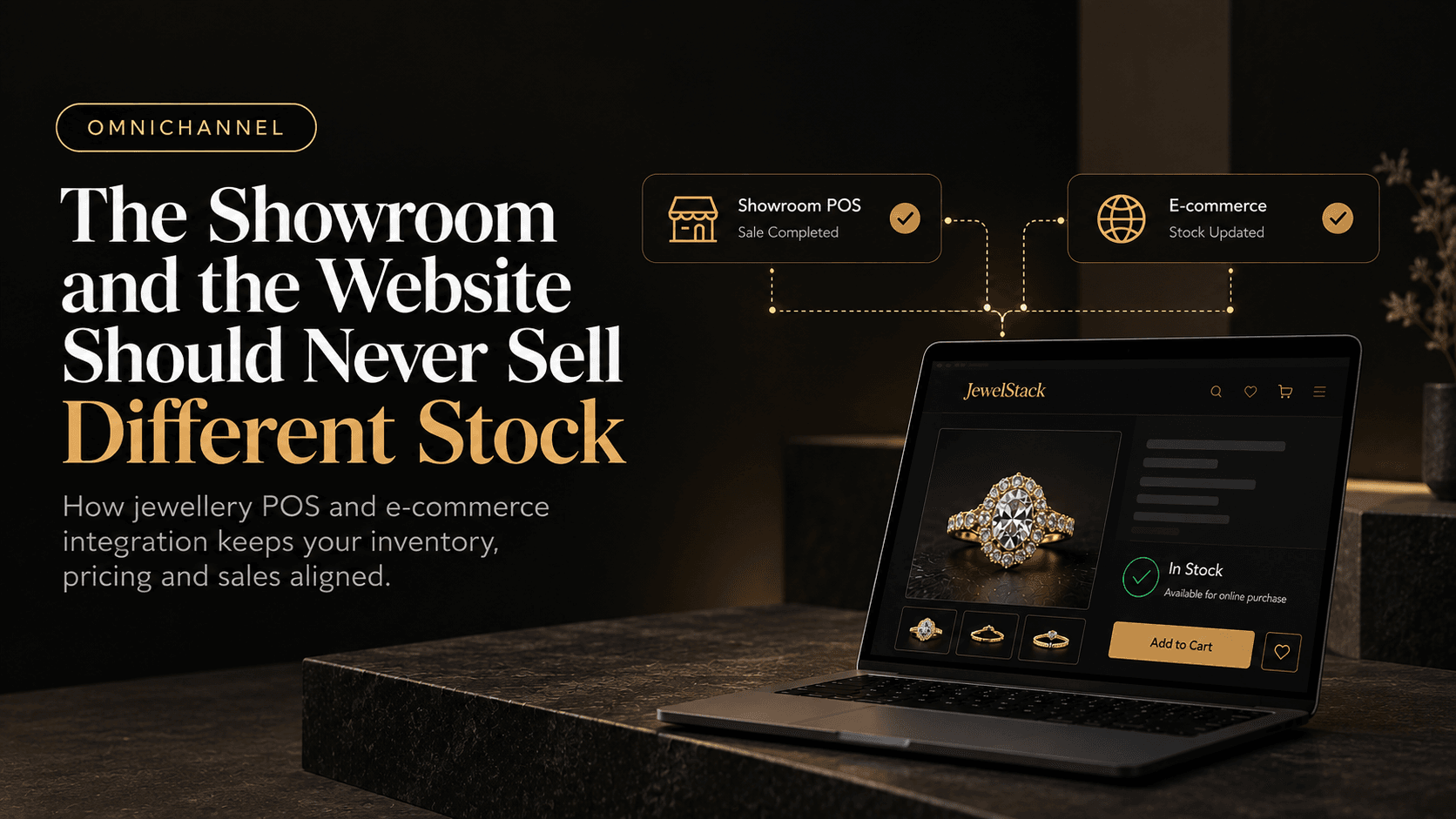
The showroom and the website should never sell different stock
Your showroom sells a ring and your website still shows it available. How real-time POS and ecommerce integration keeps jewellery stock accurate across stores.
A customer finds a diamond ring on your website. They call your showroom, confirm its availability and visit the store to try it on.
But the ring was sold an hour ago.
The website still shows it as available. The salesperson has to explain the discrepancy, the customer loses confidence, and your team spends time resolving a problem that should never have occurred.
Now imagine this happening across five showrooms, two franchise locations and an ecommerce website.
For a growing jewellery business, disconnected inventory systems are not just an operational inconvenience. They can affect customer experience, order fulfilment, store productivity and management's confidence in its own data.
Your showroom and your website should never operate as if they belong to two different businesses.
They should work together, using consistent product information, reliable inventory updates and clearly defined rules for pricing and order fulfilment.
That is the business case for jewellery POS and ecommerce integration.
The Real Problem: One Jewellery Business, Multiple Sales Channels
Jewellery retailers often expand their digital presence before connecting the systems that support their physical stores.
The website has its own product catalogue. The showroom operates through a point-of-sale (POS) system. Inventory may be managed through an ERP, spreadsheets or a separate stock management application.
Each system may work reasonably well on its own. The problem begins when they need to work together.
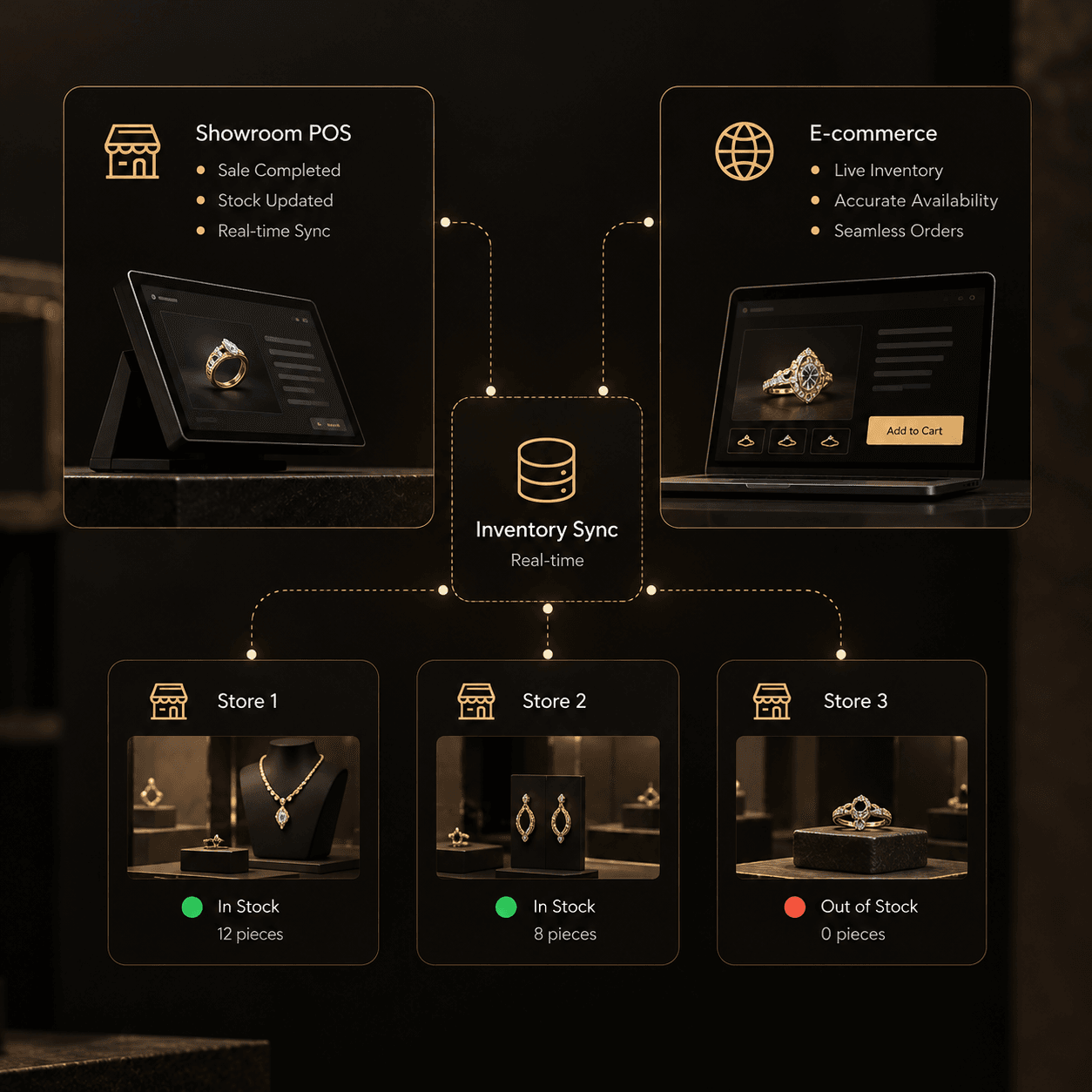
Consider a jewellery brand with three stores:
- Delhi holds a particular diamond ring.
- Jaipur holds a different size of the same design.
- Mumbai has already sold its last available piece.
- The ecommerce website displays products from all three locations.
If these systems do not communicate reliably, the website may show incorrect availability, store staff may promise products that cannot be supplied, and online orders may require manual intervention.
Inventory is not just a quantity. It is a collection of specific, identifiable products held at specific locations.
Why Jewellery Inventory Requires a Different Approach
Managing jewellery stock is more complex than maintaining a catalogue of interchangeable products.
Two gold necklaces can look almost identical but have different weights, purity, designs and making charges. Two diamond rings can share a design but differ in stone specifications or size. An individual piece may have a unique barcode, tag or inventory identifier.
A jewellery retailer needs a consistent way to identify products and track their availability throughout the business.
1. Every Piece Needs Reliable Identification
The integration should preserve product identifiers such as SKUs, item codes, barcodes or RFID identifiers where applicable.
Product variants and unique pieces must be represented correctly. Otherwise, an inventory update for one item could affect the availability displayed for another.
2. Stock Must Be Visible by Location
A product available in Delhi is not necessarily available for immediate collection in Mumbai.
A multi-store jewellery inventory management system should distinguish stock by branch, warehouse or other relevant location while allowing the business to define where orders can be fulfilled.
3. Pricing Requires Consistent Business Rules
Jewellery prices may depend on metal rates, purity, weight, making charges, stone values, applicable taxes and retailer-specific pricing policies.
Connecting inventory alone does not guarantee consistent pricing. The integration must also define which system controls the relevant pricing inputs and how updates are applied across online and offline channels.
4. Availability Must Reflect Actual Business Operations
A product may be physically present but already reserved for another customer. It may be awaiting a stock transfer, quality inspection or order fulfilment.
Physical stock and sellable stock are not always the same thing.
A dependable integration accounts for these distinctions rather than treating every recorded unit as immediately available for sale.
What Is Jewellery POS and Ecommerce Integration?
Jewellery POS and ecommerce integration connects the systems used to sell products online and in physical stores.
The objective is to synchronise the business information required to maintain consistent operations across channels.
Depending on the existing software and integration design, this can include:
- Product catalogues and jewellery attributes
- SKU-level and branch-level inventory
- POS sales, returns and stock adjustments
- Online orders and fulfilment status
- Pricing inputs and applicable pricing rules
- Stock reservations and allocation
- Inventory transfers between eligible locations
The important distinction is that integration should support the actual business workflow, not simply copy a stock number from one platform to another.
When a showroom sells a unique diamond ring, the POS should record the transaction. The integration should communicate the inventory change to the connected ecommerce platform so that the website can update the item's availability.
The same principle applies when an online order reserves a product, a store processes a return or inventory moves between branches.
The goal is one consistent view of inventory across every connected sales channel.
What Happens When a Showroom Sale Occurs?
A properly designed integration can follow this sequence:
- Sale recorded: The showroom POS records the transaction against the correct inventory item.
- Inventory updated: The relevant stock position is adjusted according to the retailer's business rules.
- Change communicated: The integration sends the inventory change to connected systems.
- Website availability refreshed: The ecommerce platform updates product availability based on the latest valid inventory information.
- Other channels updated: Relevant store dashboards and connected systems receive the change according to the integration's design.
The exact timing depends on the architecture, system capabilities and network conditions. Retailers should verify actual synchronisation behaviour rather than assume every integration is instantaneous.
The workflow must also account for concurrent sales. If a showroom sale and an online order occur almost simultaneously, the system needs appropriate stock validation, reservation or allocation controls to reduce the risk of selling the same unique item twice.
This is why jewellery POS software and ecommerce integration should be evaluated as a complete operational workflow rather than a simple website plugin.
Real-Time Inventory Sync: What Does It Really Mean?
Real-time inventory synchronisation is often presented as a feature, but jewellery retailers should understand what happens behind the scenes.
There are different ways to connect a POS with an ecommerce platform.
Event-driven synchronisation communicates changes when relevant events occur, such as a completed sale or inventory adjustment.
Scheduled synchronisation updates information at defined intervals.
Hybrid synchronisation combines event-driven updates with scheduled checks or reconciliation to identify discrepancies.
Each approach has different implications for latency, reliability and recovery from failures.
When evaluating a jewellery inventory management solution, ask:
- How quickly does a completed showroom sale affect online availability?
- What happens if an inventory update fails?
- Can the system retry failed updates without duplicating transactions?
- How are simultaneous online and offline sales handled?
- Can the team identify and reconcile stock discrepancies?
- Which system is authoritative for inventory and pricing?
A dashboard that displays stock is useful. A reliable integration must also ensure that stock changes are communicated, processed and reconciled correctly.
Multi-Store Jewellery Retail: Why One Stock Number Is Not Enough
For jewellery chains and franchise businesses, the challenge extends beyond keeping the website updated.
Management needs to understand where inventory is held, which locations can fulfil orders and how products can move between branches.
Imagine a customer in Mumbai enquiring about a ring that is available only at your Delhi showroom.
With a connected retail workflow, your team could check the relevant branch's inventory, verify whether the item is eligible for transfer or fulfilment, and communicate a realistic availability estimate.
The website might offer delivery from Delhi, an in-store reservation or another approved fulfilment option, depending on the retailer's policies.
Without this visibility, employees may have to contact individual stores and manually coordinate every request.
A connected jewellery omnichannel platform can help make these processes more structured, provided the underlying POS, ERP and inventory systems support the required workflows.
For multi-store businesses, the objective is not to make every location appear identical. It is to make the differences between locations visible and actionable.
Five Things to Check Before Integrating Your Jewellery POS
Before connecting your existing POS to an ecommerce website, review these five areas.
1. Product Data Consistency
Confirm that the POS and website use compatible identifiers for jewellery items, variants and unique pieces. Resolve duplicate SKUs and inconsistent product attributes before synchronisation begins.
2. Inventory Ownership
Decide which system is authoritative for each inventory record. Define how sales, returns, reservations, stock transfers and manual adjustments affect available stock.
3. Pricing Ownership
Document where gold rates, making charges and other pricing inputs originate. Specify how changes are calculated, approved and communicated to online and offline channels.
4. Order Allocation and Fulfilment
Define whether orders can be fulfilled from showrooms, warehouses or selected branches. Establish rules for reservations, cancellations, returns and simultaneous sales.
5. Error Handling and Reconciliation
Plan for API failures, delayed updates, network interruptions and mismatched records. Your team should have a way to identify discrepancies and restore consistency without relying entirely on manual investigation.
Addressing these areas before implementation can prevent avoidable integration problems and create a stronger foundation for future expansion.
How Jewelstack Fits Into a Connected Jewellery Retail Strategy
Jewelstack focuses on helping jewellery retailers build more connected digital and operational experiences.
For a retailer planning to integrate its website with an existing POS, the starting point should be the systems already running the business.
Which platform owns inventory? How are gold rates and product prices calculated? Can stock be allocated across branches? How are online orders communicated to showroom teams? What happens when an update fails?
These questions help establish the right integration approach.
Depending on the business, the implementation may involve connecting an existing POS, integrating an ERP, synchronising product and inventory data, or defining multi-store order workflows.
The objective is to make the website an integrated part of the jewellery business rather than a separate sales channel operating on outdated information.
If your jewellery brand is evaluating POS and ecommerce integration, explore Jewelstack and discuss the requirements of your existing retail systems with the team.
One Jewellery Business. One Consistent View of Stock.
Your showroom and your website may serve customers differently, but they should not maintain conflicting versions of product availability.
For jewellery retailers, reliable omnichannel operations begin with accurate product identification, location-aware inventory, consistent pricing rules and dependable communication between systems.
Jewellery POS and ecommerce integration brings these elements together, helping businesses reduce manual coordination and create a more consistent experience for customers and store teams.
As a jewellery brand grows, these foundations become increasingly important. Adding another showroom, franchise location or digital sales channel should not mean adding another disconnected inventory process.
Your customers should be able to discover a piece online, enquire at a showroom and place an order through an appropriate channel without your business losing track of where that piece is or whether it is available.
That is the standard a connected jewellery retail operation should work towards.
Frequently Asked Questions
What is jewellery POS and ecommerce integration?
It connects a jewellery retailer's point-of-sale system with its online store to synchronise relevant product, inventory, pricing and order information between channels.
How does real-time inventory sync help jewellery retailers?
It helps communicate stock changes across connected systems more quickly, reducing the risk of outdated availability information. Actual performance depends on the integration architecture and the systems involved.
Can a jewellery website show stock availability by showroom?
Yes, provided the POS, inventory system and website support location-level stock data and the business configures the relevant availability rules.
Can jewellery POS integration support live gold rates?
It can when the implementation connects the relevant gold-rate source and applies the retailer's pricing rules consistently across the required channels.
Does a jewellery retailer need to replace its existing POS?
Not necessarily. An existing POS may be integrated with the ecommerce platform if it supports the required interfaces, data and workflows. Feasibility depends on the existing technology.
What is the difference between inventory management and omnichannel inventory management?
Inventory management tracks products and stock movements. Omnichannel inventory management also coordinates product availability, reservations and fulfilment across connected sales channels and locations.