

The integration that quietly becomes your most critical system
The script somebody wrote to move stock between two systems is now load-bearing, unowned and undocumented. How jewellery integrations become critical.
Someone wrote it in a week, three years ago, to move stock from the billing system to the website. It was meant to be temporary.
It now runs every fifteen minutes, carries every price and every stock number the public can see, has no tests, no documentation and no owner. The person who wrote it has left.
It is, in practice, the most critical system in the business, and it does not appear on any diagram.
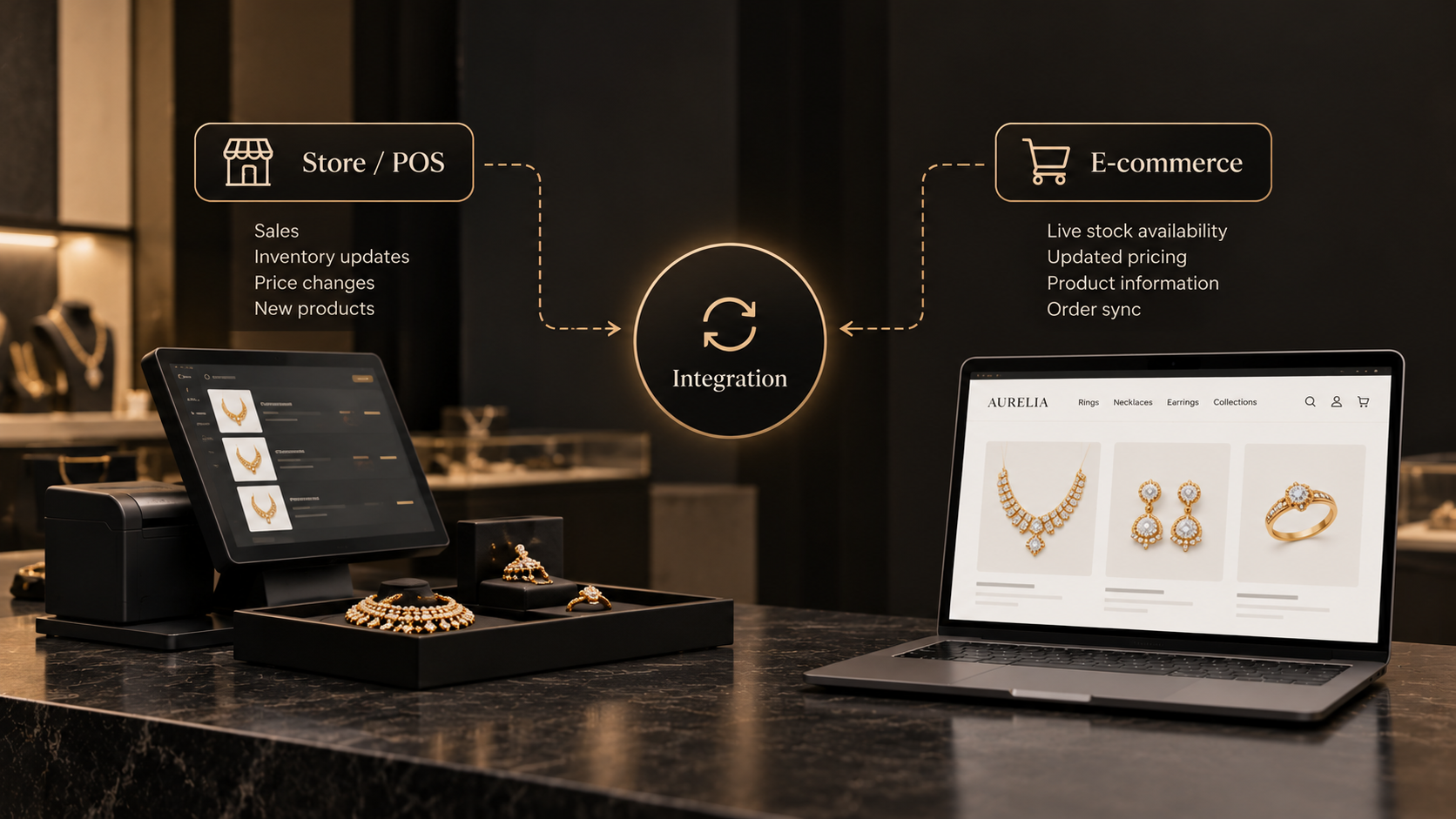
For jewellery retailers, this is a familiar but often overlooked risk. A POS system manages billing and store inventory. An ecommerce platform displays products, prices and availability. Between them sits an integration that keeps the two in sync. When it works, nobody notices. When it fails, customers may order jewellery that is already sold, see outdated gold prices or lose confidence in the brand.
As jewellery businesses expand across stores, warehouses, websites and marketplaces, these integrations become essential infrastructure. Yet they are often treated as minor technical tasks rather than systems that require ongoing ownership.
How a Temporary Script Becomes Infrastructure
The journey usually begins with a reasonable business need.
A jewellery retailer launches an ecommerce website and wants its existing point-of-sale (POS) system to supply product details, stock quantities and prices. The fastest solution is a small script that transfers data between the two systems.
Initially, it works well enough. The website receives inventory updates, the development team moves on, and the business starts selling online.
Then the dependencies accumulate.
The script begins handling product variants, branch-level stock, making charges, gold rates and order updates. Another feature is added to accommodate a new store. A workaround addresses an unusual product format. A scheduled job is introduced to prevent excessive API requests.
Before long, a simple connector has become responsible for keeping several business systems consistent.
Nobody deliberately designed a critical system without documentation or monitoring. It happened gradually, through a series of individually reasonable decisions.
This is how technical debt develops in retail integrations. The problem is not that the original developer chose a quick solution. The problem is that the business continued to depend on it without revisiting its reliability requirements.
The Signs It Has Already Happened to You
An integration does not need to be visibly broken to represent a risk. In many cases, the warning signs appear in everyday operations.
Nobody wants to touch it. The team knows the integration works, but nobody is confident about what might break if its code changes. Even a small update requires caution because the underlying logic is poorly understood.
It runs on somebody's machine. A scheduled task depends on a developer's laptop, a manually configured server or credentials associated with an employee who has left. The process may continue working until a machine is replaced, a password expires or an account is disabled.
Customers notice problems first. A shopper places an order for a ring that was sold in a physical store earlier that morning. A customer sees a product listed at an outdated price. The support team discovers the issue before anyone in technology knows the integration has failed.
Nobody can answer a basic operational question. How long does a stock update normally take? Which system wins when two updates conflict? Who receives an alert if the last successful sync was six hours ago?
If these questions do not have clear answers, the business is depending on an integration that may be more fragile than it appears.
Failure Modes Nobody Designed For
Most integration failures are not dramatic outages. They are small inconsistencies that spread through the business.
Partial synchronisation
An integration processes 500 products but fails after updating 320. The first 320 reflect the latest inventory, while the remaining products retain old quantities.
From the shop floor, this can appear as a collection of unrelated stock discrepancies. Staff may correct individual products manually without realising that the underlying sync is incomplete.
A reliable integration should record which records were processed, which failed and whether the overall operation completed successfully.
Duplicate writes
A network timeout occurs after the POS system accepts an update, but before the integration receives confirmation. The integration assumes the operation failed and sends it again.
Depending on the operation, the duplicate request might create a second order record, repeat a stock deduction or trigger a second notification.
This is especially dangerous when integrations process sales, returns, reservations or payment-related events.
Silent failure
The scheduled job continues running, but its API credentials have expired. Alternatively, the source system changes a field name and the integration no longer interprets the response correctly.
The job may still report that it executed successfully even though useful data is no longer reaching the website.
This is not simply a technical inconvenience. It can leave customers looking at stock and prices that no longer reflect the business's actual position.
Clock drift and delayed updates
Two systems may process timestamps differently, operate in different time zones or receive updates out of order.
For example, an older inventory update may arrive after a newer one and overwrite the correct quantity. A store sale may be reflected in the POS immediately but reach ecommerce much later.
In jewellery retail, where a single item may have a high selling price and only one available unit, even a short delay can create a costly customer experience.
Silent Failure Is the Expensive One
A visible crash is often easier to manage than an integration that quietly stops doing its job.
When a service goes offline, somebody may receive an error, investigate the incident and restore operations. With silent failure, the systems appear healthy while their data gradually becomes inconsistent.
Imagine a customer buying a gold necklace through an ecommerce website. The necklace was sold at a showroom two hours earlier, but the inventory connector stopped transmitting updates. The website still shows one unit available, so the customer completes the purchase.
The ecommerce platform has done exactly what it was designed to do: accept an order for an available product. The problem is that the availability information was already wrong.
The business must now contact the customer, explain the issue, offer an alternative or arrange a refund. If this happens repeatedly, the impact extends beyond individual transactions to customer trust and brand reputation.
The same risk applies to dynamic gold pricing. If the website continues displaying a previously synchronised price after the underlying pricing logic has changed, customers may see prices that do not match the retailer's current rules.
The solution is not simply to make the integration run more frequently. It is to establish whether the data is current, whether updates have been applied correctly and whether someone will be notified when those conditions are no longer met.
What an Integration Needs to Be Adult
A production integration does not need an unnecessarily complex architecture. It needs a small set of operational safeguards that the business can maintain.
1. Monitoring that measures outcomes
Logging that a script started and finished is not enough. The integration should track the number of records received, processed, rejected and successfully delivered.
It should also record the last successful synchronisation time and the age of any pending updates.
For a jewellery retailer, these measurements help answer a more important question than whether a job ran: is the website receiving reliable business data?
2. Alerts that reach a real person
An alert should be triggered when stock updates stop, repeated API requests fail, processing falls behind or the integration detects an unexpected number of rejected records.
Alerts should go to a named owner or an operational team, not disappear into an unattended log file.
A useful alert identifies the affected system, the approximate scope of the problem and the action needed to investigate it.
3. Safe retries
Temporary network failures are normal. The integration should retry operations that are safe to repeat, using controlled delays rather than continuously sending requests to an unavailable system.
Retries should have limits. If an operation continues to fail, the integration needs to stop retrying indefinitely and make the failure visible.
4. Idempotency and duplicate protection
The same message may arrive more than once. Processing it repeatedly should not create additional business effects.
For inventory updates, this might mean setting a product's quantity to a specific value rather than blindly subtracting a quantity every time a message arrives. For order events, it may mean identifying each event uniquely and recording whether it has already been processed.
5. A place for failed messages
Some records cannot be processed automatically because required fields are missing, product identifiers do not match or business rules reject the update.
These records should be isolated for investigation rather than discarded or repeatedly blocking unrelated updates. A dead-letter queue or equivalent failed-message store provides a controlled place to review, correct and replay them.
6. A named owner
Every integration needs someone accountable for its reliability, even if another team maintains the code.
The owner should know which systems are connected, what data moves between them, how failures are detected and who can authorise changes. There should also be a documented recovery procedure and access to the relevant credentials through appropriate secure processes.
These safeguards are practical foundations for a reliable jewellery integration. They do not eliminate every failure, but they make failures easier to detect, diagnose and recover from.
Point-to-Point Integrations Versus a Central Hub
When a jewellery business has only a POS system and an ecommerce website, a direct integration can be perfectly reasonable.
The challenge appears as more systems are introduced.
A retailer may eventually connect its POS, ecommerce platform, ERP, CRM, warehouse, marketplace accounts and customer application. If every system connects independently to every other system, the number of potential connections grows rapidly.
Connect every system to every other system and the number of links is n × (n − 1) ÷ 2.
That means four systems can require six pairwise connections, while eight can require 28. Each connection may have its own authentication, data mapping, error handling and maintenance requirements.
A central integration hub changes the model. Instead of every application managing every other application's requirements, systems communicate through a shared integration layer with defined interfaces and common operational controls.
For jewellery retailers, this can simplify inventory synchronisation, pricing distribution, order processing and customer data flows across multiple channels.
However, a hub is not automatically the right answer. A business with two stable systems and limited integration needs may be better served by a well-maintained direct connection. A central layer introduces its own operational responsibilities and can become a single point of failure if it is not designed for resilience.
The decision should be driven by the number of systems, the complexity of business rules, the frequency of change and the cost of managing connections individually.
A hub becomes increasingly valuable when integrations duplicate logic, systems frequently change or the business needs consistent monitoring and data governance across multiple channels.
Idempotency in Plain Terms
Idempotency sounds like an engineering term, but the underlying idea is straightforward: processing the same instruction twice should have the same business effect as processing it once.
Imagine a store has one necklace in stock. A sale reduces its available quantity from one to zero.
If the integration receives the same sale notification twice and subtracts one unit each time, it may incorrectly record a negative quantity or trigger additional downstream actions.
A safer design recognises the sale as a unique event. If that event has already been processed, the second delivery does not repeat the stock deduction.
Inventory updates can also be designed around absolute quantities. An instruction to set available stock to zero is safer to replay than an instruction to subtract one unit without checking whether it has already been applied.
This distinction matters because retries are essential to reliable integrations. Networks fail, APIs time out and acknowledgements get lost. Without duplicate protection, the very mechanism intended to improve reliability can create additional errors.
For jewellery businesses, idempotency is particularly important for stock deductions, order creation, returns, reservations and other operations that affect the same physical item across multiple sales channels.
Making It Visible
The cheapest way to reduce integration risk is often to make the existing system visible before replacing it.
Start with three practical steps.
Draw the integration diagram. Identify every connected system, the data moving between them, the direction of each flow and the frequency of updates. Mark which system is authoritative for inventory, pricing, orders and customer information.
Assign an owner. Name the person or team responsible for monitoring, incident response and changes. Document the recovery procedure and ensure that more than one authorised person can maintain the integration.
Create one meaningful alert. Start with the most commercially important failure: stock or pricing updates have stopped succeeding within the expected time window. Route that alert to someone who can act on it.
Once these basics are in place, the business can progressively add processing metrics, duplicate protection, controlled retries, failed-message handling and automated reconciliation.
Reconciliation is especially useful in jewellery retail. Even when an integration appears healthy, periodically comparing stock and order records across systems can reveal discrepancies that individual success logs miss.
There is no need to rebuild every connector immediately. The first priority is to understand which integrations can affect sales, customer commitments and financial records, and then address the greatest risks.
An integration that moves a product description once a day does not carry the same operational risk as one that determines whether a unique diamond ring can be sold online.
The objective is not to make every integration complicated. It is to ensure that the most important ones are observable, recoverable and accountable.
For a growing jewellery retailer, the integration layer is part of the commerce infrastructure. It deserves the same attention as the POS, ecommerce platform and inventory system it connects.
Frequently Asked Questions
How do jewellery systems integrations usually fail?
Jewellery systems integrations commonly fail because of expired API credentials, network interruptions, incorrect product mappings, partial synchronisation, duplicate messages or outdated business rules. Some failures are obvious, but silent failures are particularly risky because the website may continue displaying incorrect stock quantities or prices. Monitoring, reconciliation and controlled error handling help identify these issues before they affect more customers.
Who should own the integration between POS and ecommerce?
The POS-to-ecommerce integration should have a clearly named technical or operational owner responsible for monitoring, incident response, documentation and changes. The POS and ecommerce teams should also agree which system is authoritative for inventory, pricing and order status. Even when a third-party vendor maintains the connector, the jewellery retailer should retain internal accountability for business continuity and escalation.
What monitoring does a stock sync integration need?
A stock synchronisation integration should monitor the last successful update, processing delays, records received and processed, failed updates, API errors and inventory discrepancies. Alerts should notify a responsible person when updates stop or exceed an agreed delay threshold. Periodic reconciliation between the POS and ecommerce inventory records provides an additional safeguard against inconsistencies that ordinary execution logs may miss.
When should point-to-point integrations be replaced with a central system?
Point-to-point integrations should be evaluated for replacement when the number of connected systems grows, business logic is duplicated, changes become difficult to coordinate or failures are hard to trace across applications. A central integration hub can provide shared monitoring, data mapping, retry handling and consistent interfaces. However, a direct integration may remain the simpler and more reliable choice for a small number of stable systems with limited integration requirements.