
Your ERP was never designed for a metal whose price changes daily
The ERP running your accounts was built for stable prices and interchangeable stock. Where it stops fitting jewellery, and how to integrate rather than replace.
The ERP works. It has run the accounts for nine years, the finance team knows it, and replacing it is nobody's idea of a good quarter.
It was also designed on an assumption that does not hold here: that the value of a unit of stock is relatively stable between the day it arrives and the day it sells. In jewellery retail, the underlying metal price can change every day. Gold rates move, making charges vary, and the value attached to an item can shift without the physical piece changing at all.
Change that assumption, and the parts of an ERP that touch inventory valuation, costing and pricing start needing help.
The answer is not necessarily to replace the ERP. It is to understand which jobs it should continue doing, which jobs require jewellery-specific logic, and how the two systems should exchange information without creating conflicting records.
For jewellery businesses running established ERP systems, that distinction is the starting point for a more practical approach to digital transformation.
What an ERP Is Genuinely Good At
An established ERP should receive credit for the work it already does well. It connects financial transactions, procurement, payables, receivables, general ledger entries and statutory reporting into a system the business can rely on.
For a jewellery retailer, these functions remain essential. Supplier invoices need to reconcile with purchases. Payments must reach the right accounts. Tax reporting needs consistent financial records. Branch-level transactions must ultimately contribute to the company's consolidated books.
An ERP can also manage purchase orders, goods receipts, supplier information and accounting entries associated with inventory movements. Depending on the implementation, it may support warehouse management, serial numbers, batch tracking and inventory valuation.
These capabilities do not become obsolete simply because the business sells jewellery.
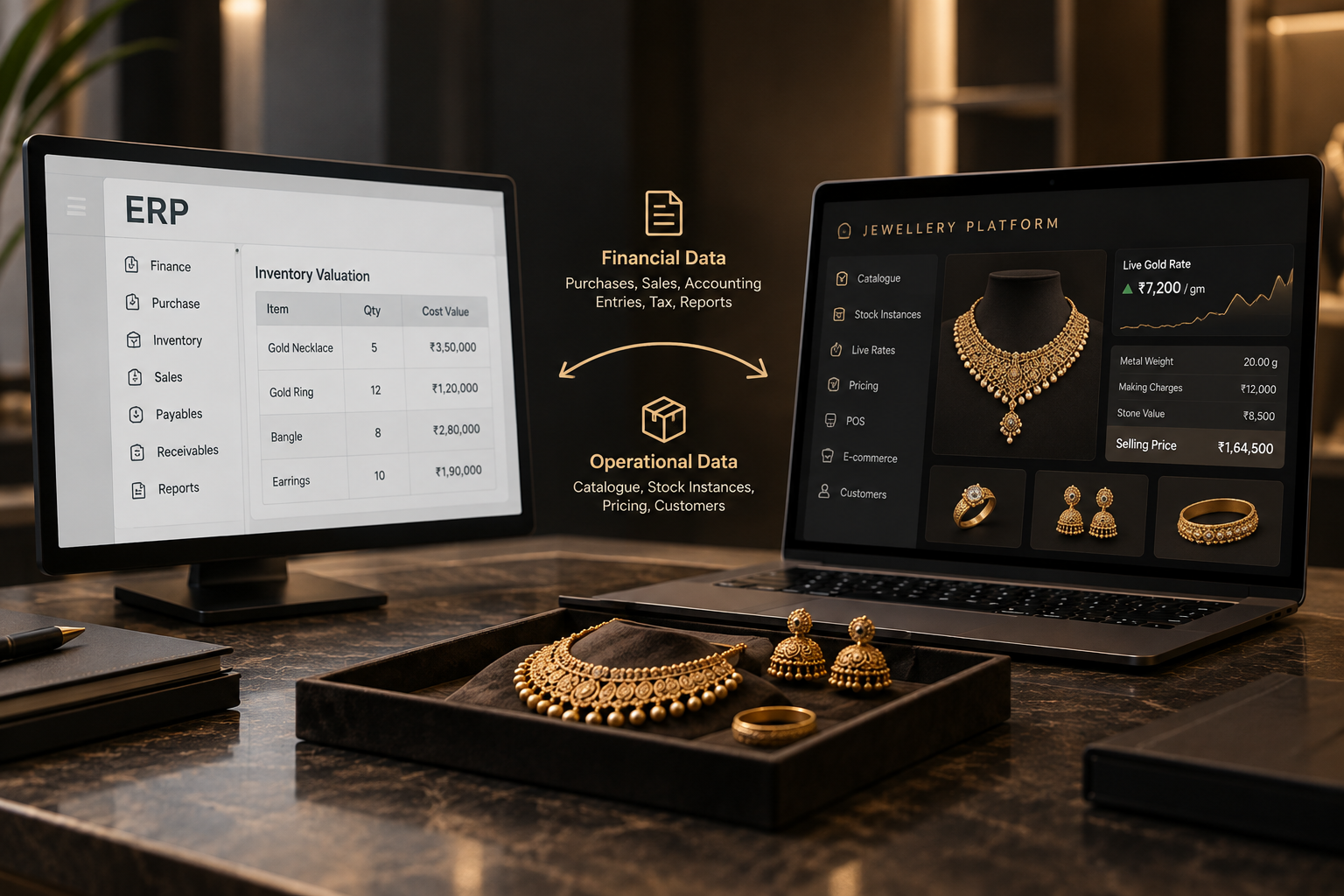
The difficulty begins when a general-purpose system is expected to understand the commercial behaviour of every individual jewellery item, including its purity, net metal weight, stone details, certificate, making charges and rate-dependent selling price.
The distinction is between financial control and jewellery-specific operational intelligence.
An ERP should remain responsible for the financial processes it handles reliably. The jewellery platform should provide the additional data and business rules needed to manage products, individual stock pieces, customer interactions and rate-sensitive commerce.
That division protects an existing investment while addressing the operational gaps that matter most.
The Assumption That Does Not Survive a Daily Rate
Many conventional inventory workflows begin with a straightforward model: purchase an item at a particular cost, record the quantity received, and track its movement until it is sold.
That model can work well for products whose prices and costs are relatively predictable. Jewellery introduces a more complicated relationship between physical inventory and commercial value.
Consider a gold necklace received when the applicable gold rate is ₹7,000 per gram. If its net gold weight is 20 grams, the metal component represents ₹1,40,000 at that rate, before accounting for making charges, stones, applicable taxes and other pricing rules.
If the applicable rate subsequently rises to ₹7,200 per gram, the same 20 grams represents ₹1,44,000 in metal value under a rate-based pricing model.
The necklace has not changed. Its weight has not changed. Its certificate has not changed. The rate used to calculate its selling price has.
That difference matters because inventory cost, current metal value and customer selling price are three distinct concepts.
- Inventory cost: The acquisition cost recorded under the business's accounting and inventory valuation policy.
- Current metal value: The value calculated using the applicable metal rate and the item's relevant metal weight.
- Customer selling price: The amount determined by the retailer's pricing rules, which may include making charges, stones, discounts, taxes and other components.
These values may be related, but they are not interchangeable.
A daily gold rate change does not automatically mean that the accounting carrying value of every item must change. Inventory valuation must follow the business's applicable accounting policies and requirements. Meanwhile, a retailer may need its customer-facing prices to reflect the latest approved rate.
This is where a conventional ERP implementation can struggle if it treats inventory cost as the only meaningful value associated with a product.
A jewellery-specific pricing engine can calculate the current selling price from approved rates and item attributes without rewriting historical purchase costs every morning.
The ERP can continue recording financial values according to the agreed accounting policy, while the jewellery platform handles the rate-sensitive calculations required for day-to-day retail operations.
Where the Friction Shows Up First
The gap rarely announces itself as a single system failure. It appears as a collection of small workarounds that gradually become part of the operating process.
1. Inventory valuation reports need manual interpretation
The ERP may show the recorded cost of a piece correctly, but management may also want to understand its current metal value, expected selling price and potential margin.
When those figures are not available from a consistent source, teams export inventory data, apply rate calculations in spreadsheets and reconcile the results manually.
The problem is not necessarily that the ERP's valuation is wrong. It may be answering a different question from the one management is asking.
2. Pricing updates become operational exercises
When the gold rate changes, the business needs to know which products are affected, which price components must be recalculated and which channels must receive the updated prices.
If the process depends on manually updating spreadsheets, POS terminals, website catalogues and branch-level records, inconsistencies become more likely.
A central pricing engine can apply approved rate changes using defined rules and distribute the resulting prices to connected systems.
3. Month-end reconciliation becomes more complicated
A jewellery business may need to reconcile purchases, sales, stock movements, returns, valuation adjustments and branch transfers.
If the ERP records one set of values while a separate operational system calculates another, the finance team needs clear explanations for the differences.
Without a defined integration contract, spreadsheets often become the unofficial bridge between systems.
That creates additional work and makes it harder to identify whether a discrepancy originated in a transaction, a rate update, an incorrect item attribute or an integration failure.
4. Different sales channels start disagreeing
A customer might see one price online and receive another at a physical store. A branch may hold a piece that the website still lists as available, or a sold item may remain visible in another channel.
These problems are not solved by accounting software alone. They require coordinated pricing, inventory availability and transaction updates across the systems that handle customer-facing operations.
Unique Stock Versus Quantity on Hand
One of the most important differences between generic inventory management and jewellery inventory management is the identity of the stock itself.
In a conventional inventory model, a business may track a product using a SKU and a quantity. Ten units of the same product can be represented as one stock record with a quantity of ten.
Jewellery often needs a more granular model.
Two rings may share the same design and nominal size while having different actual weights, stone specifications, certificates or purchase costs. They may look identical in a catalogue, but they are not necessarily interchangeable from an operational or valuation perspective.
A useful jewellery inventory model distinguishes between the product definition and the physical stock instance.
The product definition describes the design and its common attributes: product category, collection, design code, metal type, purity, standard dimensions and other catalogue information.
The stock instance identifies the actual physical piece, with attributes such as:
- Unique tag, barcode or RFID identifier.
- Gross weight, net metal weight and stone weight, where applicable.
- Metal purity and relevant stone specifications.
- Certificate or hallmark references.
- Actual purchase cost and receipt details.
- Current branch or storage location.
- Stock status, including available, reserved, sold, returned or transferred.
This distinction matters for stock accuracy, store transfers, audit trails and omnichannel selling.
A jewellery-specific inventory layer can maintain the identity and movement history of each physical piece while exposing aggregated quantities and financial summaries to the ERP.
The ERP does not necessarily need to become the primary interface for every stock instance. It needs reliable, reconciled information about the transactions and balances required for financial control.
The integration must preserve the link between each physical piece and the financial transaction that eventually records its purchase, sale, return or transfer.
The Integration Pattern That Works
For many established jewellery retailers, the practical architecture is to retain the ERP as the financial system of record and introduce a jewellery-specific operational layer around it.
This is not a universal rule. The right division depends on the existing ERP's capabilities, the quality of its APIs and the retailer's accounting and inventory policies. However, it provides a useful starting point when the existing system remains dependable for core financial operations.
A jewellery platform such as JewelStack can sit alongside the ERP to manage operational functions that require jewellery-specific logic.
The responsibilities might be divided as follows.
| Business capability | Primary responsibility |
|---|---|
| General ledger, payables and receivables | ERP |
| Statutory financial reporting | ERP |
| Purchase orders and supplier accounting | ERP, with integrated procurement workflows |
| Jewellery catalogue and product variants | Jewellery platform |
| Individual stock-piece records and identifiers | Jewellery platform, subject to the agreed inventory architecture |
| Live metal rates and selling-price calculations | Jewellery pricing engine |
| Omnichannel catalogue and availability | Jewellery platform |
| POS transactions and store-level operations | POS or jewellery platform |
| Customer profiles, interactions and campaigns | CRM or jewellery platform |
| Financial posting and reconciliation | ERP, supported by integration controls |
The important point is not which product name appears in each row. It is that every responsibility has an explicitly designated owner.
A well-designed integration also avoids making both systems independently responsible for the same calculation. If the jewellery platform calculates the selling price, the ERP should receive the relevant transaction values and references rather than independently applying a different retail pricing formula.
Similarly, if the ERP controls the accounting treatment of inventory, the jewellery platform should not silently modify financial carrying values without an agreed accounting process.
Use a defined integration boundary
The two systems should exchange structured business events and records through supported APIs, integration services, message queues or scheduled imports, depending on their capabilities.
For example, a sale at a physical store may produce a POS transaction, update the operational stock record and generate a financial posting for the ERP. The integration should carry a stable transaction reference so both systems can trace the same sale.
If the ERP is temporarily unavailable, the POS may need to continue operating under an explicitly designed offline policy. Transactions can then be queued and reconciled when connectivity returns.
The architecture should also account for duplicate messages, failed deliveries, retries, audit logs and transactions that cannot be posted automatically.
The goal is not simply to connect two databases. It is to establish a controlled exchange of business information.
What Should Flow Between Them, and How Often
Integration frequency should follow the business consequence of a delay. A stock sale that affects online availability may need to propagate within seconds, while a consolidated management report may only need to refresh periodically.
The exact schedule depends on the systems, transaction volumes, operational requirements and accounting controls.
| Data or event | Typical direction | Suggested frequency |
|---|---|---|
| Supplier and purchase-order records | ERP to jewellery platform, or shared procurement workflow | On change or near real time |
| Purchase receipts and stock intake | Operational receiving to ERP; stock-instance details to jewellery platform | At receipt, with validated posting |
| Approved gold and other metal rates | Approved rate source to jewellery pricing engine | On approved rate change |
| Selling-price calculations | Jewellery pricing engine to POS and commerce channels | On rate change or relevant product update |
| Sales transactions | POS to jewellery platform and ERP | Near real time, with controlled retries |
| Stock availability and store transfers | Jewellery platform to connected channels; financial movements to ERP | Near real time or event driven |
| Financial postings and settlement references | ERP to operational platform where needed for reconciliation | On posting or scheduled reconciliation |
| Customer master records | Designated CRM or ERP master to relevant systems | On change, according to ownership rules |
| Customer interactions and campaign activity | CRM or jewellery platform to relevant customer systems | Near real time where useful |
| Inventory and financial reconciliation reports | ERP and operational data reconciled through reporting | Daily, with month-end controls |
These are design recommendations, not fixed requirements for every implementation.
Separate the operational update from the financial posting
A common mistake is to assume that every inventory event must wait for the ERP to complete its accounting entry before the operational system can react.
That may create unnecessary delays.
When a sale is confirmed, the jewellery platform may need to mark the physical piece as sold or unavailable immediately, preventing another channel from selling it. The corresponding financial posting can then be processed through the ERP integration according to the agreed transaction and accounting rules.
This approach requires durable transaction records, clear status handling and reconciliation controls. It must not allow a failed financial posting to disappear simply because the operational stock has already changed.
Treat metal rates as controlled business data
A rate feed should not be treated as an arbitrary number copied into multiple systems.
The integration should define the approved rate source, applicable purity, effective timestamp, currency, rate type and the rules for handling corrections or delayed updates.
It should also specify whether the rate applies to new quotations only, all unsold inventory prices, or particular product categories.
A transparent rate history makes it easier to explain why a customer saw a particular price at a particular time.
Who Owns a Number When Both Systems Have One?
The rule that prevents months of argument is simple: every important field needs one authoritative owner, even when multiple systems store a copy of it.
A replicated value is not automatically an independently managed value.
For example, the ERP and jewellery platform may both store a product code. That is acceptable if the integration defines which system creates the code, how updates are approved and what happens when a conflicting value arrives.
The same principle applies to metal rates, stock quantities, purchase costs, selling prices and customer records.
A field-level ownership matrix should document at least five things:
- System of record: Which system is authoritative for the field?
- Update permissions: Which system is allowed to change it?
- Propagation rule: How does the change reach other systems?
- Conflict handling: What happens if a conflicting update arrives?
- Audit history: How can the business identify who or what changed the value and when?
For a jewellery retailer, a simplified ownership model might look like this:
| Data field | Example owner | Control rule |
|---|---|---|
| Financial inventory carrying value | ERP | Governed by accounting policy |
| Approved metal rate | Designated rate authority | Versioned and timestamped |
| Customer selling price | Jewellery pricing engine | Calculated using approved pricing rules |
| Physical stock-piece identity | Jewellery inventory platform | Unique identifier and movement history |
| Posted sales accounting entry | ERP | Linked to the originating POS transaction |
| Customer master | Designated CRM or ERP | One master, with controlled synchronisation |
Ownership may differ between businesses. The important part is that the decision is made before integration development begins.
Without this discipline, the two systems can repeatedly overwrite each other's values, creating reconciliation problems that appear to be software bugs but are actually unresolved business rules.
When Replacement Is Genuinely the Answer
Keeping the existing ERP is not always the right decision. Integration is only a sensible strategy when the current system can support the controls and interfaces the business needs.
Replacement or a substantial ERP upgrade may be justified when:
- The version is no longer supported. Security updates, vendor support or essential compliance capabilities are unavailable.
- There is no viable integration path. The system has no suitable API, supported data interface or reliable method for exchanging transactions.
- The vendor restricts access to essential data. Critical inventory and financial records cannot be extracted or reconciled through an acceptable mechanism.
- The existing architecture creates unacceptable operational risk. Batch delays, data corruption or persistent transaction failures cannot be addressed economically.
- The business has outgrown the platform. Multi-company accounting, new markets, complex procurement or other requirements exceed its practical capabilities.
- The cost of maintaining workarounds exceeds the benefit of retaining the system. Repeated manual reconciliation, fragile customisations and unsupported dependencies have become a material operating burden.
Even then, replacing an ERP is not simply a technology upgrade. It affects financial controls, reporting, procurement, supplier processes, staff workflows and historical data.
The decision should compare the total cost and risk of integration against the total cost and risk of replacement, including migration, testing, training and business disruption.
If the existing ERP is reliable and has a workable integration interface, a jewellery-specific operational layer may solve the actual problem with significantly less disruption.
If the ERP cannot provide reliable financial control or safely exchange the necessary data, retaining it at all costs can be the more expensive decision.
Frequently Asked Questions
Can a jewellery business keep its existing ERP?
Yes, a jewellery business can often retain its existing ERP for accounting, procurement, payables, receivables and financial reporting while integrating a jewellery-specific platform for pricing, catalogue management and individual stock tracking. The approach works when the ERP can exchange data reliably and the responsibilities of both systems are clearly defined. An upgrade or replacement may be necessary if the existing system cannot meet essential integration, security or operational requirements.
How should a jewellery platform integrate with an ERP?
A jewellery platform should integrate with an ERP through supported APIs, event-driven messaging or controlled scheduled data exchanges, depending on the systems' capabilities. The integration should cover the required purchase, stock, sales, customer and financial records, with stable transaction identifiers, error handling, audit logs and reconciliation controls. Each field should have a designated system of record to prevent conflicting updates.
Which system should own jewellery stock valuation?
The ERP should generally own the official financial inventory valuation when it is the designated accounting system, with valuation governed by the business's applicable accounting policies. A jewellery-specific platform can maintain item-level attributes and calculate current metal values or customer selling prices using approved rates. These figures serve different purposes and should be reconciled without treating current metal value as an automatic replacement for accounting carrying value.
What data should sync between a jewellery POS and an ERP?
A jewellery POS and ERP should exchange the data required to reconcile business operations with financial records, including sales, returns, taxes, discounts, payment references, purchase receipts and relevant stock movements. The integration should also carry transaction identifiers and sufficient item-level references to trace each sale to the physical jewellery piece. Stock availability and selling-price updates may need near-real-time synchronisation, while financial reconciliation and reporting can follow defined processing schedules.