
What the counter knows that the back office finds out on Monday
The showroom floor knows what sold, what was asked for and what walked away. If that reaches head office on Monday, every decision is made on a stale picture.
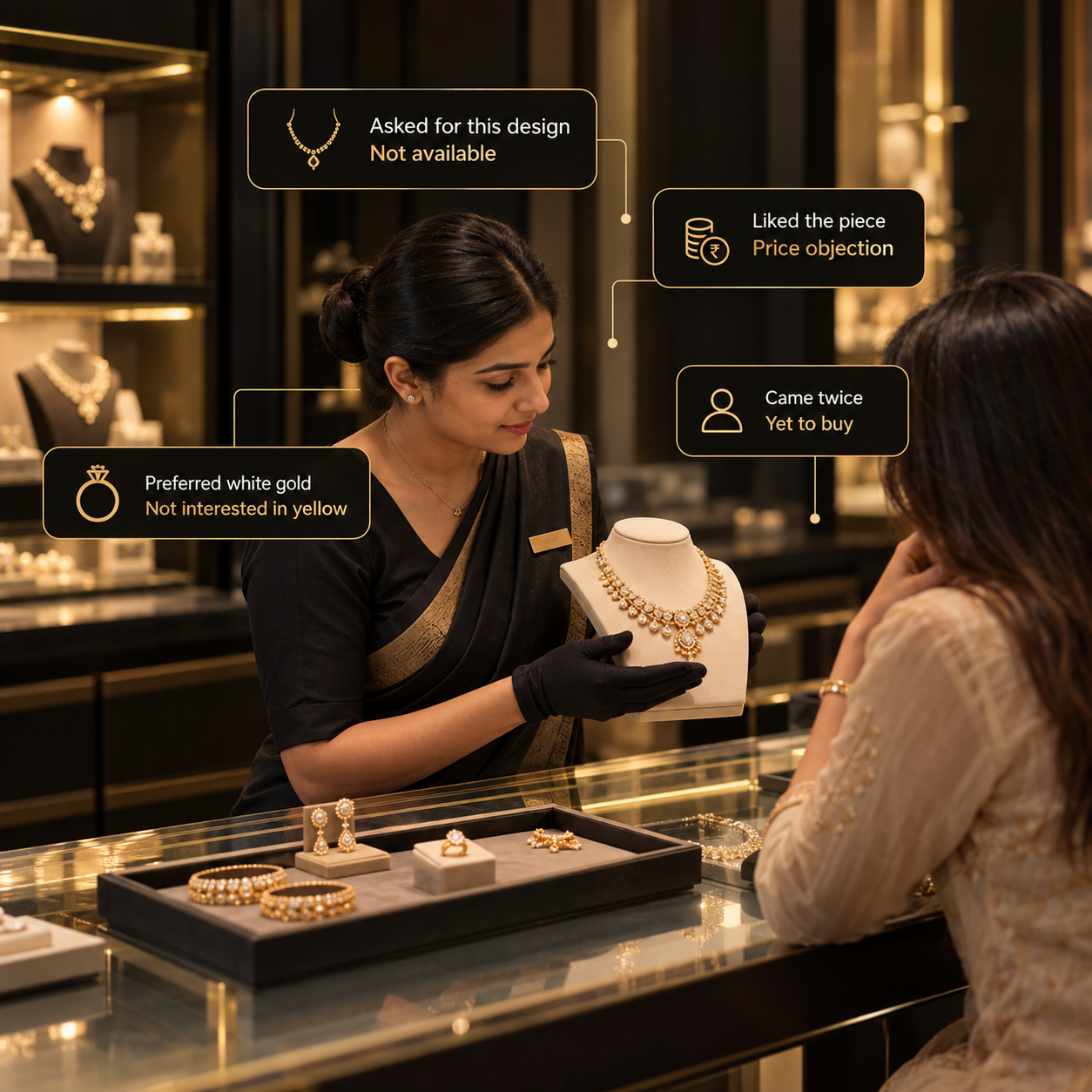
By Saturday evening, the counter knows a great deal. Which designs people asked for and you did not have. Which three customers walked out at the making charge. That the 18KT white gold bands are moving and the yellow are not. That someone came in twice about the same necklace and has not bought yet.
By Monday morning, head office knows one number: the day's sales total.
Everything else stayed in the showroom, in a salesperson's memory, and by then most of it has gone.
For a jewellery business operating across multiple stores, this gap between what happens at the counter and what reaches management is more than a reporting problem. It affects purchasing decisions, inventory allocation, customer follow-ups and the ability to respond to demand while that demand still exists.
A point-of-sale (POS) system tells you what was sold. A connected retail intelligence system should also help you understand what customers wanted, why they did not buy, and what the business should do next.
The difference becomes particularly important when a jeweller manages several outlets, multiple product categories and inventory that carries significant capital.
The information a sale does not capture
A completed transaction is easy to measure. A customer purchases a necklace, the invoice is generated, the inventory is updated, and the sale appears in the report.
But the transaction represents only the end of the customer's decision-making process. It does not capture everything that happened before it.
Consider a typical Saturday at a jewellery showroom. A customer asks for a particular diamond ring in a specific size. The store has a similar design, but not the requested variant. The customer leaves without buying.
Another customer likes a bridal necklace but finds the making charges higher than expected. A third asks for lightweight gold bangles within a particular budget, examines several designs, and promises to return after discussing the purchase with family.
None of these interactions necessarily generates an invoice. Yet each contains information that could influence future sales.
For a multi-store jeweller, these missed signals generally fall into four categories:
- Unfulfilled demand: Designs, sizes, weights, metals or price points customers request but the store cannot supply.
- Price objections: Products customers like but reject because of the total price, making charges or budget mismatch.
- Product substitutions: Customers who accept an alternative because their preferred item is unavailable.
- Unconverted enquiries: Customers who show genuine purchase intent but leave without completing a transaction.
Traditional sales reports cannot reliably distinguish between a product that nobody wanted and a product that several customers wanted but the store could not supply.
That distinction matters. If a particular design repeatedly attracts enquiries without converting into sales, the answer may not be more advertising. The store may need a different size, a different price point, better availability or a timely follow-up.
Jewellery POS reporting becomes more useful when transaction data is combined with information about customer intent.
Why the weekly report is already a historical document
Weekly reports remain useful for reviewing performance, identifying broad trends and reconciling business results. The problem begins when management uses them as the primary source for operational decisions that need to happen sooner.
Imagine a jewellery chain with eight stores. During the weekend, one outlet receives repeated requests for lightweight gold chains, while another has several customers asking for diamond earrings within a similar price range.
If these observations reach head office only in the next weekly report, the purchasing or inventory team is already working with delayed information.
By the time the report is reviewed, the buying team may have placed an order based on older sales patterns. Meanwhile, the store with unmet demand may continue losing opportunities, even though another branch has suitable inventory.
This creates two avoidable risks.
First, purchasing decisions are based on completed sales rather than emerging demand. A design that has not sold well might still be worth investigating if customers repeatedly ask for a variant the store does not carry.
Second, inventory transfers happen later than necessary. A piece sitting idle at one branch could satisfy a customer at another, but only if the business knows about the demand and the available stock in time.
Real-time jewellery inventory management does not mean buying every item a customer requests. It means giving decision-makers current information before committing capital or allowing a sales opportunity to disappear.
A weekly report explains what happened during the previous week. A live operational view helps management decide what to do today.
What the shop floor could tell you, if asked
The showroom is one of the earliest places where changes in customer demand become visible.
Sales figures show which products customers purchased. Enquiry patterns can reveal which products they are considering, what they cannot find and where the business may be losing conversions.
For a jewellery retailer, these signals become particularly valuable when they are recorded consistently across stores, so they can be compared with inventory, sales and conversion data.
A spreadsheet filled with unstructured notes from individual salespeople is unlikely to give a director a dependable picture. One employee may record a request as a product enquiry, another may write it in a notebook, and a third may not record it at all.
The objective is not to document every conversation. It is to identify meaningful purchase intent in a consistent format.
Capture at the counter without slowing the counter
Enquiry capture has a practical constraint: the salesperson is there to serve customers, not to complete administrative forms.
A process that adds thirty seconds to every interaction can quickly become unpopular during busy trading hours. If the system is difficult to use, employees may postpone entries, record incomplete information or stop capturing enquiries altogether.
The solution is to design the process around the counter's existing workflow.
A useful jewellery enquiry capture process should allow the salesperson to:
- Select the product category or design being requested.
- Record a relevant attribute, such as metal, size, weight range or budget.
- Mark the reason the sale did not happen, where applicable.
- Link the enquiry to a customer profile if the customer agrees to share their details.
- Save the entry without leaving the POS workflow.
The interface should use short selections, sensible defaults and existing product data wherever possible. It should avoid asking employees to enter information that the POS already knows.
For example, if a customer requests a ring that is unavailable in size 14, the salesperson should be able to record the missing variant with a few selections. The system should not require a paragraph describing the conversation.
The same principle applies to customer follow-ups. Contact information should be collected with appropriate consent, and the salesperson should be able to set a follow-up task without maintaining a separate diary.
The goal is simple: capture useful information in seconds, not minutes.
A short, consistent record from most meaningful enquiries is more valuable than a detailed form that nobody completes.
Enquiry capture is a CRM problem wearing an operations costume
At first glance, an unconverted enquiry may appear to be a sales or inventory issue. In practice, it often sits at the intersection of POS, CRM and stock management.
The POS knows what is available and what was sold. The CRM knows which customer showed interest, what follow-up is due and whether the customer has engaged with the business previously. Inventory management connects the product request to actual stock availability.
When these systems operate independently, employees must bridge the gaps manually.
A salesperson may know that a customer wants a particular necklace, but the inventory team may not know that demand exists. The CRM may contain the customer's phone number, but no task may be created to contact them when the necklace becomes available.
A connected system can link these activities.
For example, when a customer requests an unavailable design, the enquiry can be recorded against the relevant product attributes. If the customer agrees to a follow-up, the CRM can create a reminder. When the required item arrives or becomes available at another branch, the business can identify relevant open enquiries and arrange appropriate follow-up.
This is where the relationship between jewellery POS and CRM becomes operationally important.
CRM should not merely store names and phone numbers. It should help the business act on customer intent. POS should not merely generate invoices. It should supply the transaction and inventory context needed to understand that intent.
For a multi-store jewellery business, integration creates a more complete view of the customer journey without requiring employees to maintain multiple disconnected records.
What a director should be able to see by lunchtime
A director should not have to wait until Monday to understand what happened across the retail network over the weekend.
A useful real-time jewellery retail dashboard should prioritise a small number of actionable indicators rather than displaying every available metric.
Metric | What it helps management understand |
|---|---|
Sales by store | Which outlets are contributing to revenue and how performance is changing. |
Stock movement | Which items are selling, where inventory is moving and where stock may be underutilised. |
Unconverted enquiries | How much recorded customer interest has not yet resulted in a purchase. |
Requested but unavailable items | Which designs, variants or price bands may have unmet demand. |
Pending follow-ups | Which customers need a response, availability update or sales conversation. |
Enquiry-to-sale conversion | How effectively the business converts recorded interest into transactions. |
These metrics become more powerful when viewed together.
Suppose one store reports strong enquiries for diamond earrings but weak conversions. If the dashboard also shows that relevant inventory is unavailable, management has a concrete issue to investigate.
If the products are available but customers repeatedly cite price objections, the next step may be to examine assortment, price bands or the sales conversation instead.
The dashboard should also allow directors to move from a chain-wide overview to individual stores and relevant product categories.
However, real-time reporting must be supported by timely data synchronisation, consistent product categorisation and reliable POS integration. A dashboard cannot provide a trustworthy live picture if store systems upload incomplete records or update only periodically.
The purpose is not to give management more numbers. It is to shorten the distance between a signal on the shop floor and a decision at head office.
Festival weeks make the lag expensive
Indian jewellery retail operates around periods when customer demand can change sharply within a short window.
Dhanteras and Diwali bring concentrated buying activity. Akshaya Tritiya is an important gold-purchasing occasion. Wedding seasons create demand shaped by regional customs, family preferences, bridal requirements and local buying patterns.
During these periods, a store can experience a meaningful change in demand over a single weekend.
Customers may ask for particular chain weights, bridal sets, coin denominations, lightweight everyday jewellery or designs within specific budgets. The pattern will vary by location, customer segment and occasion.
If head office relies only on weekly sales reports, these emerging signals may reach the buying and inventory teams after the most valuable selling window has passed.
Consider a simple example.
A branch begins receiving repeated requests for lightweight gold necklaces ahead of Dhanteras. Another branch has suitable pieces that have remained unsold for several weeks. If the business can see both facts early enough, it can evaluate whether transferring selected pieces makes commercial sense.
Without timely information, the first branch may continue missing sales while the second carries stock that could be more productive elsewhere.
The same logic applies to customer follow-ups. Someone who asks about a specific piece before a festival may need a timely availability update. A reminder sent after the occasion may have little value.
Real-time visibility does not guarantee a sale or eliminate forecasting uncertainty. It does give the business more time to respond while customer intent remains relevant.
For jewellery retailers, this is particularly important during compressed trading periods, when the cost of acting on outdated information can be much greater than during a normal week.
Moving from reporting to responding
A dashboard that shows what happened is useful. A connected system that helps the business take the next step is more valuable.
The distinction lies in what happens after an insight appears.
Consider four common situations:
Inventory
A design is repeatedly requested but unavailable.
A manager reviews the open enquiries, checks inventory across branches and evaluates whether to transfer stock or replenish the item.
Customer follow-up
A customer leaves without purchasing.
The salesperson records the reason and, with the customer's consent, schedules a relevant follow-up instead of relying on memory.
Assortment
A price band generates enquiries but few sales.
Management examines stock availability, product mix and recorded objections before deciding whether the assortment needs to change.
Purchasing
A category shows rising demand across several stores.
The buying team reviews enquiry trends alongside sales velocity, existing stock and margins before adjusting the next purchase.
Not every signal should trigger an automatic action. A handful of enquiries may reflect temporary interest rather than a durable trend. Price objections may have several causes, and an item that is unavailable in one store may already be adequately stocked elsewhere.
The system should help managers distinguish between isolated observations and repeatable patterns, while keeping important commercial decisions under human control.
This requires more than a reporting screen. It requires reliable connections between the POS, CRM, inventory and management workflows.
For jewellery retailers evaluating their technology stack, the important question is therefore not simply whether the system offers live reports.
It is whether the information can lead to a useful action without creating another manual process.
Frequently asked questions
What should a jewellery POS report in real time?
A jewellery POS should report sales by store, billing activity, inventory movement, product performance and relevant stock availability. When integrated with CRM, it can also provide visibility into unconverted enquiries, pending follow-ups and customer conversion patterns. The usefulness of these reports depends on data quality and how frequently connected systems synchronise.
How can jewellery stores capture enquiries that do not become sales?
Jewellery stores can capture unconverted enquiries through a short POS-integrated workflow that records the requested product, relevant attributes, reason for non-conversion and follow-up requirement. Where customers consent to share their details, the enquiry can be linked to a CRM profile. Keeping the process quick and consistent makes it easier for salespeople to maintain accurate records during busy hours.
Why is weekly sales reporting not enough for multi-store jewellers?
Weekly reports are useful for historical analysis but can delay decisions about stock transfers, replenishment and customer follow-ups. In a multi-store business, demand at one branch may be met by inventory available at another, provided the information reaches the right team in time. Real-time or frequently refreshed reporting helps management respond while the opportunity is still relevant.
What is the difference between POS reporting and business intelligence?
POS reporting focuses primarily on transactions, billing and operational records, while business intelligence combines data from sources such as POS, CRM and inventory systems to identify patterns and support decisions. For jewellery retailers, POS reporting can show what sold, while business intelligence can help investigate why certain enquiries did not convert or where stock may be better allocated. The two capabilities complement each other.