

Hallmarking, HUID and the paperwork that slows a sale
HUID made every hallmarked piece individually identifiable, and made jewellery billing a compliance process. What the software has to handle at the counter.
HUID gave every hallmarked article a unique six-character identity. For the customer, it is reassurance. For the counter, it is one more field that must be right before an invoice can be raised.
Where that field lives decides whether a sale takes four minutes or fourteen.
A customer has selected a gold necklace. The weight is confirmed, the making charges are explained, and the payment is almost ready. Then someone has to locate the correct stock record, check the hallmark details and make sure the invoice reflects the article being sold.
If the information is already connected, this is a routine step. If it lives on a paper tag, in a spreadsheet and in a separate billing system, the same sale can turn into a search across three different places.
That is the operational side of hallmarking and HUID that jewellery businesses need to understand.
Hallmarking is intended to protect customers by providing assurance about the purity of precious-metal articles. The Hallmark Unique Identification (HUID) number adds an individual identity that customers can verify through the BIS CARE app. For retailers, however, the challenge is making sure that identity remains connected to the correct article throughout its journey, from receiving stock to billing, returns and reconciliation.
The question is not simply whether a jeweller records HUID. It is whether the business can find and use the correct information without slowing down the showroom.
What HUID changed operationally
Before a retailer considers its software or billing process, it helps to distinguish between two things: identifying a product design and identifying an individual physical article.
A catalogue may contain one design of gold ring in several sizes and weights. The design tells the salesperson what the product is. A stock record tells the business which particular piece is available. HUID provides a unique identification for an individual hallmarked article.
This distinction matters when multiple pieces look almost identical.
Imagine a store holding five gold rings with the same design. Their displayed product names may be identical, but their individual weights, stock references and hallmark identifiers may differ. Selecting a generic product name is not enough to establish which physical ring has been handed to the customer.
A well-designed inventory system therefore needs to distinguish between:
- Product: The design or catalogue item displayed to the customer.
- Stock instance: The individual physical piece held by the store.
- HUID: The unique identifier associated with the hallmarked article.
- Transaction: The sale, transfer, return or other event involving that piece.
The precise records required for a particular transaction depend on the applicable BIS rules and the retailer's operating process. The underlying data principle remains the same: information about an individual article should not be confused with information about its overall design.
For a jeweller operating multiple branches, the distinction becomes even more important. A salesperson should be able to identify the actual piece in the selected store rather than assume that a catalogue entry represents all available units.
The operational takeaway: HUID makes individual article identification an important part of stock control. The software must preserve that identity without treating every piece of the same design as interchangeable.
Where the number has to appear
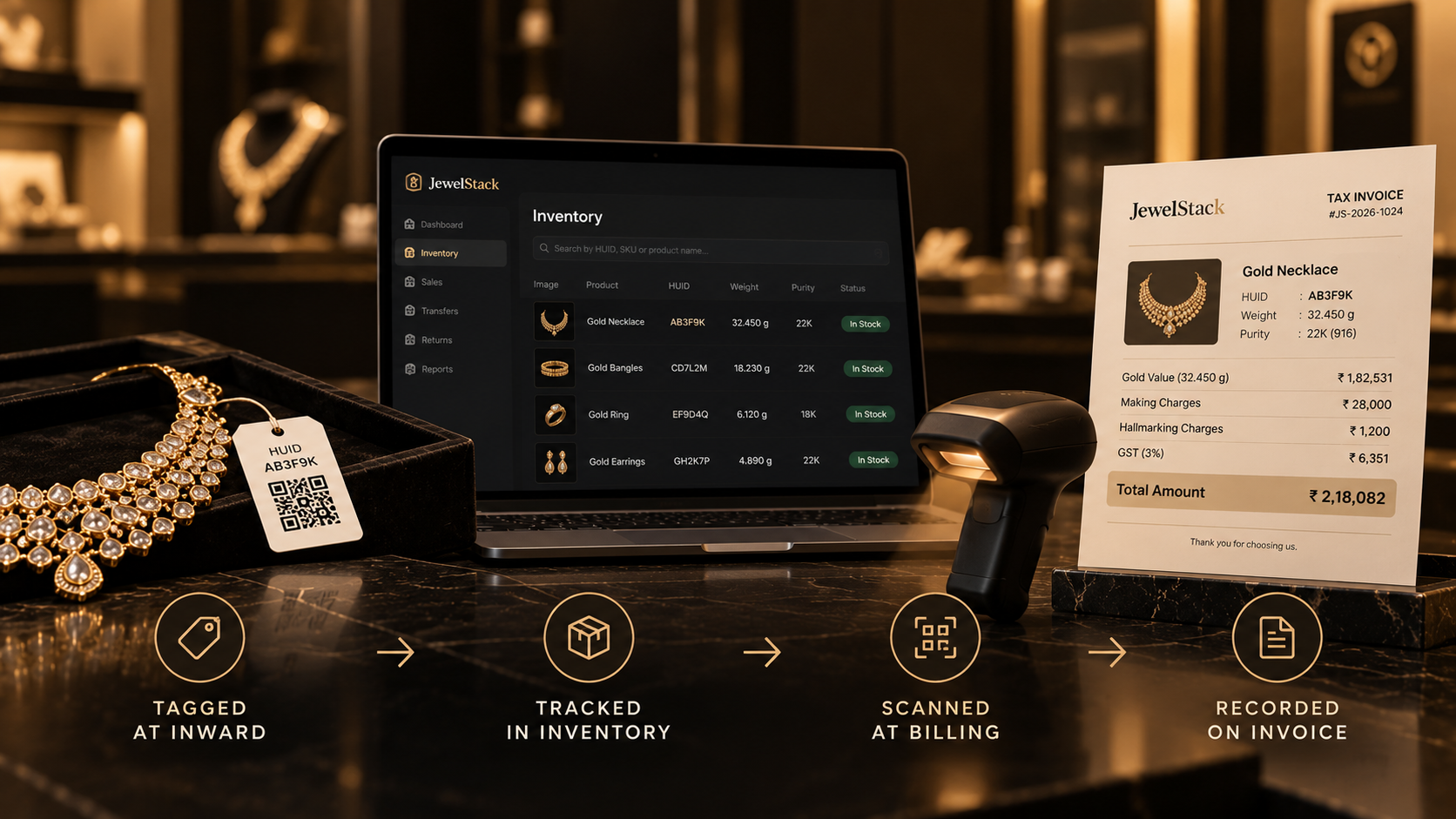
HUID management is not a single-field exercise. It is a chain of information that must remain consistent across physical stock and business records.
A typical retail workflow looks like this:
- Stock receipt: The team receives the article and records the supplier, purchase details, weight, purity and relevant identification.
- Article tagging: The physical piece is connected to its stock record through an appropriate tag or other reliable reference.
- Inventory storage: The record is associated with the correct branch, display location or stock status.
- Billing: The salesperson selects the actual article, and the system retrieves its stored information.
- Post-sale records: The transaction remains connected to the item so that authorised staff can investigate it later.
The exact fields, documents and mandatory disclosures at each stage should be verified against current BIS requirements and the retailer's accounting procedures.
The main failure point is often the connection between the physical item and the digital record.
A tag may be attached to one piece while the software record belongs to another. A stock transfer may change the branch but not update the system. A salesperson may select a similar-looking item because the correct article is difficult to locate.
These are not necessarily failures of hallmarking itself. They are failures of identification and record management.
A practical example
A retailer has three similar gold chains in stock. Their catalogue descriptions match, but each chain has its own stock reference and weight.
If the billing system retrieves information from the selected article record, the salesperson can confirm the relevant details before completing the invoice.
If the billing system only retrieves the common product description, staff may have to compare tags manually and verify the correct weight and identification.
The difference is not the complexity of the regulation. It is the quality of the connection between stock and billing.
The counter experience: scanning versus typing
A busy jewellery counter is not the ideal place to reconstruct missing information.
Customers may be comparing designs, asking about exchange value or waiting for a family member to approve a purchase. A salesperson may be handling several articles while another employee prepares the invoice.
Every additional manual step creates another opportunity for delay or error.
Typing an identifier by hand can be necessary in some circumstances, but it should not be the only practical way to retrieve a stock record.
A better workflow is to let staff scan an appropriate stock barcode or another supported identifier and retrieve the corresponding article record. Where HUID is captured separately, the software should retain its association with that article.
These identifiers should not be confused: a store-generated barcode is not automatically the same thing as the BIS-issued HUID.
A useful billing workflow should allow staff to:
- Locate the correct physical article quickly.
- View its recorded weight, purity and other relevant details.
- Confirm the stock record before generating the invoice.
- Detect missing or inconsistent information before the transaction is completed.
- Retrieve the transaction record later when an authorised review is required.
The system should also support a controlled manual fallback when a scanner, label or device is unavailable. The objective is to reduce unnecessary manual work without making the sale dependent on a single piece of hardware.
The principle: Capture information accurately when stock enters the system. Reuse it during billing rather than asking staff to recreate it at the counter.
Returns, exchange and old gold
Returns and exchanges deserve particular attention because they can involve several different physical articles and transactions.
A customer might return a recently purchased ring, exchange a necklace for another design or offer old gold towards a new purchase. Although these situations may look similar from the customer's perspective, they are not the same operational event.
When a previously sold article is returned
The retailer needs to establish which transaction the return relates to and identify the article being received.
Where the original item and its records can be matched, the system can connect the return to the original sale. The business should then record the item's resulting status according to its approved return and inventory process.
A returned article should not automatically be treated as available for resale simply because it has re-entered the store.
When a customer exchanges jewellery
An exchange can involve the return of one article, a valuation or adjustment, and the sale of a different article.
The system should preserve the relationship between the original sale, the returned item, any applicable credit or adjustment, and the replacement item. Each article should retain its own stock identity.
This makes it easier to answer questions later about what was returned, what was issued and how the transaction was settled.
When a customer brings old gold
Old gold purchased from a customer must be handled as a distinct transaction. The retailer needs an appropriate process for recording the received material, its assessment and valuation, and its subsequent disposition.
BIS guidance confirms that consumers can sell old hallmarked or unhallmarked jewellery to jewellers. That does not mean every item of old gold should be treated as a newly hallmarked retail article. Its handling depends on the actual transaction and the applicable requirements.
For this reason, the software should distinguish between customer returns, exchanges, purchases of old gold and material sent for melting or further processing.
Compliance note: The specific hallmarking, re-hallmarking and documentation treatment of returned articles, exchanged items and old gold should be confirmed with a BIS compliance specialist before publication or implementation. Do not assume that the HUID of an incoming article can simply be transferred to a different article.
Invoice requirements beyond HUID
HUID is only one part of the information a jewellery retailer needs to manage correctly.
The Bureau of Indian Standards' published guidance for bills covering hallmarked precious-metal articles identifies the description of each article, net weight of precious metal, purity in carat and fineness, and hallmarking charges as details to include. The current requirements should be checked against the latest applicable notifications before a billing template is finalised.
A retail invoice may also need to present relevant commercial and tax information, depending on the transaction and applicable GST rules.
| Information | Why it matters |
|---|---|
| Article description | Identifies what the customer purchased |
| Net precious-metal weight | Helps communicate the metal quantity accurately |
| Purity in carat and fineness | Records the declared purity details |
| Hallmarking charges | Provides the required charge disclosure where applicable |
| Making charges | Shows the applicable manufacturing or workmanship charge |
| GST details | Supports correct tax calculation and reporting |
| Article or stock reference | Helps connect the invoice to the internal inventory record |
| HUID, where captured or required | Supports identification and verification of the hallmarked article |
The last two rows should not be interpreted as a claim that BIS mandates the same invoice format for every retailer. An internal stock reference is a useful operational control, while the precise legal requirement to display HUID on a customer invoice must be confirmed against the current applicable rules.
Why the invoice configuration matters
A billing template is not merely a printed document. It is the output of the inventory, pricing and tax configuration behind it.
If the system does not store net metal weight separately from other weight components where applicable, staff may have to correct the details manually. If making charges are configured inconsistently, the invoice may not explain the transaction clearly. If tax rules are hard-coded without proper review, a software change may be needed whenever the business's approved tax treatment changes.
For ordinary retail sales of jewellery, CBIC guidance states that GST is calculated at 3% of the total transaction value, whether making charges are shown separately or not. Special transaction types and other circumstances require their own review.
The correct approach is to have the accountant or tax adviser validate the tax configuration, while the jewellery operations team confirms that the underlying article details are accurate.
Stock records that carry identity, not just quantity
A conventional stock report might say that a store has 12 gold rings in a particular design. That is useful for understanding overall availability, but it is not enough to manage each physical piece independently.
For individual hallmarked articles, a retailer benefits from an inventory model that distinguishes the design from its physical instances.
For example, a record for a gold ring could contain:
- Product design and SKU.
- Individual stock reference.
- Weight and purity details.
- HUID, where applicable.
- Current branch and stock status.
- Supplier and inward transaction reference.
- Relevant purchase and sales history.
- Links to returns, transfers or adjustments.
Not every field is a statutory requirement. This is a practical data model designed to improve traceability and reduce manual reconciliation.
Why this matters for multi-store jewellery businesses
Consider a retailer with four branches. One branch has a ring that a customer wants, but the customer is currently visiting another branch.
A connected inventory system should help the team determine whether the required piece is available, where it is located and whether it is actually available for sale.
When the item is transferred, the movement should be recorded against the correct stock instance. When it is sold, the same record should reflect the resulting status.
This avoids a common operational problem: the catalogue says the item exists, but nobody can confidently establish where the physical piece is.
For enterprise jewellery retailers, the benefits extend to stock audits, branch transfers, replenishment, customer service and reconciliation between the point of sale and the central inventory.
Audit and the records you have to produce
A useful test for any jewellery inventory system is simple:
Can the business reconstruct what happened to a particular article without relying on someone's memory?
For a selected article, an authorised employee should be able to retrieve the available records linking its inward entry, stock movements, sale and any subsequent return or adjustment.
Depending on the transaction, supporting records may include purchase documents, supplier information, stock movement logs, invoices, credit or return records, and applicable hallmarking documentation.
The records required and the periods for which they must be retained depend on the relevant BIS rules, GST requirements and other applicable laws. These should be confirmed with the retailer's compliance and accounting advisers rather than assumed to be identical for every record type.
From a systems perspective, three capabilities are particularly useful.
1. Searchable article history
Staff should be able to locate an article through the available identifiers and view the associated records.
2. Traceable changes
The system should preserve who made a material change, when it occurred and what was changed, subject to appropriate access controls.
3. Reconciliation across systems
Where POS, inventory, accounting or ERP platforms are separate, the business should be able to reconcile the relevant transactions and investigate discrepancies.
An audit trail does not replace statutory records or a compliance review. It makes the records the business already needs easier to retrieve and verify.
Designing compliance so it does not slow the sale
The goal is not to remove necessary checks. It is to avoid repeating the same work at every stage.
A practical approach is to design the workflow around the article's journey.
At inward: Capture the available article information, validate the relevant identifiers and connect the physical piece to its digital record.
During storage and transfers: Preserve the article's identity and update its location and status when it moves.
At billing: Retrieve the existing information, validate the details required for the transaction and generate the invoice using the approved configuration.
After the sale: Preserve the transaction history so returns, exchanges and reviews can be handled without reconstructing the original sale from scratch.
This approach becomes especially valuable when the retailer operates multiple stores or uses separate systems for POS, inventory, accounting and ERP.
The technology does not need to make every employee a compliance specialist. It should make the correct process straightforward and make missing information visible before it creates a problem.
A checklist for jewellery retailers
Before reviewing a POS or inventory platform, ask:
- Can we identify each physical article independently of its product design?
- Can authorised staff retrieve the relevant HUID and stock information quickly?
- Are required invoice fields configured and validated?
- Can we distinguish a return from an exchange and an old-gold purchase?
- Do stock transfers preserve the connection to the correct article?
- Can we investigate changes and reconcile transactions across branches?
- Have our invoice templates, record-retention settings and operating procedures been reviewed against current requirements?
If several answers are no, the issue may be larger than a missing field in the billing software. It may be a gap in how the business manages article identity across its operations.
For retailers evaluating connected POS and inventory systems, this is where a well-designed jewellery platform can help: not by replacing compliance expertise, but by connecting the information that staff need to complete routine transactions accurately.
At JewelStack, the relevant technology conversation is about building that continuity between inventory, billing and multi-store operations so the showroom team can focus on the customer rather than searching for records.
Frequently asked questions
What is HUID and what does it mean for jewellery billing?
HUID stands for Hallmark Unique Identification. It is a unique six-character alphanumeric identifier associated with an individual hallmarked gold jewellery article under India's hallmarking framework. For jewellery billing, it helps retailers connect the physical article with its stock record and relevant transaction information. Customers can use the BIS CARE app's Verify HUID feature to check available hallmark details.
Does HUID have to be printed on a jewellery invoice?
BIS guidance specifies article description, net precious-metal weight, purity in carat and fineness, and hallmarking charges among the details to be included in the bill for hallmarked precious-metal articles. That published list does not, by itself, establish a universal requirement to print HUID on every invoice. Jewellers should verify the latest applicable BIS notifications and directions before finalising their invoice format.
How is HUID handled when a customer returns or exchanges a piece?
The retailer should identify the article received and connect the transaction to the relevant original sale or exchange records where applicable. The article's existing identification should not be transferred to a different piece, and its inventory status should be updated according to the retailer's approved process. The specific hallmarking treatment for returned and exchanged articles should be confirmed against current BIS requirements.
What records must a jeweller keep for hallmarked items?
A jeweller should maintain the applicable purchase, stock, invoice, movement and transaction records needed to demonstrate the article's history and meet relevant legal requirements. BIS hallmarking rules and GST recordkeeping requirements may impose different obligations depending on the record and transaction. The required records and retention periods should be confirmed with a qualified compliance professional or accountant.