
Stock that has not moved since Akshaya Tritiya
Jewellery stock does not expire, so it is easy to stop noticing. How to measure ageing against the festive calendar and decide what to melt, move or remake.
Gold does not spoil. That is the problem.
A design that has not sold since Akshaya Tritiya is still worth its metal, so nothing about it looks like a loss. It sits in the drawer, holds its value, and quietly occupies capital that could have been three designs people actually want.
In a jewellery business, inventory is also a form of savings. Gold retains intrinsic value, making slow-moving stock easy to overlook. But the value of the metal is only one part of the equation. The money tied up in an unsold piece cannot be used to buy fresh designs, respond to customer demand, or expand inventory in a better-performing store.
This is why dead stock management in jewellery retail requires a different approach from conventional retail inventory management. The objective is not simply to identify old stock. It is to understand whether a piece still has a realistic chance of selling, where it is most likely to sell, and whether holding it is worth the opportunity cost.
Why ageing is harder to see in jewellery
In most retail categories, ageing inventory eventually becomes an obvious problem. Fashion products go out of season, electronics lose relevance, and perishable goods have expiry dates. Jewellery behaves differently.
A gold necklace purchased months ago may still carry substantial metal value. Even if the original design attracts no buyers, the gold can potentially be recovered, reused, or converted into another product. This creates a misleading sense that the inventory is safe to hold indefinitely.
However, metal value and commercial performance are not the same thing.
Consider a jewellery store holding a collection of necklaces purchased before Akshaya Tritiya. If those pieces have not sold by the following months, the store may not record an immediate accounting loss. Yet the business has already incurred costs associated with manufacturing, making charges, procurement, storage, insurance, and the capital committed to those pieces.
There are three reasons ageing stock often goes unnoticed in jewellery retail.
First, the metal retains value. The rising gold rate can make an old piece appear financially protected, even when the design has stopped attracting customers.
Second, there is no natural expiry date. A piece can remain in a display tray for months or years without triggering an automatic decision to remove it.
Third, aggregate inventory values hide individual problems. A store may report a healthy inventory valuation while a significant portion of its designs has not moved for months.
The solution is to evaluate jewellery inventory using both its financial value and its sales behaviour. A piece should not be considered healthy stock simply because its gold value remains high.
Measuring age against the calendar you actually trade on
A conventional inventory report might show that a necklace has been in stock for 120 days. That is useful information, but it does not tell the complete story of jewellery demand.
Jewellery purchases are strongly influenced by occasions, regional traditions, wedding dates, and festival calendars. Akshaya Tritiya, Dhanteras, Diwali, and wedding season can create distinct periods of customer demand.
A piece that has not sold for 30 days immediately after a major buying occasion may require a different response from a piece that has remained unsold through two relevant festive seasons.
This is why jewellery retailers should track festivals missed alongside days in stock.
For example, consider a gold necklace purchased before Akshaya Tritiya that remains unsold after the festival. If it also fails to attract buyers during the next relevant wedding period, the business has stronger evidence that the design, price point, or local demand may be misaligned.
A practical inventory ageing report should include:
- Stock-in date: When the piece entered inventory.
- Days in stock: The total number of days since receipt.
- Relevant selling occasions missed: Festivals, wedding periods, or campaigns during which the piece was available.
- Last sale date for the design: When a comparable piece last sold.
- Last customer interaction: When the piece was last selected, enquired about, or tried on.
- Current stock value: Its current inventory carrying value, alongside relevant metal and making-cost information.
- Sales velocity: How frequently comparable pieces sell.
Retailers should also distinguish between calendar age and active selling time. A product received shortly before a major festival may have had more meaningful exposure to demand than one received immediately afterwards.
The objective is not to establish one universal deadline for every piece. It is to identify when a design has had a fair opportunity to sell and what its sales history suggests should happen next.
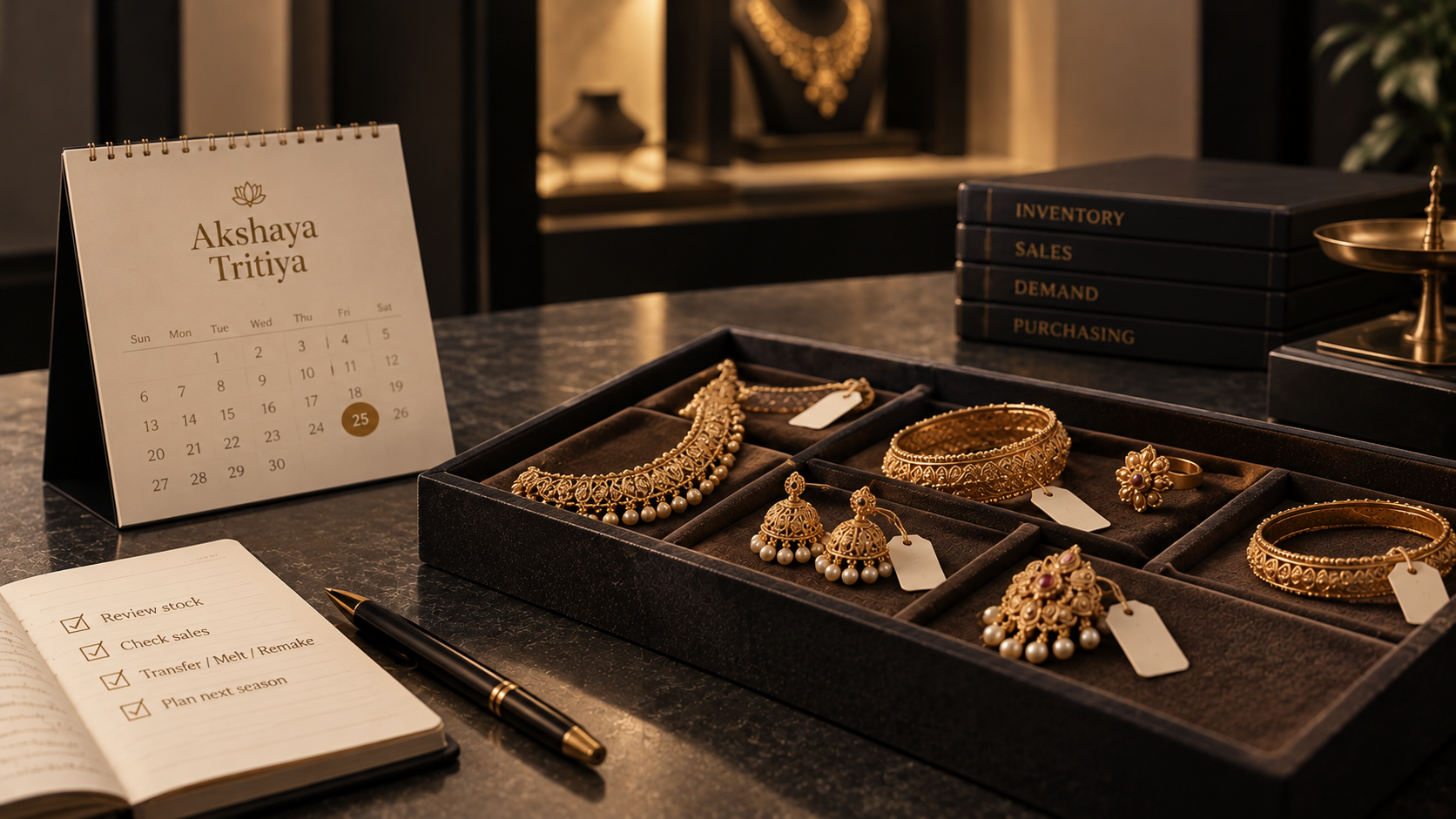
The design that sells in one city and not another
One of the most expensive inventory decisions a jewellery retailer can make is writing off a design that has simply been placed in the wrong market.
Customer preferences vary across cities, regions, store formats, and price segments. A heavy bridal necklace may sell consistently in a store with strong wedding demand while remaining untouched in a location whose customers prefer lightweight daily-wear jewellery.
Looking at company-wide sales alone can conceal this difference.
Imagine a retailer operating six stores. A particular design has not sold in one store for four months, but three units of the same design have sold in another location during the same period. The design may not be dead stock at all. It may be a location-specific inventory problem.
Before discounting, melting, or remaking a piece, retailers should examine its performance at three levels:
1. Store-level performance
Has the design failed to sell only at the current location, or has it remained unsold across every branch?
2. Regional demand
Are similar designs selling in nearby stores or in locations with comparable customer preferences?
3. Product-level demand
Are customers buying the same category, weight range, purity, or price band but rejecting this particular design?
These comparisons help distinguish a demand problem from a distribution problem.
A structured stock transfer can recover the selling opportunity without immediately sacrificing making charges or commissioning a replacement design. However, transfers should account for logistics costs, stock availability at the destination, and the likelihood of selling within a defined period.
The right question is not simply, "Why has this piece not sold?"
It is, "Has this piece failed everywhere, or have we failed to place it where it is most likely to sell?"
Melt, move or remake
Once a jewellery piece has been identified as ageing inventory, the next decision should be based on its remaining commercial potential rather than its age alone.
Most pieces have three broad options: move them to another store, melt or recover the metal, or remake them into a more relevant design.
Option 1: Move the stock
A transfer is worth considering when comparable pieces are selling elsewhere and the destination store has a clear customer segment for the design.
Before transferring, compare the expected selling price, estimated selling time, transport and handling costs, and the likelihood of the piece selling before the next relevant demand period.
Set a review date after the transfer. Otherwise, the business may simply move the ageing problem from one stockroom to another.
Option 2: Melt or recover the metal
When the design has weak demand across locations and comparable products are also underperforming, metal recovery may be more sensible than continued holding.
The important calculation is the net recovery value, not the headline value of the gold.
Consider:
- Recoverable gold value based on weight, purity, and the applicable rate.
- Refining, melting, testing, and other applicable recovery charges.
- Any recoverable or non-recoverable stones and other components.
- Applicable taxes, settlement deductions, and operational costs.
- The difference between the original inventory cost and the amount recoverable.
Making charges are particularly important. The making charge paid to create the original piece is generally not recovered in full when the item is melted. That amount is a sunk cost, although the original cost still matters when assessing the overall financial outcome.
The decision should compare the net recovery value with the expected proceeds from continued selling, after allowing for selling costs and the cost of waiting.
Option 3: Remake the design
Sometimes the problem is not the gold but the design in which it is currently held.
A heavy necklace might be redesigned into lighter pieces. An older chain design might be converted into a more contemporary style. Depending on the product, stones and other components may be reused.
Remaking can preserve some of the original material's utility while creating a product better aligned with current demand. However, it introduces additional making charges, labour, wastage considerations, and production time.
The comparison should therefore include the expected selling price of the new design, remake costs, recoverable material value, and the probability of selling the finished product.
The practical rule is simple: transfer stock when demand exists elsewhere, remake it when the material has better commercial potential in another design, and recover the metal when neither the existing design nor a remake offers an attractive return.
What ageing data should tell the buying decision
Inventory ageing is not just a way to clean up last season's stock. It is also feedback for the next buying cycle.
If the same types of pieces repeatedly remain unsold, the problem may extend beyond individual designs. It could indicate that the business is buying too deeply into certain categories, overestimating local demand, or purchasing products at price points that customers are no longer choosing.
A useful review connects ageing data to purchasing decisions.
For every major category, examine:
- Which designs sold quickly during the previous season.
- Which designs remained unsold despite sufficient customer exposure.
- Which price bands generated the highest conversion.
- Which weights, styles, and product categories attracted enquiries but few purchases.
- Which stores had excess stock while others experienced shortages.
- Which designs sold only after substantial discounts.
- How much capital remained tied up in ageing inventory.
This information should influence the next purchase order.
For example, if lightweight necklaces consistently sell through while heavier versions remain in stock, the next buying cycle might favour a different mix of weights and designs. If bridal sets sell well only in specific locations, purchasing and allocation should reflect that regional demand rather than relying on a uniform assortment across every store.
Retailers should also compare purchase quantities with actual sell-through. A design that sells three units from a purchase of four tells a different story from a design that sells three units from a purchase of thirty.
The goal is to move from intuition-led buying to evidence-informed buying without removing the role of merchandising expertise.
The counter signal you are not recording
Inventory ageing tells a retailer what has not sold. It does not necessarily explain why.
A customer may pick up a necklace, examine it, and put it back. Another may enquire about a ring in a particular size or budget, only to discover that the store does not have a suitable option. A third may like a design but reject it because the final price exceeds their budget.
These interactions contain useful demand signals, even when they do not produce a transaction.
If a retailer records only completed sales, the inventory system sees no demand for an unsold piece. In reality, the piece may have attracted considerable attention but failed to convert for a specific reason.
Jewellery retailers can improve inventory decisions by recording a few practical signals:
Product interactions: Which pieces customers picked up, tried on, or repeatedly viewed.
Unfulfilled enquiries: Which designs, sizes, weights, or price ranges customers requested but the store could not supply.
Rejection reasons: Whether customers rejected a piece because of design, price, weight, availability, or another identifiable factor.
Sales conversion: How often customer interest in a product or category results in a purchase.
Campaign response: Whether specific designs attract enquiries when featured in advertising or customer outreach.
Combining these signals with stock-ageing data gives a more complete picture.
A piece with no sales and no meaningful customer interest may be a strong candidate for transfer, remaking, or recovery. A piece with no sales but repeated customer interest may need better pricing, more suitable placement, or a related product variant.
The distinction matters. Without demand signals, retailers risk treating every unsold piece as the same problem.
Holding periods and the cost of capital
Gold may retain much of its underlying material value, but the capital invested in a finished jewellery piece still has an opportunity cost.
Suppose a retailer has ₹10 lakh tied up in designs that have not sold for several months. That money cannot simultaneously be used to replenish fast-moving products, purchase new collections, or support other business needs.
The actual cost of holding stock depends on how the business finances its inventory, its operating expenses, the risk of damage or loss, and the alternatives available for deploying the capital.
A simple starting point is:
Annual capital cost = Inventory value × Annual cost of capital
For illustration, if ₹10 lakh remains tied up in stock and the business uses an assumed annual cost of capital of 12%, the annual capital cost is ₹1.2 lakh. Over six months, the equivalent simple carrying cost is approximately ₹60,000.
This is an illustrative calculation, not a universal financing rate. A retailer should use its own borrowing cost or an appropriate estimate of the return available from alternative uses of the money. Avoid counting the same cost twice if financing expenses are already included elsewhere in the analysis.
The calculation becomes more useful when applied to individual categories or ageing-stock groups.
A non-moving tray can then be evaluated against the potential return from using that capital to purchase faster-selling designs.
However, the comparison should not assume that all inventory is equally unproductive. Some products sell seasonally, some serve strategic customer requirements, and others act as display pieces that help complete a collection.
The aim is to make the holding decision explicit, not to force every product to sell within an arbitrary number of days.
A monthly review that takes twenty minutes
Inventory ageing does not need to become another lengthy management exercise. A short, structured monthly review can help a jewellery retailer identify the stock that requires attention and assign a clear action.
The review should involve the inventory or merchandising manager, the relevant store managers, and the person responsible for purchasing. Larger businesses may also include finance.
Minutes 1–5: Identify the ageing stock
Generate a report of pieces that have crossed the business's defined review thresholds. Include stock age, last sale date, current stock value, relevant festivals missed, and store location.
Separate seasonal products, core designs, display pieces, and other categories where the expected holding period differs.
Minutes 6–10: Check the demand signals
Review recent sales of comparable designs, stock availability at other branches, customer enquiries, product interactions, and rejection reasons.
The objective is to understand whether the problem comes from weak demand, poor placement, pricing, or insufficient product information.
Minutes 11–15: Assign an action
Every shortlisted piece or stock group should receive a specific decision:
- Retain: Demand is seasonal or the product is performing within the expected holding period.
- Transfer: Another location has a stronger likelihood of selling it.
- Reprice or remarket: Customer interest exists, but the current price or presentation may be limiting conversion.
- Remake: The material has a better commercial use in another design.
- Recover metal: The existing design and realistic alternatives do not justify further holding.
The decision should include an owner and a review date.
Minutes 16–20: Close the loop
Record the decision, expected outcome, and next review date. At the following meeting, check whether transfers resulted in sales, repricing improved conversion, or remaking generated a better return.
Over time, track the value of ageing inventory, the share of stock sold within target periods, the number of pieces transferred successfully, and the amount of capital released through stock rationalisation.
A monthly review is effective only when decisions lead to action. A report that identifies dead stock but leaves every piece untouched is simply a more organised way of observing the problem.
Frequently asked questions
How do you identify dead stock in a jewellery business?
Identify dead stock by combining days in inventory, sales velocity, relevant festivals missed, and demand for comparable designs. Review whether the piece has attracted customer interest, whether similar products are selling at other stores, and whether it has a realistic opportunity to sell in the next relevant period. A piece should be classified as dead stock based on its commercial prospects, not its age alone.
When should a jewellery design be melted rather than discounted?
A jewellery design should be considered for metal recovery when it has weak demand across relevant stores, has limited realistic resale potential, and does not justify the cost of remaking. Compare the net recovery value with expected selling proceeds after accounting for discounts, selling costs, additional holding costs, and the likelihood of conversion. Melting is not automatically the best option because making charges may not be recovered and a discounted sale may still produce a better outcome.
How long is too long for a jewellery piece to sit in stock?
There is no universal holding-period limit for jewellery because demand varies by category, price point, location, and season. Retailers should set category-specific review thresholds using historical sell-through, seasonal demand, and the number of relevant selling occasions missed. A piece that remains unsold through multiple relevant demand periods deserves closer examination, even if its metal value has increased.
Should slow-moving stock be transferred between stores first?
Yes, a transfer should be considered before discounting or melting when comparable designs sell well at another location and the destination store has suitable demand. Check stock availability, customer preferences, transfer costs, and the likely time to sale before moving the piece. Set a review date after the transfer so that unsuccessful relocation does not result in indefinite additional holding.
Conclusion: Inventory value is not the same as inventory performance
A jewellery business can hold valuable gold and still make inefficient inventory decisions.
The piece that has not moved since Akshaya Tritiya may not have lost much of its intrinsic metal value, but it may have missed a selling opportunity, occupied working capital, and prevented the business from investing in products customers actually want.
The answer is not to melt every old design or discount every slow mover. It is to understand the reasons behind the ageing, compare the available options, and make a decision before another selling season passes.
For multi-store jewellery retailers, this requires more than a stock report. It requires a connected view of inventory, sales, customer enquiries, store-level demand, and purchasing decisions.
The real objective of jewellery inventory management is not simply to protect the value of gold. It is to make sure the gold is held in the right designs, at the right stores, for the right commercial reasons.