
Build or buy: what a jewellery brand should never outsource
Some systems a jewellery brand should own outright and some it should never write. A decision framework based on what is actually specific to your business.
Every growing jewellery business eventually reaches a meeting where someone asks whether to build its own software or buy an existing platform. The discussion usually turns into a cost comparison: the development estimate on one side, the software subscription on the other. It sounds logical, but it misses the bigger question.
The cheaper option depends on how long the business plans to use the system, who will maintain it, how much customisation it needs, and what happens when the business outgrows the original solution.
For a jewellery brand, the decision is even more complicated. Gold rate fluctuations, product variants, weight-based pricing, multi-store inventory, exchange schemes, loyalty programmes and customer purchase histories create requirements that generic retail software may not handle well.
The better question is this: Which parts of your jewellery business are standard operations, and which parts give your brand a competitive advantage?
That distinction determines what you should buy, what you should build, and what you should never hand over entirely to a software vendor.
Why the Cost Comparison Misleads
Building software comes with an upfront development cost. Buying software typically involves subscriptions, implementation charges, customisation fees and ongoing maintenance. Comparing only the initial numbers creates an incomplete picture.
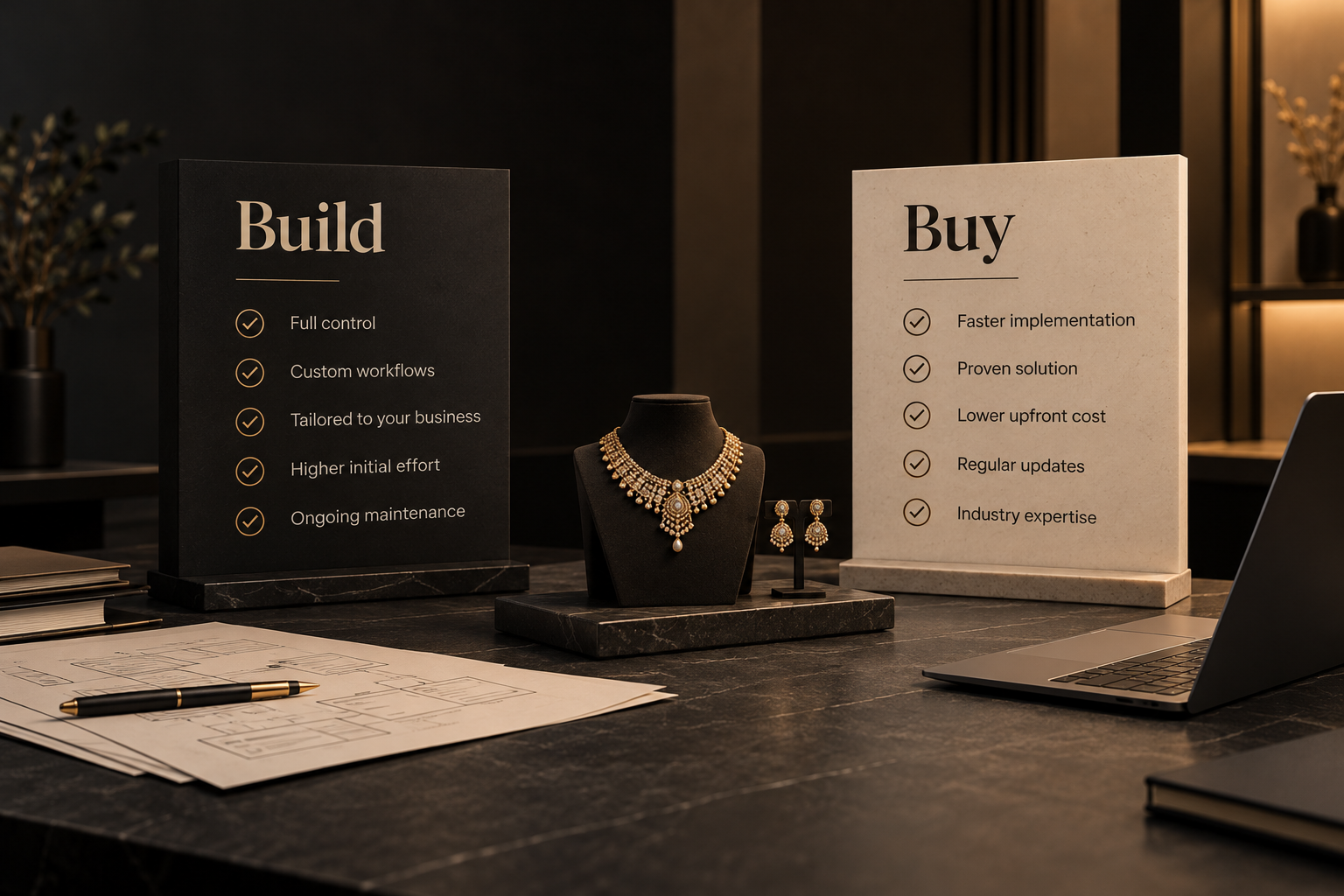
A custom-built platform may require a larger initial investment, but it can be designed around your business processes. Purchased software may be quicker to implement, but its limitations can become expensive when you need new integrations, specialised pricing rules or workflows that the vendor has not anticipated.
The real comparison should consider the total cost of ownership over three to five years.
For a jewellery brand, that includes:
- Implementation costs: Initial development, licensing, configuration and data migration.
- Ongoing maintenance: Bug fixes, security updates, hosting, upgrades and technical support.
- Customisation costs: Changes required to accommodate your pricing logic, schemes, branches and business processes.
- Integration costs: Connecting ecommerce, POS, inventory, CRM, accounting and logistics systems.
- Operational costs: Manual work, reconciliation errors, inaccurate stock information and lost sales caused by disconnected systems.
- Exit costs: Moving your data, replacing integrations and rebuilding workflows if the vendor no longer meets your needs.
A platform that appears inexpensive at launch may become costly when every new requirement needs a paid modification. Equally, a custom platform can become an expensive liability if nobody plans for its maintenance.
The goal is not to choose the cheapest software. It is to choose an architecture that supports the business without creating unnecessary technical or operational debt.
The Three Categories Every Jewellery System Falls Into
Before deciding whether to build or buy, classify each capability according to the value it creates for your business.
1. Commodity capabilities
These are functions that most businesses need and that rarely differentiate one jewellery brand from another.
Examples include payroll processing, employee attendance, standard accounting, email, document management and routine compliance workflows.
Building these systems internally rarely creates a meaningful competitive advantage. Established products already solve these problems, and maintaining a custom alternative diverts resources from more important work.
The practical decision: Buy a proven solution.
2. Differentiating capabilities
These are functions that directly affect how customers experience your brand or how efficiently your stores operate.
For a jewellery retailer, they may include gold rate-based product pricing, jewellery-specific product variants, online-to-store inventory visibility, customer scheme management and the way products are presented across ecommerce channels.
The underlying technology may be widely available, but the way it is configured and connected to your business can be distinctive.
The practical decision: Buy the foundation, then customise or build where your requirements justify it.
3. Strategic capabilities
These are the capabilities that influence your long-term competitive advantage, customer relationships, margins and ability to expand.
Examples include proprietary pricing rules, customer segmentation logic, demand forecasting based on your own sales history, franchise allocation policies and the commercial structure of your jewellery savings schemes.
These capabilities should remain under your control, even if an external technology partner implements them.
The practical decision: Retain ownership of the business logic, data and strategic decisions. Build selectively where existing products cannot support them adequately.
This classification is more useful than treating every software requirement as a simple build-versus-buy choice.
What Is the Same at Every Jeweller?
Every jewellery business needs certain operational capabilities regardless of whether it operates one showroom or a nationwide chain.
Accounting, payroll, email, employee management, standard billing compliance and routine business reporting are examples. These functions matter, but they rarely explain why a customer chooses one jewellery brand over another.
Developing each of them from scratch introduces responsibilities that do not necessarily improve the customer experience or increase revenue.
A custom accounting system, for example, requires continuous attention to reporting, access controls, auditability, changing compliance requirements and integration with other business applications. An established accounting product may already handle most of these needs.
The same principle applies to payroll and standard business administration.
Buying these capabilities is not a compromise. It is a way to direct engineering investment towards the parts of the business that need specialised attention.
There is one important qualification: standard software must still meet the business's integration, security and compliance requirements. A purchased product that cannot exchange reliable data with the rest of the technology stack can create more work than it removes.
The objective is to avoid rebuilding standard capabilities while ensuring they work properly within the wider jewellery retail ecosystem.
What Is Specific to Your House?
Two jewellery brands may sell similar products, operate comparable showrooms and use the same accounting software. Their commercial strategies can still be fundamentally different.
One brand may calculate prices using a particular combination of live gold rates, purity, net weight, making charges and applicable taxes. Another may use different pricing policies across product categories or customer segments.
One retailer may offer a 10+1 savings scheme. Another may operate a digital gold programme, a recurring purchase plan or a specialised exchange policy.
Their customer relationships, catalogue structures, franchise agreements and promotional strategies may also differ.
These are not merely software settings. They are representations of how each business operates.
A jewellery brand should retain control over:
- Pricing rules: How gold rates, purity, weight, making charges, stones and taxes contribute to the final price.
- Scheme structures: Eligibility, instalments, maturity conditions, benefits and redemption rules.
- Customer relationships: Purchase histories, preferences, consent records, loyalty information and segmentation criteria.
- Catalogue architecture: How designs, metal types, purity, sizes, stones, weights and other variants are represented.
- Commercial policies: Discounts, exchange conditions, store-level permissions and promotional eligibility.
The distinction is between owning the underlying business decisions and owning every line of code used to implement them.
A jewellery brand does not necessarily need to build its own pricing engine from scratch. It does need to control the rules that determine its prices and ensure those rules can be changed without becoming dependent on a vendor's commercial priorities.
The same applies to customer data. A CRM provider can supply the software, but the brand should retain the rights, access and practical ability to use its customer information in accordance with applicable law and customer consent.
The principle is simple: outsource implementation when it makes sense, but do not surrender control of the business logic that defines your brand.
The Middle Category That Causes the Arguments
Ecommerce, point-of-sale systems and inventory management sit between commodity software and strategic business capabilities.
They are established software categories, so buying them often makes sense. However, jewellery retail has operational requirements that distinguish it from ordinary apparel, electronics or general merchandise.
Ecommerce is more than a product catalogue
A jewellery ecommerce platform must do more than display product photographs and accept payments.
Depending on the business, it may need to support weight-based pricing, frequently changing gold rates, metal and purity variations, stone specifications, customisation options, store-level stock visibility and product availability across multiple locations.
A product may have several combinations of size, metal, purity, weight and stone configuration. Managing these variants requires a catalogue architecture that keeps product information, pricing and inventory consistent.
A generic ecommerce platform may provide a suitable foundation, but the jewellery-specific logic must be evaluated carefully before committing to it.
POS must reflect what happens in the showroom
A jewellery POS system needs to support the retailer's actual billing and inventory processes. Depending on the operation, this may include weight-based billing, returns, exchanges, barcode or RFID workflows, branch transfers and integration with accounting or ERP software.
If online and offline systems operate independently, a product may appear available on the website even after it has been sold in a showroom.
The resulting problem is not just technical. It affects customer trust, staff productivity and the reliability of business reporting.
Inventory must connect the entire operation
Inventory becomes increasingly complex as a jewellery brand expands across branches, warehouses, franchise partners and ecommerce channels.
The system needs a consistent way to identify products, track stock movements, record transfers and determine availability. Jewellery-specific attributes must remain accurate throughout these operations.
For most growing retailers, building an entire POS or inventory platform from scratch is unnecessary. A proven product can provide the foundation, provided it supports the required workflows and integrations.
This is where specialist implementation matters.
A vendor that understands gold rate pricing, jewellery variants, store-level inventory and omnichannel transactions can identify problems that a general-purpose software provider might overlook.
The right question is not whether a platform supports ecommerce, POS or inventory in its feature list. It is whether those capabilities work reliably for your jewellery business.
Ownership of Data Versus Ownership of Code
One of the most common misconceptions in software procurement is that buying a platform means giving up control, while building a platform means retaining it.
Neither assumption is necessarily correct.
A custom-built system may leave a business dependent on the original developer if documentation is incomplete, deployment access is restricted or the architecture is difficult to maintain.
A purchased platform may provide strong data export capabilities, documented APIs and clear contractual rights, allowing the business to change providers without losing operational continuity.
The important distinction is between owning the code, owning the data and controlling the rules.
Before signing a software agreement, a jewellery brand should establish the following.
Data access and export: Can the business export customer records, product catalogues, inventory, transactions and relevant historical data in usable formats?
API availability: Can authorised systems access the information required for ecommerce, CRM, reporting, accounting and other integrations?
Business logic portability: Are pricing rules, scheme configurations and other critical settings documented and transferable, or do they exist only inside the vendor's proprietary environment?
Code ownership and licensing: For custom development, who owns the source code? For purchased products, what rights does the business have to use, configure and extend the software?
Exit clauses: What happens when the agreement ends? Are data exports, migration assistance, transition periods and deletion obligations clearly defined?
Operational continuity: Can the business continue accessing essential records and completing necessary operations during a migration or vendor transition?
Not every retailer needs ownership of every software component. But every retailer should understand its rights and the practical effort required to move away from a provider.
The strongest protection against vendor lock-in is not a promise that data can be exported. It is a tested, documented process that makes the data and business rules genuinely portable.
The Build Decision Almost Nobody Regrets, and the One Almost Everybody Does
There are two decisions that are particularly useful to distinguish: building targeted capabilities that solve a real business problem and attempting to recreate an entire transactional platform without a compelling reason.
Build integrations and internal tools when they create leverage
Suppose a jewellery group uses an established POS, an ecommerce platform, a CRM and an accounting system. The systems are individually capable, but information moves between them inconsistently.
The business may benefit from a custom integration layer that synchronises inventory, routes orders to appropriate stores, updates customer records and combines operational data into a useful dashboard.
Another example is a management tool that identifies products frequently requested by customers but unavailable at nearby stores. This can help management make better stock-allocation decisions.
These targeted capabilities can create substantial value without requiring the company to replace every system it already uses.
The key is to build around a clearly defined business problem, with measurable outcomes and a maintenance plan.
Be cautious about rebuilding core transactional systems
Building an entire POS, accounting system, inventory engine or ecommerce platform can appear attractive when existing software feels restrictive.
However, core transactional systems must remain accurate and dependable under real operating conditions. They need security controls, permissions, audit trails, exception handling, backups, recovery procedures, testing and ongoing updates.
A custom jewellery POS, for example, must do more than generate a bill. It needs to preserve transaction integrity, handle returns and exchanges correctly, maintain stock records and communicate reliably with connected systems.
Building a replacement may be justified when existing products cannot meet critical requirements or impose unacceptable long-term limitations. But the decision should follow a documented assessment of those limitations, not frustration with a few missing features.
Before rebuilding a core system, ask whether a supported extension, a specialist product or a focused integration could solve the problem at a lower operational risk.
The strongest architecture is often a combination of proven software, specialist configuration and carefully chosen custom development.
Questions to Settle Before the Meeting Ends
A build-versus-buy discussion should conclude with clear answers rather than a general preference for custom software or ready-made products.
Use this checklist before approving the investment.
- What is genuinely differentiating? Identify the capabilities that directly affect margins, customer experience, retention or expansion.
- What can be standardised? Separate routine operational requirements from jewellery-specific workflows.
- Who maintains the system in year three? Identify the responsible team, support arrangements, upgrade process and recurring costs.
- What happens if the vendor disappears? Establish how the business will access its records, maintain essential operations and transition to an alternative.
- Can we leave with our data? Confirm export formats, API access, data ownership rights and migration responsibilities.
- Can we change our business rules? Determine whether pricing, scheme structures and commercial policies can be modified without excessive vendor dependency.
- Will the systems work together? Validate integration requirements across POS, ecommerce, inventory, CRM, accounting and reporting.
- What is the five-year cost? Include implementation, subscriptions, customisation, maintenance, integrations, internal effort and potential migration.
- How will success be measured? Define outcomes such as fewer inventory discrepancies, faster store fulfilment, reduced manual reconciliation or improved customer conversion.
If these questions remain unanswered, the organisation is not yet ready to make a sound build-or-buy decision.
Frequently Asked Questions
Should a jewellery brand build its own ecommerce platform?
A jewellery brand should build a custom ecommerce platform only when its business requirements cannot be met effectively by an established platform and the benefits justify the long-term cost of development and maintenance. Most brands can start with a proven ecommerce foundation and customise jewellery-specific pricing, catalogue management, inventory synchronisation and store fulfilment. The brand should retain control over its data, commercial rules and customer experience.
What jewellery systems are worth buying rather than building?
Most jewellery brands should consider buying established accounting, payroll, email and other standard business applications rather than building them internally. A proven POS, inventory or ecommerce platform can also be a sensible purchase if it supports jewellery-specific workflows such as weight-based pricing, product variants, exchanges and multi-store stock management. Custom development is best reserved for genuine business gaps, strategic rules and integrations that create measurable value.
How do you avoid vendor lock-in with jewellery retail software?
Avoid vendor lock-in by establishing contractual data access and export rights, documented APIs, clear exit clauses and a practical migration process before purchasing jewellery retail software. Ensure that customer records, product catalogues, transaction histories and inventory data can be transferred in usable formats. Document critical business rules and test exports periodically so that changing vendors remains a realistic option rather than a theoretical promise.
Who should own the pricing rules in a jewellery business?
The jewellery brand should retain control over its pricing policies, including how gold rates, purity, weight, making charges, stones, taxes and commercial adjustments affect the final price. A software vendor or implementation partner can build and maintain the pricing engine, but the business should define the rules, approve changes and have access to the configuration and relevant calculation records. This protects commercial autonomy while allowing the brand to benefit from specialist technology.