
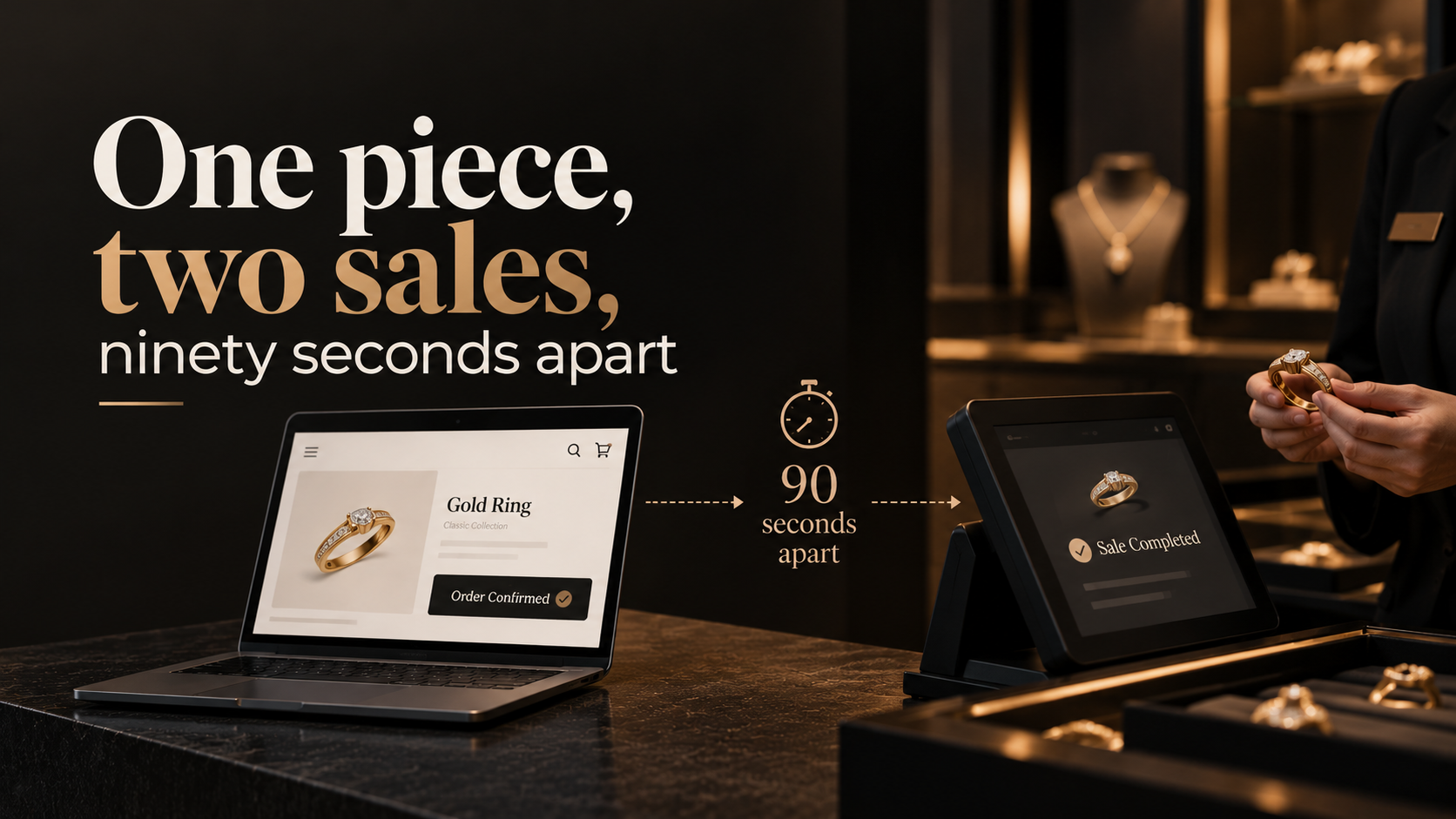
One piece, two sales, ninety seconds apart
A unique piece sold online and in the showroom within the same minute. Why jewellery cannot absorb a double sale the way ordinary retail can.
At 4:14 on a Saturday, a customer in the Ghatkopar showroom decides on a necklace. At 4:15, someone in Bengaluru completes checkout for the same piece.
In apparel, this is a minor problem; there may be another item in the warehouse. In jewellery, there is one necklace. One of those two customers is about to be telephoned and disappointed, and whoever makes that call will spend the rest of the conversation explaining a system failure as though it were a personal one.
Neither customer did anything wrong. The showroom salesperson followed the usual billing process. The online customer saw an available product and paid for it. Both channels accepted a legitimate purchase.
The failure happened between them.
For jewellery brands selling through ecommerce websites and physical stores, this is one of the most consequential problems in omnichannel retail. The challenge is not simply keeping stock quantities updated. It is making sure that two sales channels cannot promise the same physical piece to two different customers.
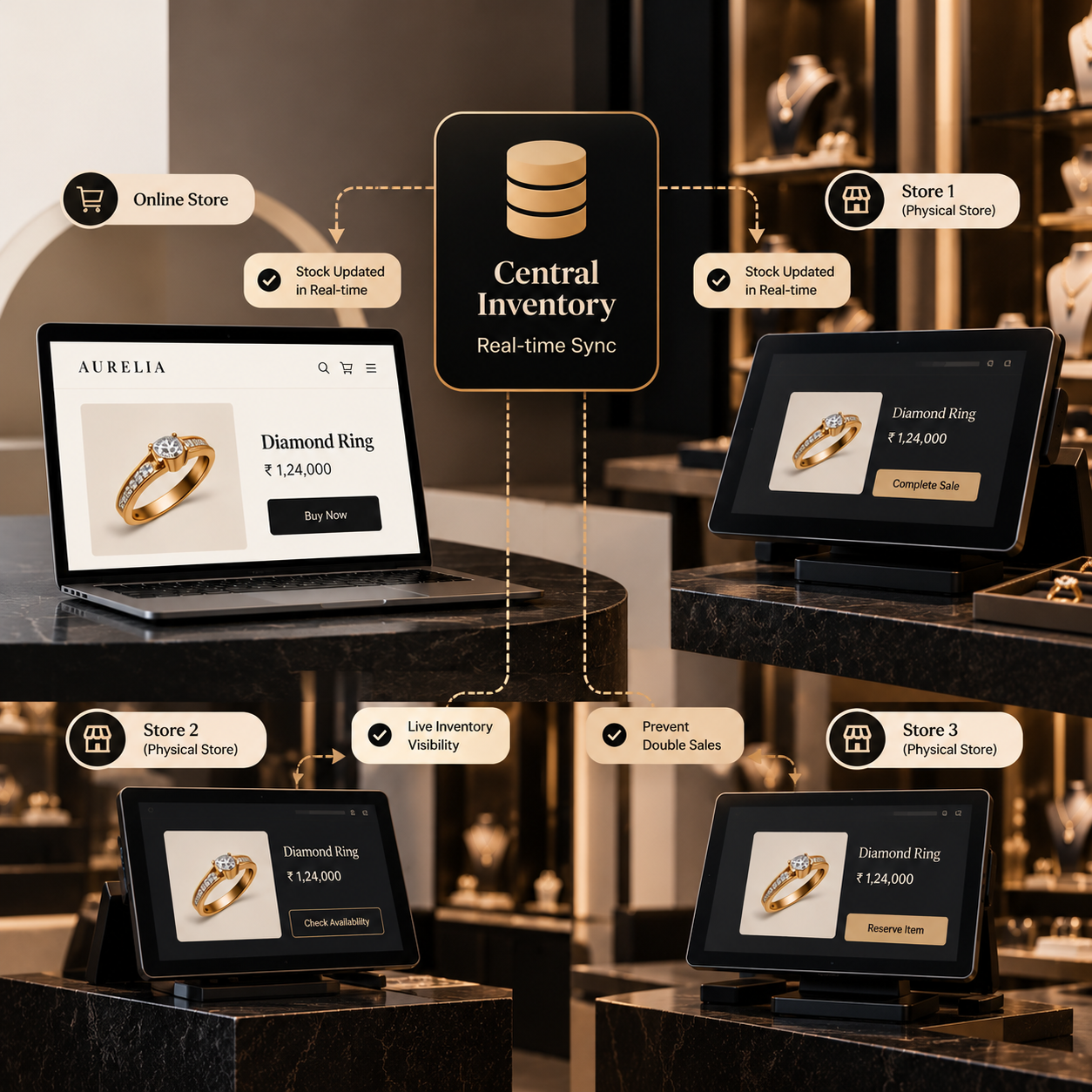
Real-time stock synchronisation is part of the solution. But the more important mechanism is inventory reservation: establishing who has the right to purchase a piece before another channel can claim it.
Why jewellery cannot absorb a double sale
Jewellery inventory does not always behave like ordinary retail inventory.
A clothing retailer selling a particular T-shirt might have twenty identical units in a warehouse. If one store sells a unit while an online order arrives, another unit can often fulfil the order.
A jewellery retailer may have one necklace with a specific weight, stone configuration, design, finish, and item-level identity. Even when two pieces share the same design, they may not be interchangeable for the customer who selected a particular item.
That difference changes the consequences of an inventory error.
There is no substitute for a piece that exists only once unless the customer agrees to one.
When a double sale occurs, the retailer may need to arrange a refund, offer a similar design, locate another piece at a different store, or arrange a new production order if the design can be recreated.
Every option introduces work that should never have been necessary.
The impact extends beyond the immediate transaction:
- Customer trust: A confirmed order that cannot be fulfilled makes the retailer's availability promises less credible.
- Store operations: Salespeople, ecommerce teams, and managers must investigate what happened and coordinate a resolution.
- Revenue and fulfilment: The retailer may lose the sale or incur additional handling, shipping, or discount costs.
- Brand experience: A customer may remember the failed purchase more strongly than the original shopping experience.
For a premium jewellery brand, the problem is especially uncomfortable. Customers expect accurate information, attentive service, and confidence in what they purchase.
A disconnected inventory system undermines all three.
The ninety seconds
To understand the failure, follow the sequence rather than looking only at the final stock quantity.
Imagine that a necklace is the last available unit in the retailer's inventory.
4:14:00 PM — The showroom decision
A customer selects the necklace. The salesperson checks its details and begins billing through the store's POS system.
4:14:20 PM — The store sale is recorded
The POS records the transaction. However, the ecommerce platform has not yet received the inventory change, or it has received the message but has not applied it.
The website continues to show the necklace as available.
4:15:00 PM — The online checkout succeeds
A customer in Bengaluru adds the necklace to their cart and completes checkout. The ecommerce platform checks its own stock record, sees one available unit, and accepts the order.
4:15:30 PM — The conflict becomes visible
The systems exchange updates, or a member of the team notices the discrepancy. Both transactions refer to the same physical necklace.
The retailer now has two legitimate customer expectations and only one item to fulfil them.
The exact timing depends on the systems involved. Some integrations update quickly but still allow conflicting purchases. Others rely on scheduled synchronisation, delayed messages, or manual stock updates.
The critical question is what happens between the first customer's purchase and the second customer's attempt to buy the same piece.
If both channels can independently approve the sale, the inventory architecture has a race condition: two transactions are competing for one available unit without a shared mechanism to decide which one succeeds.
Reducing the synchronisation interval helps, but it does not necessarily remove that race condition.
Reservation is the mechanism, not synchronisation
Real-time stock synchronisation communicates inventory changes between systems. Reservation determines whether a particular unit is still available to be sold.
These are different responsibilities, and a dependable omnichannel jewellery platform needs both.
Consider what happens when the first customer attempts to buy the necklace.
Instead of allowing the website or POS to sell the item solely because its local stock record says one unit is available, the system requests a reservation against the authoritative inventory record.
If the reservation succeeds, the available-to-sell quantity becomes zero. Other channels must respect that allocation, even if their displayed inventory has not yet refreshed.
If another transaction requests the same item, the system rejects the competing reservation or directs the customer towards an alternative.
Only one request can successfully reserve the last available unit.
Soft reservation at cart
A soft reservation temporarily allocates inventory while a customer is actively progressing through checkout.
This can reduce conflicts when a customer is entering delivery information or reviewing payment details. However, reserving every item indefinitely whenever someone adds it to a cart can make unique pieces unavailable to genuine buyers.
A retailer can instead use a short, clearly defined reservation window at a meaningful checkout stage.
Hard reservation at payment
A hard reservation is a firm allocation that competing sales channels must respect.
For an online purchase, the system should secure inventory atomically as part of the order acceptance workflow, before making an unconditional promise that the item is available.
Payment processing and inventory allocation must be coordinated carefully. If payment fails, the order is cancelled, or a transaction times out, the system needs a defined way to release or reconcile the allocation.
The exact sequence depends on the payment architecture, but the underlying rule remains the same: two channels must not successfully claim the same unit.
Release when the reservation ends
A reservation should have a lifecycle, not just a start time.
When a customer abandons checkout, payment fails, or an authorised hold expires, the system should release the reservation and make the piece available again if no other restriction applies.
The release operation must also be safe to retry. A repeated timeout event should not accidentally increase stock or release an item that has already been sold.
This is where reservation logic, inventory accuracy, and integration reliability meet.
What to reserve, and for how long
Reservation windows must balance two competing needs: protecting a customer's purchase opportunity and keeping inventory available to other buyers.
There is no single duration that works for every jewellery retailer.
A customer who has reached payment may need a short window to complete the transaction. A customer who has only opened a product page has not necessarily expressed the same level of purchase intent.
A practical reservation policy can distinguish between these situations.
| Customer action | Suggested inventory treatment |
|---|---|
| Browsing a product | Do not reserve the item |
| Adding to cart | Usually keep it available; apply a temporary hold only if justified |
| Entering checkout | Consider a short, clearly defined reservation |
| Payment processing | Maintain the reservation while the transaction is resolved |
| Payment failure or checkout timeout | Release the reservation after confirming no active transaction remains |
| Confirmed order | Keep the unit allocated to the order until fulfilment |
| Cancellation before fulfilment | Release the unit once cancellation and payment handling are resolved |
The durations should be set using actual checkout behaviour, payment response times, and customer service requirements rather than arbitrary long holds.
The abandoned-cart problem
Imagine a retailer has one distinctive diamond pendant. A visitor adds it to a cart and leaves the website open for three hours.
If the pendant remains reserved for that entire period, a customer ready to pay may be unable to purchase it. Across a large catalogue, excessive reservations can make available inventory appear smaller than it really is.
A better system uses explicit expiry rules, checks whether payment is genuinely in progress, and releases abandoned reservations safely.
For expensive or highly individualised pieces, retailers may also choose a different workflow for appointment-based holds or assisted purchases.
The principle is simple: reserve inventory in proportion to the customer's actual purchase commitment, and release it when that commitment ends.
The showroom side of the same problem
Online carts are only half the story.
In a physical showroom, a customer may try on a necklace, ask for a quotation, and tell the salesperson they will return on Sunday after discussing the purchase with their family.
The salesperson agrees to hold the piece.
Where does that reservation exist?
It might be written in a notebook, marked on a paper tag, mentioned in a staff WhatsApp group, or remembered by the salesperson who handled the visit.
Meanwhile, the ecommerce website continues to show the necklace as available. A different store may also assume it can sell the piece.
The retailer has created a reservation, but the inventory system does not know about it.
A showroom hold is an inventory reservation, even when it happens without a payment.
The same principle should apply to customer appointments, manager-approved holds, inter-store transfers, and pieces sent for repair or inspection. Each status needs a clear meaning and an appropriate effect on sellable inventory.
For example, a retailer could distinguish between:
- Available for sale
- Temporarily reserved for an online checkout
- Held for a showroom customer
- Sold and awaiting fulfilment
- In transit between stores
- Unavailable because of repair or inspection
These states should not all be treated as identical. A piece in transit may still belong to the business but may not be available for immediate collection. A showroom hold may have an expiry date. A sold item must not return to available stock merely because a delayed message arrives.
The POS, ecommerce platform, and inventory service should use the same reservation rules, even when the customer interaction begins in different places.
Deciding who wins when it happens anyway
No inventory system is perfect. Payment gateways time out, integrations fail, staff make mistakes, and transactions sometimes arrive in an unexpected order.
A retailer needs a documented conflict-resolution policy before the first double sale occurs.
The policy should distinguish between the event that happened first and the event that the system successfully committed first.
For example, an online customer may click Pay before a showroom customer completes billing. But if the online transaction has not secured inventory, the click alone does not establish a completed purchase.
Similarly, a salesperson may begin billing before another customer checks out online. Starting a transaction does not necessarily mean the piece has been allocated.
A retailer should define which event establishes the priority of a sale, such as a successful inventory reservation tied to an accepted order or a completed POS transaction under the retailer's rules.
Possible policies include:
- First successful reservation: The first valid transaction to secure the item receives priority.
- First completed sale: Where the system supports a reliable and auditable sequence, a documented completed-sale rule determines priority.
- Alternative fulfilment: If another identical or acceptable piece exists elsewhere, offer a transfer or alternative fulfilment route.
- Manual escalation: If records conflict or the event sequence cannot be established, route the case to an authorised manager.
These rules must be implemented consistently across channels and supported by transaction logs.
A manager should not have to negotiate between two store teams to determine which customer gets a necklace. The system should record what happened, while the policy determines what to do next.
Recovering the customer you have to disappoint
Even with appropriate safeguards, a retailer may occasionally be unable to fulfil an order. When that happens, the recovery process matters.
The first step is to acknowledge the problem clearly. Avoid blaming the website, the store, or an unnamed technical issue. Customers should not have to understand the retailer's internal architecture to receive an honest explanation.
A useful service script might be:
"We're sorry, but we've discovered an inventory discrepancy affecting the piece you ordered. We understand you selected this particular design and expected us to fulfil your order. We can check whether the same piece is available at another location or offer you a similar design, if you would like to consider it. If neither option works for you, we'll explain the cancellation and refund process."
The alternatives should be genuine, not promises made before stock is verified.
Depending on the product and customer preference, the retailer might offer:
- The same piece from another store, with a confirmed fulfilment timeline.
- A similar design, after sharing accurate photographs and specifications.
- A bespoke or made-to-order option, where feasible and with an agreed delivery date.
- A suitable service recovery gesture under the brand's customer service policy.
A discount should not be used to distract from the problem or pressure a customer into accepting an unsuitable substitute.
The objective is to preserve the customer's confidence through honesty, clear options, and timely resolution.
Measuring the leak
A retailer cannot improve a problem it never records.
Double-sale incidents are the most obvious measure, but they are not the only useful signal. Near-misses, expired reservations, failed inventory updates, and manual stock corrections can reveal weaknesses before they become customer-facing incidents.
Start with a small operational dashboard.
| Metric | What it reveals |
|---|---|
| Double-sale incidents | Confirmed cases where multiple customers were promised the same unit |
| Near-misses | Conflicting purchase attempts prevented by reservation controls |
| Reservation timeouts | How frequently holds expire without a completed purchase |
| Reservation duration | How long inventory remains unavailable under temporary holds |
| Inventory update latency | How quickly stock changes reach connected channels |
| Manual stock corrections | Where system records repeatedly disagree with physical inventory |
| Cancellation rate due to stock errors | How often inaccurate availability prevents fulfilment |
These metrics need clear definitions. For example, a near-miss should be counted only when a genuine competing transaction attempts to reserve the same unit, not whenever a customer views an unavailable product.
Review incidents by channel, store, product type, and failure reason. A recurring problem at one location may indicate a POS integration issue, while excessive reservation timeouts may indicate that checkout holds are too long or payment statuses are not being resolved correctly.
The aim is not merely to report a number. It is to identify which control failed and whether the corrective action reduced recurrence.
Frequently asked questions
How do jewellery retailers prevent the same piece being sold twice?
Jewellery retailers should use a shared inventory system with atomic stock reservations across ecommerce, POS, and physical-store channels. When one transaction reserves the last available piece, competing transactions must be prevented from claiming it. Reliable event synchronisation, reservation expiry rules, and inventory reconciliation provide additional protection.
How long should an online cart hold a unique jewellery piece?
The reservation duration should reflect the checkout stage, payment-processing requirements, and customer behaviour. Browsing and ordinary cart additions generally should not lock a unique piece indefinitely. A short, clearly defined hold at checkout can protect the purchase while allowing abandoned reservations to expire safely.
What should happen when a piece is sold in store and online at once?
The retailer should check the authoritative inventory and transaction records to determine which sale secured the piece under its documented priority rules. If only one transaction can be fulfilled, the retailer should contact the affected customer promptly, explain the discrepancy, verify any alternative stock, and offer suitable fulfilment or cancellation options.
Is real-time stock sync enough to prevent double sales?
No. Real-time stock synchronisation reduces the delay between inventory changes, but two channels can still attempt to sell the same piece simultaneously. Atomic reservation and allocation logic is needed to ensure that only one transaction can claim the last available unit. Reliable synchronisation, failure recovery, and reconciliation complete the solution.