

What we learned taking a 55-store house omnichannel
What actually happened when a multi-store jewellery business moved to one connected system: what went well, what did not, and what we would sequence.
Taking a jewellery business omnichannel sounds straightforward on paper. Connect the website to the point-of-sale system, synchronise inventory across stores, and give customers a consistent experience online and offline.
The complexity becomes clearer when the business has dozens of showrooms, years of product data, established store-level processes, and customers who expect accurate information every time they enquire.
For a jewellery retailer operating across 55 stores, the challenge is not simply introducing new software. It is connecting the systems, information, and people that already keep the business running.
At JewelStack, we believe these projects are best understood through the operational details: how product data is handled, how inventory moves between systems, what happens when a customer enquires about an item at another location, and how comfortably store teams can work with the new setup.
Here are the key lessons that matter when taking a multi-store jewellery business towards omnichannel retail.
Where the Business Actually Was Before We Started
A jewellery business does not reach 55 showrooms without developing processes that work for its customers and teams.
Over time, a retailer builds its own way of managing stock, pricing, product information, customer enquiries, billing, and store operations. Different systems may support different parts of this workflow. Some information may live in a central platform, while other details are maintained through store-level processes.
This is not necessarily a sign of poor management. It is often the natural result of a business expanding over several years.
The challenge appears when customers begin moving freely between channels.
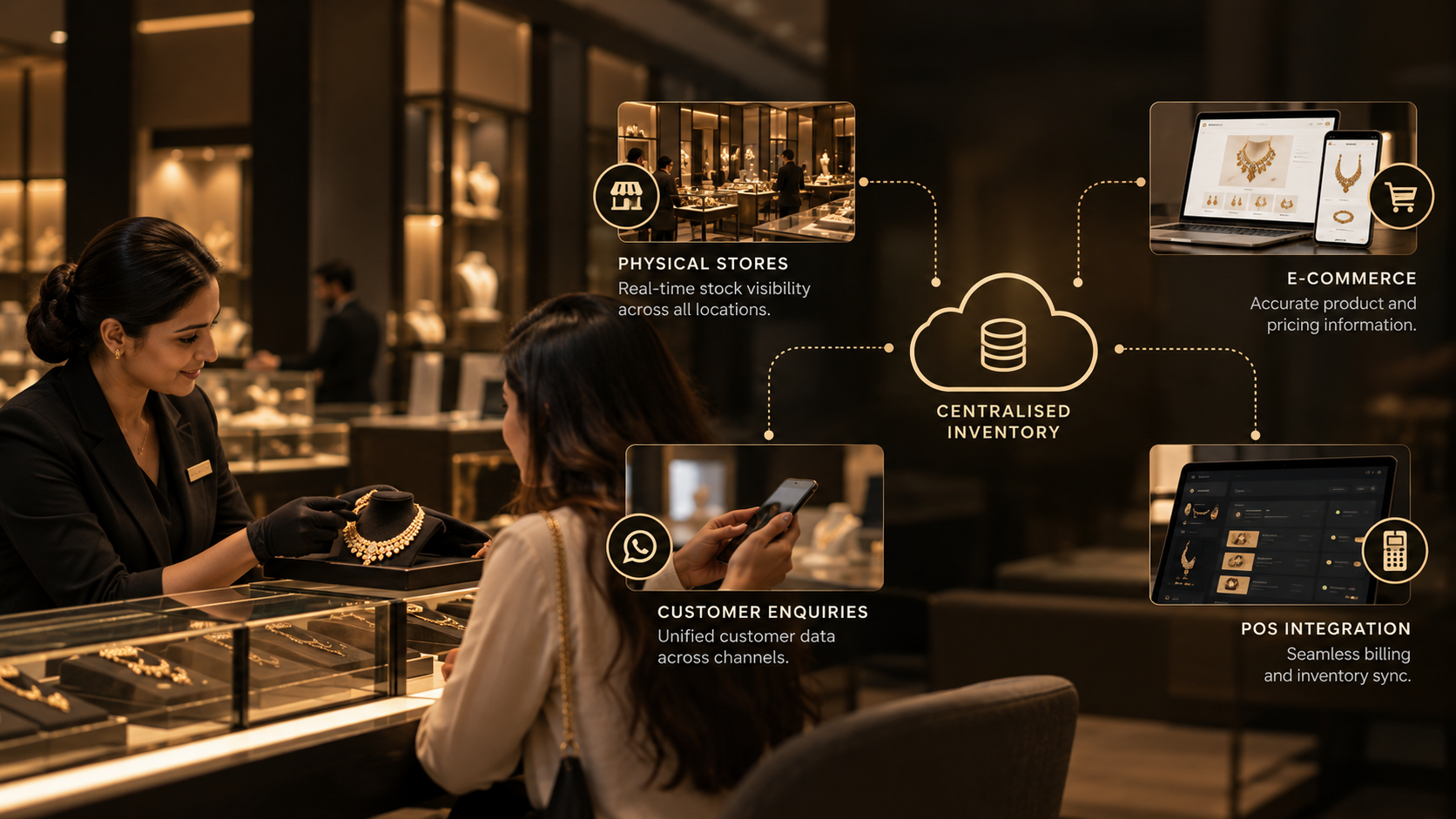
A customer might discover a necklace online, enquire through WhatsApp, visit a nearby showroom, and expect the salesperson to know which design they saw. Another customer might visit one branch for a product that is available at another location.
If the relevant information is not connected, employees must bridge the gaps manually.
That is where omnichannel retail becomes valuable. The objective is to establish a reliable connection between product information, inventory, pricing, customer interactions, and store operations.
The starting point is not replacing everything that exists. It is understanding which existing systems work, where information gets disconnected, and what needs to change.
What We Thought the Hard Part Would Be
In a jewellery omnichannel implementation, technology naturally receives much of the early attention.
Teams discuss website architecture, POS integration, APIs, inventory synchronisation, product search, and customer-facing features. These are important decisions, particularly when multiple stores need to work with shared information.
But technical connectivity is only one part of the problem.
An integration can successfully transfer a product record from one system to another without guaranteeing that the information is accurate, complete, or useful to the business.
A website might display a product that has already been sold. Two systems might describe the same design differently. A product could have inconsistent weight information or lack attributes needed for filtering.
The software may be working exactly as configured while the business experience remains inconsistent.
This is why omnichannel planning must begin with operational discovery rather than a feature checklist.
Before implementation, the team needs to understand how the retailer handles product creation, pricing updates, stock movements, customer enquiries, returns, and exceptions. Those details determine how the systems should behave.
The important question is not just whether two systems can communicate.
It is whether they can exchange the right information, at the right time, in a way that supports actual store operations.
What the Hard Part Actually Becomes
The real complexity of a multi-store jewellery implementation often sits at the intersection of data, existing workflows, and people.
1. Making different systems agree
A POS system, an ERP, and an ecommerce platform may each represent products and inventory differently.
One system might identify a design using an internal product code. Another might use a variant identifier. A third might organise products around customer-facing attributes such as jewellery type, metal, purity, or stone characteristics.
Integration requires a clear mapping between these records.
It also requires decisions about which system owns each type of information. For example, the POS or ERP may be the authoritative source for stock quantities, while the ecommerce platform manages website presentation and merchandising.
Without these rules, synchronisation can spread inconsistencies instead of resolving them.
2. Handling the exceptions
Retail workflows rarely follow a single happy path.
Stock may be reserved for a customer, transferred between branches, returned after a sale, or temporarily unavailable while an order is being processed.
The implementation must define how each relevant event affects the inventory displayed to customers and employees.
This matters especially in jewellery retail, where individual pieces may have unique identifiers, detailed attributes, and significant differences in value.
The system needs to distinguish between inventory that physically exists, inventory that is available to sell, and inventory that has already been committed to another transaction.
3. Keeping the workflow practical
A process that works in a technical demonstration may become frustrating during a busy sales period.
Store employees need to retrieve product information, check availability, assist customers, and complete transactions without unnecessary steps.
If a new workflow adds too much friction, employees may develop workarounds that undermine the purpose of the implementation.
Successful omnichannel design must therefore account for the pace and realities of showroom operations, not just the capabilities of the software.
Cleaning a Catalogue That Has Grown Over the Years
Product data is one of the most underestimated parts of jewellery ecommerce.
A large jewellery catalogue may contain years of product additions, discontinued designs, duplicate records, inconsistent naming conventions, incomplete attributes, and images that do not follow a common standard.
These issues become more visible when the same catalogue needs to support multiple channels.
Consider a simple example. The same ring might appear under different product names in two systems. One record might include metal purity, while the other omits it. A third record might contain a different image or an outdated price.
A customer browsing the website needs a coherent product experience. The inventory system needs to identify the correct item. The salesperson needs reliable information when the customer visits a showroom.
All three depend on consistent product data.
What catalogue preparation should include
A structured catalogue cleanup generally covers:
- Product identification: Establish consistent product codes and unique identifiers for designs, variants, and individual pieces where applicable.
- Duplicate detection: Identify records that appear to represent the same product and determine which record should remain authoritative.
- Attribute standardisation: Align fields such as jewellery category, metal, purity, weight, size, stone details, and other relevant characteristics.
- Image organisation: Match product images to the correct designs and variants.
- Pricing validation: Confirm the source of truth for product prices, metal rates, making charges, and other applicable pricing rules.
- Status management: Separate active products from discontinued, archived, reserved, or otherwise unavailable items.
The precise scope depends on the retailer's systems and catalogue structure. A business with a relatively clean catalogue may need only limited corrections, while a retailer with years of inconsistent records may require a more extensive exercise.
The important lesson is to assess data quality before committing to a migration schedule.
Catalogue size alone does not tell you how difficult the migration will be. The quality, structure, and relationships between records matter just as much.
Migrating Stock Without Closing a Single Store
For a multi-store jewellery retailer, system migration must protect business continuity.
Showrooms cannot casually stop selling jewellery while technical teams reconcile product records or test integrations. Billing, stock visibility, customer service, and store operations need a carefully planned transition.
The appropriate cutover approach depends on the existing architecture, integration capabilities, and risk tolerance.
Build a migration plan around business continuity
A practical migration plan should include the following stages.
1. Map the existing systems.
Identify the systems responsible for product data, inventory, pricing, billing, and customer information. Document how information currently moves between them.
2. Define the migration rules.
Agree on data ownership, product identifiers, stock status, pricing logic, and the handling of incomplete or conflicting records.
3. Test with representative data.
Use a controlled sample that includes ordinary products as well as difficult cases, such as variants, reserved stock, returns, and inter-store transfers.
4. Reconcile inventory.
Compare source and destination records using agreed identifiers and business rules. Investigate discrepancies rather than assuming that a successful data transfer means the migration is correct.
5. Plan the cutover.
Choose whether the rollout should happen store by store, in controlled groups, or through another approach appropriate to the architecture. Define responsibilities, validation checks, escalation procedures, and rollback criteria.
6. Monitor after launch.
Check synchronisation failures, inventory discrepancies, pricing mismatches, and operational issues. Make sure store teams know how to report problems and who is responsible for resolving them.
Parallel running can be useful when the systems support it safely, but it must have clearly defined rules for which system is authoritative. Two systems independently updating the same stock records can create additional problems.
The goal is not simply to move data from one platform to another.
It is to establish a controlled transition in which the retailer can continue serving customers while the new workflow is validated.
The Training Nobody Budgets Enough For
Even a technically sound implementation can struggle if store employees are not comfortable using it.
Jewellery sales teams work in a customer-facing environment. They need to answer questions, explain product details, check availability, and complete transactions while maintaining a personal shopping experience.
They cannot spend several minutes navigating an unfamiliar interface every time a customer asks about a design.
Training should therefore focus on the actual tasks employees perform rather than presenting every feature available in the system.
Train around real showroom scenarios
A useful training programme should cover scenarios such as:
- Finding a product using its code, category, or relevant attributes.
- Checking availability at the current showroom and other locations.
- Understanding whether stock is available, reserved, or committed to an order.
- Responding to an enquiry that originated on the website or another digital channel.
- Handling common billing, stock, and customer-information exceptions.
- Reporting a discrepancy and knowing which team can resolve it.
Training should also include hands-on practice in a test environment before employees use the system during live operations.
Short reference guides, designated store champions, and accessible support during rollout can help employees build confidence.
Most importantly, feedback from the showroom floor should influence the final workflow. If employees repeatedly struggle with a particular step, the answer may be to simplify the interface or reconsider the process rather than simply repeating the training.
The measure of successful adoption is not how many employees attended a session. It is whether they can complete their daily work accurately and confidently.
What We Would Sequence Differently
Every omnichannel project has dependencies, and the order in which they are addressed can make a significant difference.
A retailer may be eager to launch a new website, introduce advanced search, or make inventory visible across every showroom. Those are valuable objectives, but they depend on the reliability of the underlying data and integrations.
A more effective sequence is to establish the operational foundations first.
Start with data and ownership
Before building complex customer-facing features, establish product identifiers, catalogue standards, inventory ownership, and pricing rules.
These decisions influence almost every downstream workflow.
Validate integrations before scaling them
Prove that the systems handle important stock and pricing events correctly. Test exceptions, not just successful transactions.
A small, representative pilot can reveal problems that are difficult to detect during development alone.
Design around the store workflow
Involve the people who will use the system every day. Validate the number of steps required to complete common tasks and make usability improvements before expanding the rollout.
Roll out in measurable stages
Where the architecture allows it, introduce the new workflow in controlled stages. Establish clear acceptance criteria for each stage, including data accuracy, operational readiness, and issue resolution.
Measure outcomes that matter
Define the baseline before launch. Depending on the business objectives and available data, useful measures might include inventory discrepancy rates, product-data completeness, enquiry response time, order fulfilment accuracy, and the time required to complete common store workflows.
Without a baseline, it is difficult to distinguish genuine improvement from anecdotal feedback.
The broader lesson is that implementation speed should not come at the expense of operational confidence. A well-sequenced rollout can reduce rework and make expansion across additional stores more predictable.
Where the Business Is Now
The value of omnichannel retail should ultimately be visible in how the business operates.
Product information should be more consistent across channels. Store employees should have a clearer view of relevant inventory. Customer enquiries should be easier to connect with showroom activity. Teams should spend less effort resolving avoidable discrepancies and more time serving customers.
However, these outcomes should be measured rather than assumed.
For a case study involving a 55-store jewellery house, the strongest evidence would include verified before-and-after data, supported by a clear measurement period and confirmation from the client.
Relevant metrics could include:
- Inventory accuracy across participating stores.
- Time taken to synchronise stock and pricing information.
- Catalogue completeness and duplicate-record reduction.
- Customer enquiry response times.
- Order fulfilment and inter-store transfer performance.
- Adoption of the new workflows by store employees.
Not every result needs to be expressed as a percentage. A documented improvement in the reliability of product information or the clarity of store-level processes can be meaningful when supported by specific evidence.
At JewelStack, our approach to jewellery omnichannel is built around connecting technology with the realities of retail operations. The objective is not to add another disconnected platform to an existing business. It is to make the systems supporting the business work together more effectively.
The most valuable outcome is a retail operation in which customers, products, inventory, and store teams are better connected.
Publication note: Insert the confirmed project outcome here once the client has approved the figures and the description of the implementation. Do not present the outcomes above as measured results until they have been verified.
Frequently Asked Questions
How long does an omnichannel rollout take for a multi-store jewellery business?
The timeline depends on the number of systems involved, the condition of the product catalogue, the complexity of POS and ERP integrations, and the number of stores included in the rollout. A project with clean data and well-documented APIs will generally be easier to implement than one requiring extensive data reconciliation and workflow changes. The timeline should be finalised after technical discovery and migration planning.
Do jewellery stores have to close during a systems migration?
Not necessarily. A jewellery business can often migrate systems while stores remain operational, provided the cutover is carefully planned and business continuity is protected. The approach may involve controlled store-by-store rollout, phased deployment, or another validated migration strategy. The decision depends on the existing architecture, transaction requirements, and the availability of a tested rollback plan.
What is the most common reason jewellery technology projects stall?
One common cause is underestimating the complexity of product data, system ownership, and existing business workflows. Integrations can move information successfully while still producing inconsistent prices, duplicate products, or incorrect inventory availability. Early discovery, clear data ownership, representative testing, and store-level user involvement help reduce these risks.
How much catalogue cleanup is needed before migrating?
The amount of cleanup depends on the catalogue's current quality, structure, and consistency. Typical tasks include standardising product identifiers, resolving duplicates, validating product attributes, matching images, and checking product statuses. A catalogue audit should identify the scale of the problem before the migration plan is finalised; there is no universal cleanup percentage that applies to every jewellery retailer.